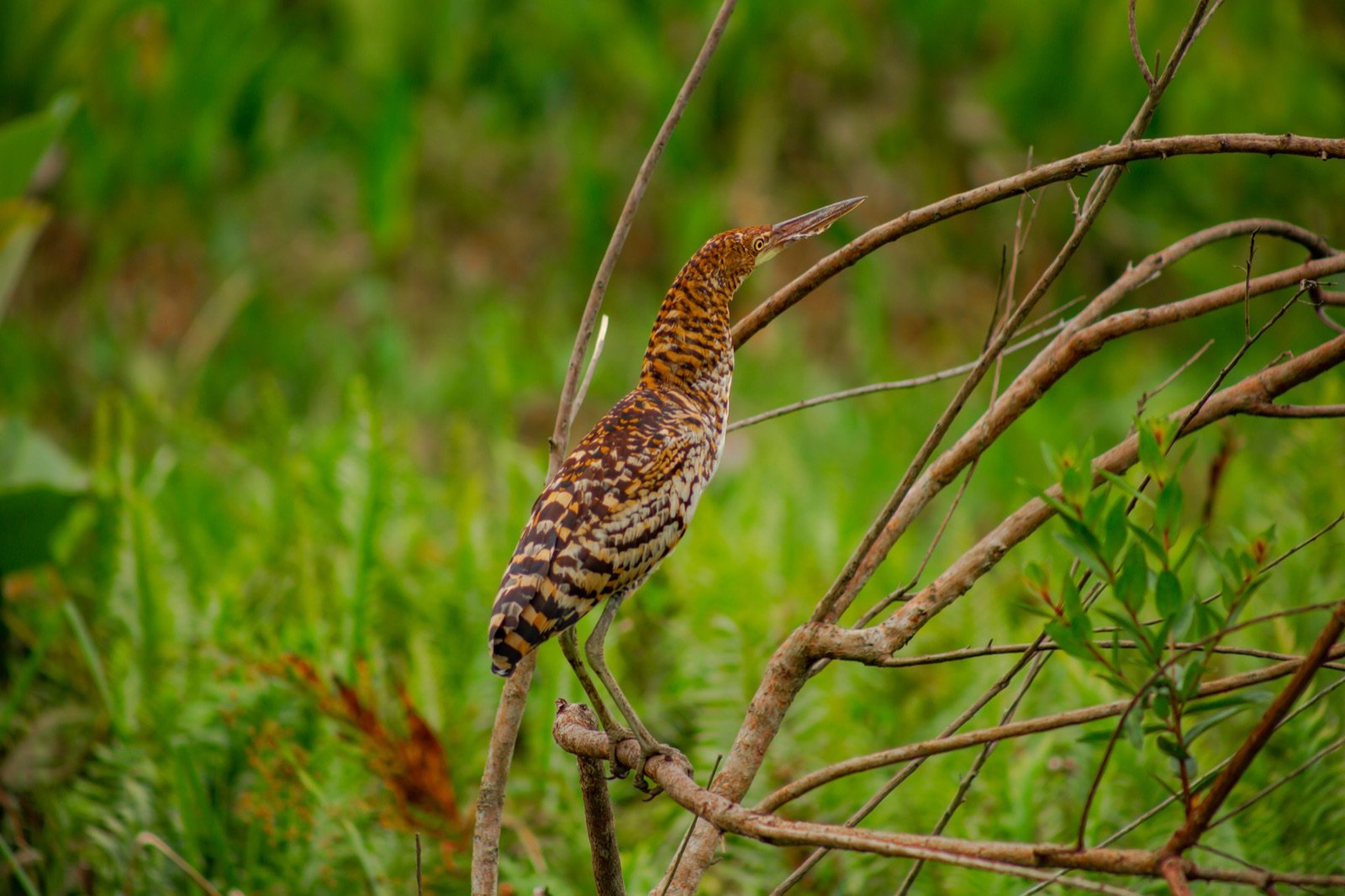
 Pinnated Bittern
Family Ardeidae
Pinnated Bittern
Botaurus pinnatus
In Spanish: Avetoro Neotropical (Puncus, Mirasol)
- Resident
A straw-colored marsh heron of the northern lowlands, best looked for at Medio Queso.
The Pinnated Bittern is a classic hard-to-find species that birders prize. It hides in dense marsh vegetation, and in Costa Rica it is mainly a bird of the northern lowland wetlands.
Medio Queso Wetlands in Alajuela Province is the place most often named for it, and Palo Verde National Park in Guanacaste is another. Boat trips at Medio Queso have turned up birds standing at the edge of a brushy canal, trying to blend in.
On a trip we build in the north, a late afternoon or morning at Medio Queso is a natural way to look for it, often alongside another boat trip in the region.
How to find it
Search reed beds in northern lowland wetlands, since the bird hides in dense marsh vegetation. Medio Queso is one of the few places in Costa Rica where birders can reliably see it. Boat tours there are the usual approach, and some visits also bird from the road. Aim for early morning, from dawn to about 8 AM, or for dusk. The road from Los Chiles to Medio Queso is described as productive for hard-to-see birds. Scan marsh areas with short grass for pale spots, then check them through binoculars.
How to recognise it
This is a large heron, about 64 to 76 cm long, with buffy-brown plumage in a camouflage pattern. Males are heavier than females. These marks describe the species across its whole range.
Look for these features:
Throat and middle of the underparts: white.
Foreneck and breast: broad pale brown streaks.
Facial skin: bright yellow.
Bill: horn-colored.
Legs: greenish.
At Medio Queso, birders describe it as the larger, paler, straw-colored bittern. In short-grass marsh areas the birds looked like odd pale spots that turned into straw-colored, striped herons through binoculars. One photo record describes a bird moving stealthily through reeds and being very well camouflaged.
What it sounds like
Recording: Pablo H Capovilla, CC BY 4.0, source, read 4 Nov 2026.
Behaviour and diet
The Pinnated Bittern is mostly nocturnal and solitary. It stays hidden in thick reeds, sometimes with only the raised neck, head and long bill visible. It eats fish, frogs and rodents, and other sources add reptiles and arthropods, all caught after long, patient waiting.
In Costa Rica, one tour report called the birds sneaky, and another noted that two birds sat in view while trying to blend in. Stillness is its main strategy, so patience helps you as much as it helps the bird.
Where it lives
In Costa Rica this is mainly a northern lowland wetland bird. One Costa Rica site says it is seen from sea level up to about 600 meters, but it is mostly a lowland bird and usually stays in dense marshes and reed beds. A photo record places one at Medio Queso, Alajuela, at 44 meters elevation.
Across its range it uses freshwater marshes, lake edges with cattails and tall sedges, and flooded pastures with tall grass. Breeding-range localities listed for Costa Rica include Río Frío, Guanacaste and Turrialba.
When to see it
Costa Rican nesting has been recorded in July, and birds have also been recorded in the non-breeding season, which suggests they live in the country year-round. For Medio Queso, about February to the end of April, depending on water level, is named as a time to look, and it is said to be easier there than at another site.
Similar birds
The American Bittern is a rare visitor to Costa Rica, a casual migrant with very few records, including Medio Queso, a wetland in Paraíso de Cartago and Coto 47. It differs from the Pinnated Bittern by a black stripe on the side of the throat (malar) and an unbarred neck. The Least Bittern is much smaller and shares the same Medio Queso marshes.
Names and lore in Costa Rica
The official Spanish name is Avetoro Neotropical, and the AOCR list also gives the common Costa Rican names Puncus and Mirasol. Other Spanish names used for the species include Mirasol Grande, Mirasol Pinado and Mirasol Neotropical. The second part of the scientific name means feathered or winged in Latin.
Status and conservation
The AOCR list classes the Pinnated Bittern as a resident (R), and the IUCN rates it Least Concern because of its wide range.
Photography tips
Dawn to 8 AM and dusk are the best viewing times. At Medio Queso the bitterns were easy to find in marsh areas with short grass, looking like odd pale spots before turning into straw-colored, striped herons through binoculars. A birding writer says it is tough to find unless you bird at dawn or late afternoon.
How we know this 20 sources, each read on the date shown
- Costa Rica Focus read 2026-11-04
https://www.costaricafocus.com/bird-species/pinnated-bittern/ - Macaulay Library read 2026-11-04
https://macaulaylibrary.org/asset/201222601 - HeronConservation read 2026-11-04
https://www.heronconservation.org/herons-of-the-world/list-of-herons/south-american-bittern/ - Aves de Peru read 2026-11-04
https://avesdeperu.org/ardeidae/mirasol-grande-botaurus-pinnatus/ - Birda read 2026-11-04
https://app.birda.org/species-guide/7848/Pinnated_Bittern - Bird Watching Costa Rica read 2026-11-04
https://www.birdwatchingcostarica.com/ave/pinnated-bittern/ - Oiseaux-Birds read 2026-11-04
https://www.oiseaux-birds.com/card-pinnated-bittern.html - Avestikas read 2026-11-04
https://avestikas.com/2024/02/22/avetoro-norteno/ - Hotel de Campo Caño Negro read 2026-11-04
https://www.hoteldecampo.com/category/birdwatching-in-costa-rica/ - Birds by BIJS read 2026-11-04
https://birdsbybijs.com/costa-rica-northern-region-birding-tour/ - Field Guides trip list read 2026-11-04
https://fieldguides.com/triplists/cr217.html - Quetzal By Car read 2026-11-04
https://www.quetzalbycar.com/locations/cano-negro - Birding Craft read 2026-11-04
https://birdingcraft.com/wordpress/2019/01/17/cano-negro-birding-in-costa-rica-delivers-the-goods/ - Eagle-Eye Tours read 2026-11-04
https://www.eagle-eye.com/blog/costa-rica-birding-tour-trip-report-jan-22-feb-7-2025/ - Birdwatching in Costa Rica (AOCR list) read 2026-11-04
https://birdwatchingincostarica.com/bird-lists/ - Museo Nacional de Costa Rica read 2026-11-04
https://www.museocostarica.go.cr/nuestro-trabajo/investigaciones/historia-natural/garzas/distribucion/ - Costa Rica Focus read 2026-11-04
https://www.costaricafocus.com/birding-cano-negro-costa-rica-a-complete-guide/ - Tripadvisor (Cano Negro Experience) read 2026-11-04
https://www.tripadvisor.com/LocationPhotoDirectLink-g1190053-d15529115-i373379711-Cano_Negro_Experience-Cano_Negro_Province_of_Alajuela.html - Birding Craft read 2026-11-04
https://birdingcraft.com/wordpress/2019/05/28/medio-queso-costa-rica-tough-birds-made-easy/ - 10,000 Birds read 2026-11-04
https://www.10000birds.com/quality-birds-at-cano-negro-costa-rica.htm