Family Thamnophilidae
Plain Antvireo
Dysithamnus mentalis
In Spanish: Batarito Cabecigrís
- Resident
A small, shy antbird of the forest understory on both slopes.
The Plain Antvireo (Batarito Cabecigrís) is a small, chunky antbird that lives in Costa Rica all year round. The official bird list gives it the status R, a resident, and it occurs on both the Caribbean and Pacific slopes.
It is a quiet bird of the understory, hard to spot and hard to separate from other small antbirds unless you see it very clearly. That is exactly why a slow, patient look pays off.
On a trip we build, guests can meet it in forest around Carara National Park and in the Turrialba area, where it is fairly common at middle elevations.
How to find it
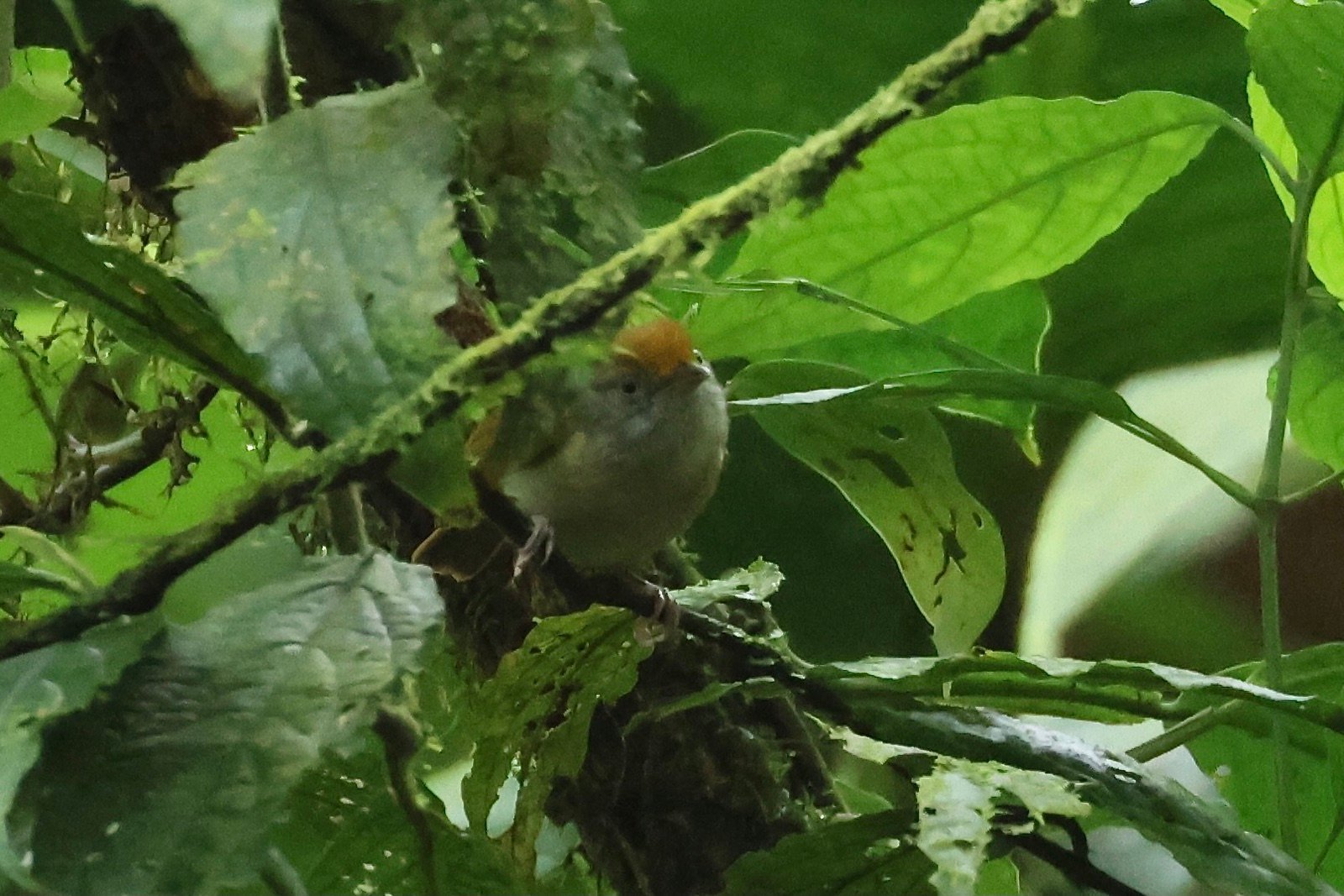
Look in thick vegetation low in the forest and listen for the mournful, trailing song first. Scan close to the ground and up to about 4 to 5 meters, since it forages there. Check mixed-species flocks and pairs working through the understory. The female's tawny crown is the best mark to watch for in dense leaves. In the Turrialba area, forest near Guayabo National Monument and the Aquiares coffee fields offers the right habitat. At Carara National Park a guide reported it inside the forest, alongside Russet Antshrike.
How to recognise it
This is a small, chunky antbird, about 10 to 13 cm long, with a big head and a short tail.
The male:
- slate-gray above, with a dark gray crown
- two narrow white wing bars
- white throat and upper breast with light gray spots
- yellow center to the belly, pale yellow in Costa Rican birds
The female is the easier one to pick out:
- cinnamon-tawny crown, also described as rufous-tawny
- thin white eye-ring
- olive-brown upperparts, more olive than the male
- more yellow underneath
What it sounds like
Recording: Pablo H Capovilla, CC BY 4.0, source, read 4 Nov 2026.
Behaviour and diet
In Costa Rica it hunts actively, with quick hops and short flights, pausing now and then to scan the surrounding vegetation. It takes beetles, moths, ants, spiders and katydids from leaves and twigs.
Across its range it forages in pairs or with mixed-species flocks, close to the ground, about 4 to 5 meters up.
Both parents incubate the two eggs by day, and in Costa Rica the nesting season runs from February to July. The nest is a thin-walled, deep cup hung from a horizontal fork and decorated with moss, set low in the forest at 0.6 to 2 m.
Where it lives
It lives in the understory of mature forest and the nearby second growth. Across its range it is often common in humid foothill and lower montane forest, mostly below 1,800 m.
In Costa Rica it occurs on both slopes of the northern cordilleras and Talamanca, and on the Caribbean side of the Central Volcanic range, mostly at 700 to 1500 m. It reaches 2,500 m, but only rarely. It is considered uncommon in the Costa Rican lowlands.
Similar birds
Costa Rica has two other antvireos, the Streak-crowned and the Spot-crowned, so check which one you are looking at. The Streak-crowned male has a dark gray crown streaked with grayish-white and a white throat and breast with dark streaks. The Spot-crowned has a spotted crown. The female's tawny crown also looks like that of the Tawny-crowned Greenlet, a small vireo-type bird that also lives in the Turrialba area, so note the crown color.
Names and lore in Costa Rica
In Costa Rica and Nicaragua it is called batarito cabecigrís. In Mexico and Colombia it is hormiguero sencillo, and in Honduras hormiguero cabecigrís.
Status and conservation
The official Costa Rican list marks it R, a year-round resident, and the IUCN lists it as Least Concern.
Photography tips
Mature forest understory and nearby second growth are the places to try, and at Wilson Botanical Garden a tour saw it foraging at eye level. A pair once visited a moth cloth early in the morning at a lodge in the Turrialba region, so a lit sheet can bring this shy bird into view.
How we know this 13 sources, each read on the date shown
- Lista Oficial de las Aves de Costa Rica (AOCR) read 2026-11-04
https://listaoficialavesdecostarica.wordpress.com/lista-oficial/lista-oficial-online/ - Wikipedia read 2026-11-04
https://en.wikipedia.org/wiki/Plain_antvireo - Wikipedia (Spanish) read 2026-11-04
https://es.wikipedia.org/wiki/Dysithamnus_mentalis - Birds Colombia (from Wikipedia text) read 2026-11-04
https://birdscolombia.com/2018/08/10/hormiguero-tiznado-plain-antvireo-dysithamnus-mentalis/ - Birds for Beer read 2026-11-04
https://birdsforbeer.com/2023/10/24/spotted-antbird-and-plain-antvireo-close-to-home-on-the-turrialba-volcano-slope/ - Cornell Birds of the World read 2026-11-04
https://birdsoftheworld.org/bow/species/plaant1/cur/introduction - Birding Craft read 2026-11-04
https://birdingcraft.com/wordpress/2013/05/03/carara-can-be-great-for-antbirds/ - Field Guides tour list read 2026-11-04
https://fieldguides.com/triplists/cos18.html - Flickr (Costa Rica natural history text) read 2026-11-04
https://www.flickr.com/photos/jobando/50851520072 - Field Guides tour list read 2026-11-04
https://fieldguides.com/triplists/cr118.html - Aves Ibericas, Aves Costa Rica read 2026-11-04
https://www.avesibericas.es/costaricaaves5.htm - Wikipedia read 2026-11-04
https://en.wikipedia.org/wiki/Dysithamnus_mentalis - The World Birds read 2026-11-04
https://theworldbirds.org/HTML/Thamnophilidae-Misc.htm