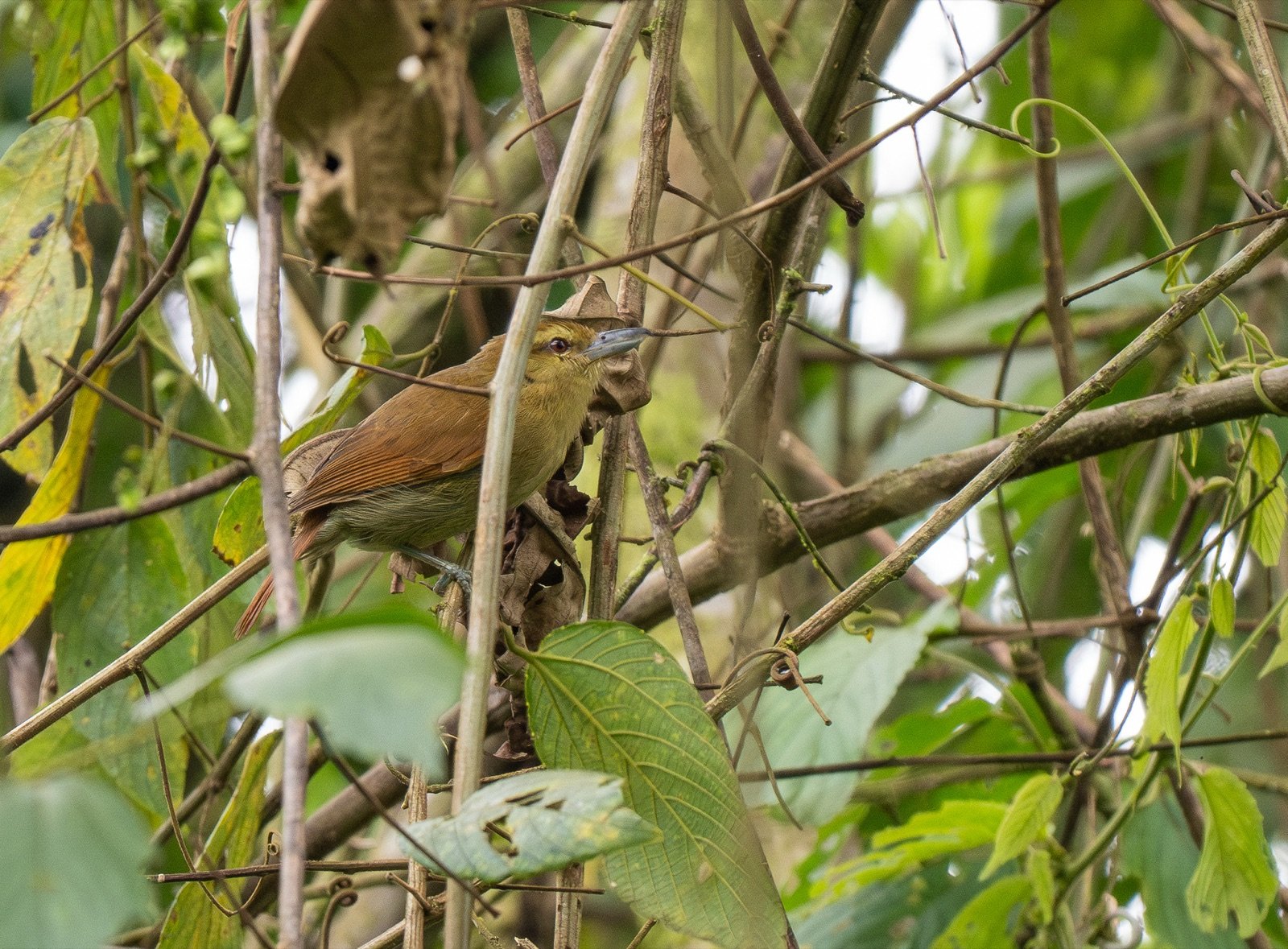
Family Thamnophilidae
Russet Antshrike
Thamnistes anabatinus
In Spanish: Batará Café
- Resident
A small, vireo-like antbird that rides high in mixed flocks.
The Russet Antshrike, Batará Café in Spanish, is a small, plain brown antbird that behaves more like a vireo than a typical antbird. It forages higher than other antbirds and usually joins mixed feeding flocks, so most birders find it by checking the flock rather than hunting for the bird itself.
In Costa Rica the subspecies saturatus lives on both the Caribbean and Pacific slopes, from near sea level up to about 1,500 m. The far northwest is the exception.
That makes it a good bird for a beginner learning to read a busy flock: scan the canopy, listen for thin high calls, and look for a thick, hooked bill and a brick red eye.
How to find it
Check the canopy of mixed flocks, since it forages higher than other antbirds. Listen for thin high calls inside busy flocks and scan overhead, because it sits in noisy mixed flocks in the lower canopy and upper understory. Its call carries far, so you may hear it across a valley first. A flock that moves slowly, or feeds along a forest edge you can walk, gives much better views, and one group followed a flock for about 200 m along such an edge. Fast flocks are frustrating. Nest sites are a good chance for a long look.
How to recognise it
This is a small arboreal antbird, 14 cm long. Look for these marks:
Plain tawny-olive brown above.
A rufous tail.
A thick, hooked bill.
A brick red iris.
Its behaviour resembles a vireo's, so a russet bird gleaning along branch ends is worth a second look.
Males have a cinnamon patch between the shoulders, but it is very hard to see in the field, and females lack it. Do not count on it to tell the sexes apart.
Birds from the northwestern Pacific coast of Costa Rica can show dark barring on a buffy belly. One seen on the Caribbean slope had this feature, which was unexpected there.
What it sounds like
Recording: keesgroenendijk, CC BY 4.0, source, read 4 Nov 2026.
Behaviour and diet
It goes alone or in pairs and sometimes joins mixed flocks of tanagers, vireos and warblers. It searches the ends of branches, leaf bases and rolled leaves for insects such as beetles and cicadas, and for spiders. It also checks vine tangles, moss and piles of dead leaves while foraging. It is thought to make local movements or altitudinal migrations, so where you find it may change. Breeding in Costa Rica is reported from April to June, with two eggs laid in a deep cup nest of dead leaf pieces.
Where it lives
In Costa Rica it ranges from near sea level up to about 1,500 m, on both the Caribbean and Pacific slopes. It uses the upper understory or lower canopy at forest edges, cacao plantations and secondary forest. It is common on the southern Pacific side, north to about Quepos, and quite uncommon farther north, up to Carara National Park. It is found from sea level to 1,500 m in the upper Coto Brus Valley. On the Caribbean slope and nearby lowlands it is an uncommon to fairly common resident, and very uncommon in drier coastal areas south of Lake Nicaragua.
When to see it
Breeding in Costa Rica runs from April to June. One birder found several mixed flocks with Russet Antshrike in Carara at the start of the wet season, and credited cloud cover with better activity than on hot, dry season days.
Similar birds
Its plumage looks like a foliage-gleaner's, such as the Rufous-rumped Foliage-Gleaner, but its behaviour and overall look are different. The closely related Rufescent Antshrike was split from this species on song and call differences. It lives south of the Marañon River in Peru, so it does not overlap with Costa Rica.
Names and lore in Costa Rica
The Costa Rican name is Batará Café. Elsewhere in Latin America it is Batará Canelo in Mexico, Batará Rufo in Panama, Hormiguero Bermejo in Venezuela and Hormiguero Café in Honduras.
Status and conservation
The AOCR list marks it as a resident (R), and its status in Costa Rica varies by area, from rare to fairly common.
Photography tips
A pair building a nest above a trail gave good scope views, and nest sites are a good chance for a long look. A mixed flock that moves slowly, or feeds along a forest edge you can walk, gives much better views than a fast one.
How we know this 19 sources, each read on the date shown
- Wikipedia read 2026-11-04
https://en.wikipedia.org/wiki/Russet_antshrike - Flickr (Costa Rican natural history text) read 2026-11-04
https://www.flickr.com/photos/jobando/24227149678 - Flickr (Rancho Naturalista photo) read 2026-11-04
https://www.flickr.com/photos/faulkners_fowl_shots/7073664981 - Macaulay Library read 2026-11-04
https://macaulaylibrary.org/asset/638983683 - Birds Colombia read 2026-11-04
https://birdscolombia.com/2019/01/02/hormiguero-bermejo-russet-antshrike-thamnistes-anabatinus/ - Peru Aves read 2026-11-04
https://www.peruaves.org/thamnophilidae/russet-antshrike-thamnistes-anabatinus/ - Wikipedia (es) read 2026-11-04
https://es.wikipedia.org/wiki/Thamnistes_anabatinus - SACC Proposal 758 read 2026-11-04
https://www.museum.lsu.edu/~Remsen/SACCprop758.htm - Birds of the World read 2026-11-04
https://birdsoftheworld.org/bow/species/rusant1/cur/introduction - Avibase read 2026-11-04
https://avibase.bsc-eoc.org/species.jsp?avibaseid=EE472B65661CCFC6 - Field Guides trip list read 2026-11-04
https://fieldguides.com/triplists/crh21b.html - Field Guides trip list read 2026-11-04
https://fieldguides.com/triplists/cr217.html - Eagle-Eye Tours read 2026-11-04
https://www.eagle-eye.com/blog/costa-rica-caribbean-mountains-to-coast-october-2021/ - Field Guides trip list read 2026-11-04
https://fieldguides.com/triplists/cr123PRINT.html - Birding Craft read 2026-11-04
https://birdingcraft.com/wordpress/2014/03/27/birding-costa-rica-march-2014/ - Birding Craft read 2026-11-04
https://birdingcraft.com/wordpress/category/biodiversity/page/11/ - Field Guides trip list read 2026-11-04
https://fieldguides.com/triplists/cos16.html - Aves y Ventanas Costa Rica read 2026-11-04
https://avesyventanascostarica.wordpress.com/algunas-aves-que-han-golpeado-contra-ventanas-en-costa-rica/ - Eagle-Eye Tours read 2026-11-04
https://www.eagle-eye.com/blog/costa-rica-caribbean-mountains-to-coast-2025-trip-report-oct-1-12/