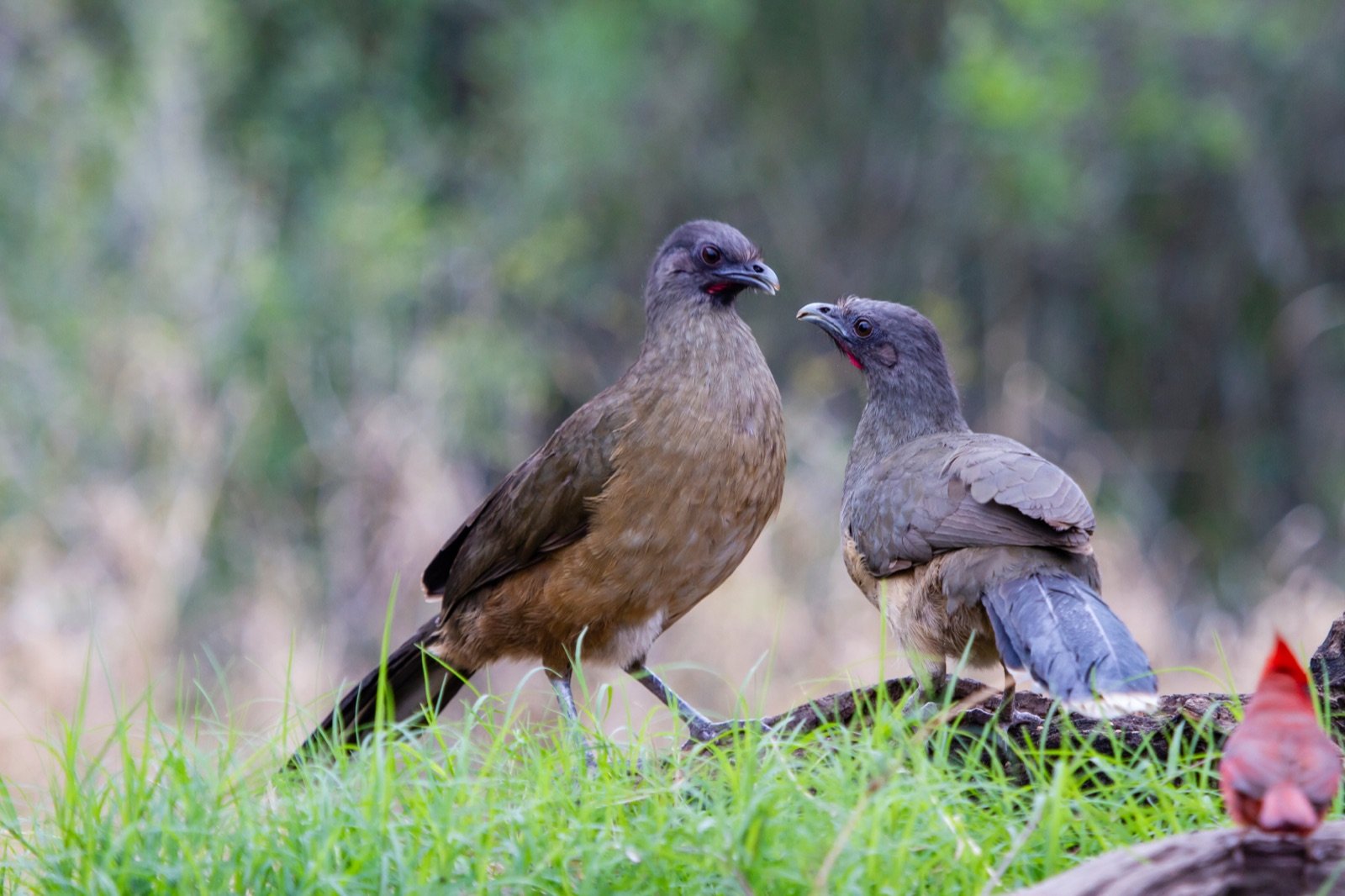
 Plain Chachalaca
Family Cracidae
Plain Chachalaca
Ortalis vetula
In Spanish: Chachalaca Olivácea (Chachalaca)
- Resident
A loud, shy tree-dweller of the dry northwest and the Nicoya hills.
The Plain Chachalaca (Chachalaca Olivácea) is a large, long-necked bird that is far easier to hear than to see. Its name imitates its call, a loud cha-cha-lac-a, and a whole flock together gives an overlapping, ear-splitting chorus.
In Costa Rica it lives in the hills of the Nicoya Peninsula and in the dry lowlands of the northwest. These birds are an isolated population, cut off from the main range, and the nearest birds live in northern Nicaragua, a short distance away.
For a beginning birder this is a bird to listen for first and look for second. Knowing where it lives and when it sings makes the search far more rewarding.
How to find it
Start by listening, because the birds are very inconspicuous and easily missed unless they are singing. Go in the morning, and aim for May to July when they are most vocal. Activity is low from 9 to 3:30, and dust in the dry season makes early hours the better choice. The higher hills of the Nicoya Peninsula are the place to focus, where it is described as common. Scan thorny thickets and forest edge for a long-tailed bird sitting in a tree, and expect a group rather than a single bird.
How to recognise it
Look for a large, long-necked bird with a small head and a long tail. Adults weigh about 650 g and measure about 56 cm in Costa Rica, and across the species length runs about 48 to 58 cm.
The head and neck are grayish.
The body and wings are dull olive-brown, and the belly is paler than the back.
The tail is blackish with a green gloss and a pale tip.
The bill is black and the feet are dull gray.
In the breeding season the bare throat patch turns deep red in both sexes.
Males and females look alike, and males are only slightly larger on average.
What it sounds like
Recording: José Gerardo Velasco, CC BY-SA 4.0, source, read 4 Nov 2026.
Behaviour and diet
This is a bird of groups. In Costa Rica it usually moves in company, and across its range groups can reach about 15 birds. Unlike most temperate-zone game birds, it spends most of its time in trees, though it feeds both on the ground and in trees. It is mostly active on cool mornings and in the evening.
Chachalacas are shy and wary. They prefer to run quickly along the ground, or to leap and glide through tangled brush, rather than fly off. Breeding usually starts at the start of the rainy season.
Where it lives
On the Pacific slope of Costa Rica it favors small groups in tall thorny thickets, scrub, second growth and forest edge. It is also seen in tropical dry forest and savanna, usually in groups.
Its range here covers the hills of the Nicoya Peninsula and the dry lowlands of the northwest. Chachalacas of this genus cope better than other members of the family with open areas, mixed crops and gardens, while most other cracids prefer forest.
When to see it
In Costa Rica the birds sing mainly from May to July, and that is the best time to detect them. Mornings are when a flock's chorus is heard most often.
Similar birds
Costa Rica has two chachalacas. The Plain is limited to the dry northwest, in Guanacaste. The Gray-headed is the one in other parts of the country, so location is the simplest way to tell them apart. The Gray-headed is also smaller and has rufous in the primary feathers.
Names and lore in Costa Rica
Costa Rican sources use the Spanish names Chachalaca and Chachalaca Olivácea. Pavas, pavones, chachalacas and pajuilas are common names for the whole guan and chachalaca family.
Status and conservation
It is a resident on the AOCR list, and the IUCN rates the species Least Concern, so it is not currently considered threatened.
Photography tips
The birds are very inconspicuous and easily missed unless they are singing, so listening is the best way to find them. Once you have a call, trace it to a tree at a thicket edge in the morning.
How we know this 16 sources, each read on the date shown
- Asociación Ornitológica de Costa Rica (Cracidae page) read 2026-11-04
https://avesdecostarica.weebly.com/cracidae.html - Wikipedia read 2026-11-04
https://en.wikipedia.org/wiki/Plain_chachalaca - Cornell Birds of the World read 2026-11-04
https://birdsoftheworld.org/bow/species/placha/cur/introduction - Bird Watching Costa Rica read 2026-11-04
https://www.birdwatchingcostarica.com/ave/plain-chachalaca/ - Birda species guide read 2026-11-04
https://app.birda.org/species-guide/617/Plain_Chachalaca - Costa Rican natural history entry (Flickr, Cabuya photo) read 2026-11-04
https://www.flickr.com/photos/jobando/49662462618 - Birdingcraft read 2026-11-04
https://birdingcraft.com/wordpress/2010/02/12/seeing-curassows-guans-and-chachalacas-when-birding-costa-rica/ - Birding Club of Costa Rica read 2026-11-04
https://birdingclubcr.org/bccr-adventures-new/northern-pacific-lowlands.html - Natural Atlas read 2026-11-04
https://naturalatlas.com/birds/plain-chachalacas - Birds for Beer read 2026-11-04
https://birdsforbeer.com/2020/04/20/in-a-costa-rican-garden-gray-headed-chachalaca/ - Birding Craft read 2026-11-05
https://birdingcraft.com/wordpress/category/dry-forest/ - Birdwatching in Costa Rica read 2026-11-05
https://birdwatchingincostarica.com/nicoya-peninsula-birding-one-of-the-blue-zones-of-the-world/ - Exotic Birding read 2026-11-05
https://www.exoticbirding.com/costarica/paloverde/checklist.html - Wikipedia read 2026-11-05
https://en.wikipedia.org/wiki/Ortalis_vetula - Greg Lasley Photography read 2026-11-05
https://www.greglasley.com/content/BirdsofNorthAmerica/PlainChachalaca.php - iNaturalist (from Wikipedia) read 2026-11-05
https://www.inaturalist.ca/taxa/2090-Ortalis-vetula