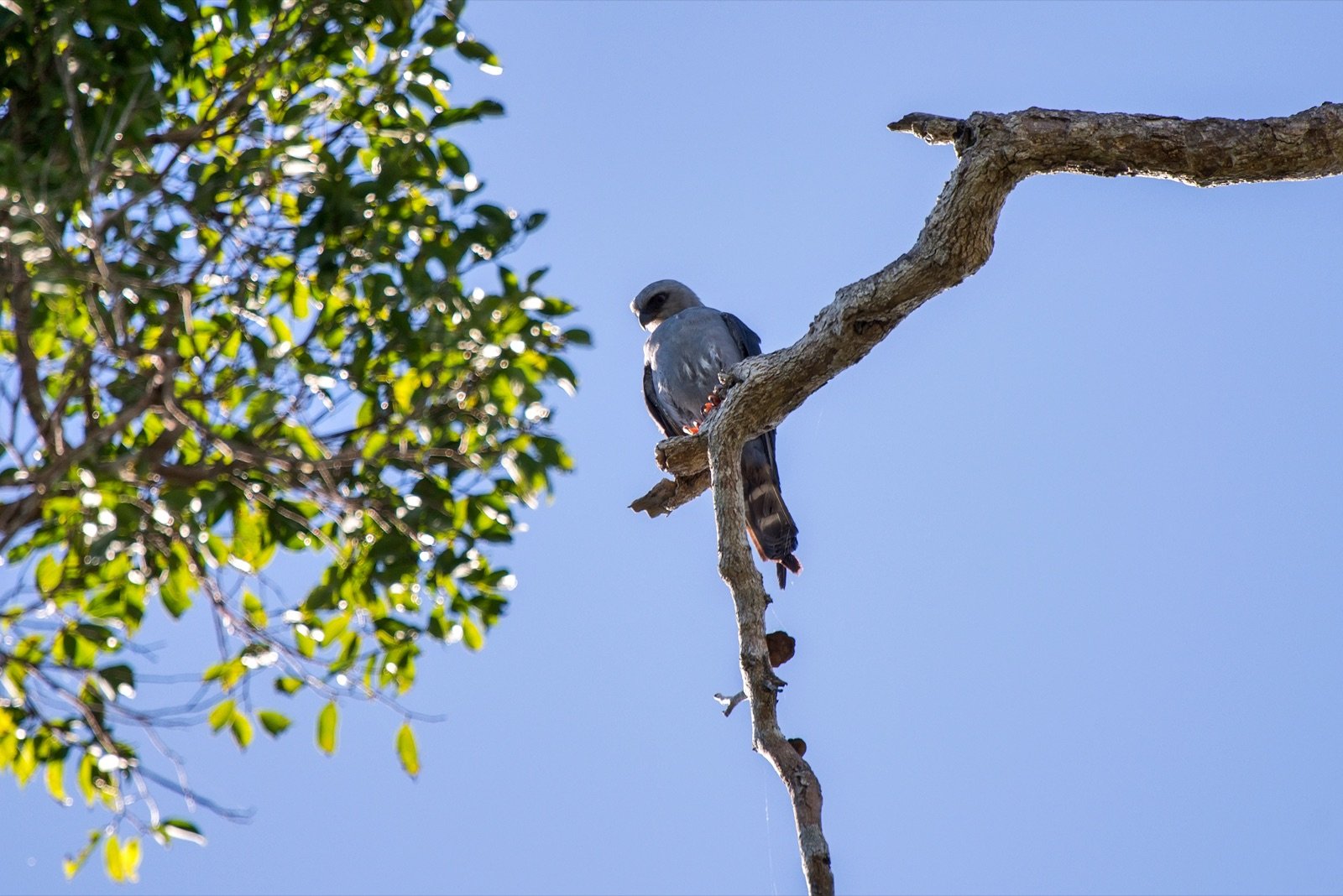
 Plumbeous Kite
Family Accipitridae
Plumbeous Kite
Ictinia plumbea
In Spanish: Elanio Plomizo
- Resident
A grey, red-eyed kite soaring over Carara and the Tárcoles mangroves.
The Plumbeous Kite (Elanio Plomizo) is a mostly grey raptor with red eyes and orange legs. On the Central Pacific coast, Carara National Park and the Tárcoles area are a dependable place to look for it.
Birders report it over the River Trail, along the entrance road of a lodge nearby, and in the mangroves. It is a migrant as well as a rare resident (RR,M), so timing and place both matter.
On a trip we build around the Central Pacific, Carara is a common stop for visitors, and this kite is one of the raptors worth scanning for while you are there.
How to find it
At Carara, birds are sometimes seen soaring high over the River Trail. A local guide says they are easier to find around the lodge entrance road near Carara and in the mangroves.
That area has long sight lines and varied habitat, a good place to look for this kite among other raptors, including Gray-headed and Hook-billed Kites. A boat tour through the Tárcoles mangroves is another way to see it: one group saw a bird perched high above a canal, and others flying over Carara. On a March tour, kites were also seen on the road above Villa Lapas, beside Carara.
How to recognise it
Adults are about 33 to 38 cm long and weigh 190 to 280 g, measurements that describe the species across its range. Look for these marks:
Mostly grey plumage.
Red eyes.
Orange legs.
In flight, a rusty patch on the primaries.
A short black tail with two or three white bands underneath.
Immatures look different. They lack the rusty wing patch and have streaked underparts, so take extra care with young birds.
What it sounds like
Recording: Pablo H Capovilla, CC BY 4.0, source, read 4 Nov 2026.
Behaviour and diet
It feeds mainly on insects, which it catches either from a perch or in flight. Across its range it is not very social, but it is often seen in flocks on migration.
In Costa Rica, one account says it flies above the canopy and along forest edges, savannas and mangroves, and is less often seen over dense forest. At Carara, birds are sometimes seen soaring high over the River Trail, and one bird circled low over the parking lot.
It builds a stick nest in a tree.
Where it lives
Across its range it favors lowland forest and savannah. In Costa Rica, a natural history account calls it a breeding resident of the Caribbean and Pacific lowlands and foothills.
The same account describes it as relatively common only in mangroves and nearby forest on the north Pacific, and in the lowlands south of Lake Nicaragua. One bird guide takes a different view and calls it local, or absent except as a migrant. A record from the Ceiba-Cascajal Road west of Orotina is described as a vagrant migrant that is not expected there.
When to see it
The first migrating raptors appear in August, when Plumbeous Kites and Swallow-tailed Kites begin gliding through the Caribbean skies. A March tour at Carara described the birds seen there as recent arrivals from their wintering grounds in South America.
Similar birds
The look-alike is the Mississippi Kite, which visits Costa Rica as a migrant. The Plumbeous is darker grey overall and has no white patch on the inner wing. It also shows a rusty patch on the primaries.
Names and lore in Costa Rica
Costa Rica's Spanish name is Elanio Plomizo. Other Spanish names for the species include milano plomizo, milano azulado and aguililla plomiza, and the Costa Rican wildlife-rescue guide lists it as Milano plomizo.
Status and conservation
The AOCR list marks it RR,M, a rare resident and a migrant, and a Costa Rican wildlife-rescue guide lists it as Least Concern with a decreasing population trend.
Photography tips
At Kéköldi, Plumbeous Kite passage peaked late morning, between 11:00 and 12:00, a useful time to watch for flying birds. Around Carara, a boat tour through the mangroves can give a view of a perched bird.
How we know this 19 sources, each read on the date shown
- Birding Craft read 2026-11-04
https://birdingcraft.com/wordpress/tag/carara-national-park/ - Birding Craft read 2026-11-04
https://birdingcraft.com/wordpress/category/costa-rica-bird-finding-guide/ - Field Guides Birding Tours read 2026-11-04
https://fieldguides.com/triplists/cos20.html - Field Guides Birding Tours read 2026-11-04
https://fieldguides.com/triplists/cos24.html - Visit Costa Rica (ICT) read 2026-11-04
https://www.visitcostarica.com/things-to-do/greatest-wildlife-spectacles/on-the-wing - Birding Craft read 2026-11-04
https://birdingcraft.com/wordpress/2021/10/18/some-of-the-best-road-birding-in-costa-rica-the-ceiba-cascajal-road/ - Animalia.bio (Wikipedia text) read 2026-11-04
https://animalia.bio/plumbeous-kite?category=3 - Animalia.bio (Wikipedia text) read 2026-11-04
https://animalia.bio/plumbeous-kite - Planetscott (Wikipedia text) read 2026-11-04
https://www.planetscott.com/speciesdetail/3336/plumbeous-kite-ictinia-plumbea - Wild Atlas Guide read 2026-11-04
https://wildatlasguide.com/birds/plumbeous-kite/ - Guía de fauna decomisada, Costa Rica read 2026-11-04
https://faunadecomisada.go.cr/guia-de-especies/aves/accipitridae/ictinia-plumbea - Wikipedia read 2026-11-04
https://en.wikipedia.org/wiki/Ictinia_plumbea - Cornell Birds of the World read 2026-11-04
https://birdsoftheworld.org/bow/species/plukit1/cur/introduction - Aves Costa Rica (avesibericas.es) read 2026-11-04
https://www.avesibericas.es/costaricaaves1.htm - Flickr (Historia Natural text) read 2026-11-04
https://www.flickr.com/photos/jobando/26690005178 - Cotinga 36, Spring raptor migration at Talamanca read 2026-11-04
https://hawkmountain.org/download/?dl=1&id=5029 - World Bird Photos read 2026-11-04
https://www.worldbirdphotos.com/photo/kite-plumbeous-ictinia-plumbea-adult-costa-rica/ - EcuRed read 2026-11-04
https://www.ecured.cu/Gavil%C3%A1n_azulado_grande - Planet of Birds read 2026-11-04
https://planetofbirds.com/accipitriformes-accipitridae-plumbeous-kite-ictinia-plumbea/