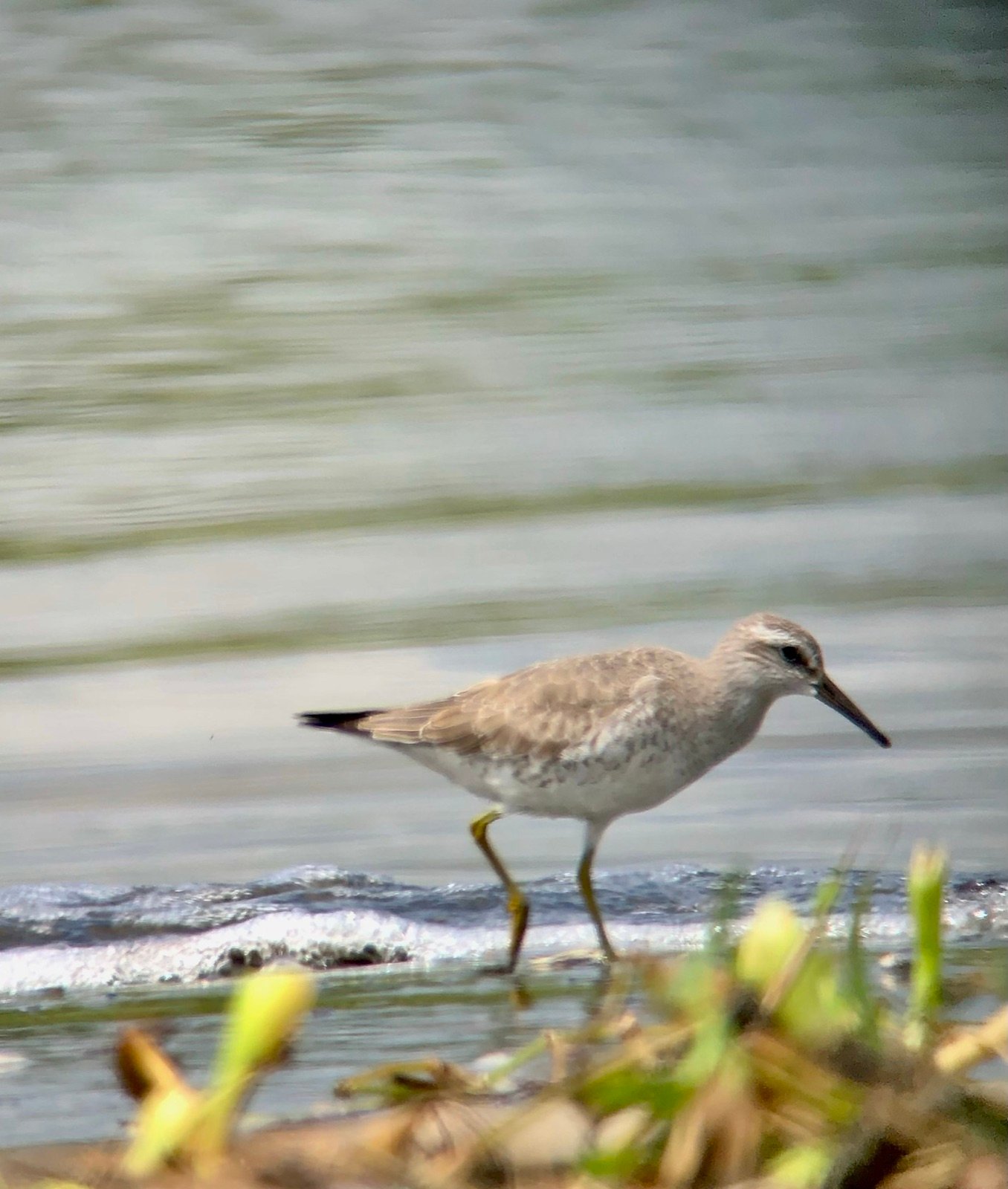
Family Scolopacidae
Red Knot
Calidris canutus
In Spanish: Correlimos Grande
- Migrant
A pale, uncommon migrant shorebird of Pacific beaches, mudflats and salt flats.
The Red Knot (Correlimos Grande) is a migrant in Costa Rica, and the official bird list gives it the status M. It does not stay all year. It passes along the coast in two windows, and the main one runs from mid-March to late April.
This is an uncommon bird on the Pacific coast, and it has generally been regarded as uncommon across Central America. A sighting is something to enjoy rather than expect.
It belongs to sandy beaches, river mouths, mudflats and salt flats, and the Gulf of Nicoya stands out as a notable place for it during migration.
How to find it
Plan around the main passage, mid-March to late April, and keep late August to October as a second chance. Start at river mouths and sandy or pebbly beaches. Scan mudflats for feeding birds, then check salt flats and salt-pond dikes for resting ones. Pick out pale grey shorebirds and wait for the white wing bar and pale rump patch when they fly. Listen for a soft knutt from flocks passing overhead.
How to recognise it
Look for these marks on any pale shorebird you suspect might be a knot. They describe the species across its whole range, not only Costa Rica.
A narrow white wing bar, in every plumage.
A pale rump patch, in every plumage.
A pale grey look from a distance in non-breeding plumage.
These are the marks to lean on when a flock lifts off. On a bright beach a non-breeding bird can read as a plain pale shape until the wing bar shows in flight.
What it sounds like
Behaviour and diet
In Costa Rica the Red Knot feeds on mudflats and rests on salt flats and salt-pond dikes. Because feeding birds rarely call when alone, you will often find them by sight rather than by sound.
Where Red Knots are common, which is not the case in Costa Rica, they may roost in very dense flocks, standing shoulder to shoulder on the sand.
Where it lives
In Costa Rica the Red Knot uses sandy or pebbly beaches, especially near river mouths. It feeds on mudflats and rests on salt flats and salt-pond dikes.
All of these habitats are coastal, so think sea level rather than the highlands or the forest interior. The birds on the Pacific side are the ones most linked with Costa Rica.
When to see it
Migrating Red Knots pass through Costa Rica in two windows. The main one runs from mid-March to late April, and the other is from late August to October.
Similar birds
The Great Knot looks similar in shape, but the Red Knot is smaller and less bulky and has a shorter bill. Their breeding plumages differ markedly. The Great Knot is not a Costa Rica bird, so it should not complicate an identification here.
Names and lore in Costa Rica
Another Spanish name listed for the Red Knot in Costa Rica is Correlimos Pechirrayado, alongside the official Correlimos Grande. Correlimos Grande is also a local name for the Greater Yellowlegs, so ask which bird a guide means.
Status and conservation
The official Costa Rican bird list gives the Red Knot the status M, meaning a migrant, and it is described as an uncommon migrant along the Pacific coast.
How we know this 13 sources, each read on the date shown
- Encyclopedia of Puget Sound read 2026-11-04
https://www.eopugetsound.org/species/calidris-canutus - NatureServe Explorer read 2026-11-04
https://explorer.natureserve.org/Taxon/ELEMENT_GLOBAL.2.100057/Calidris_canutus - Lista Oficial de las Aves de Costa Rica (AOCR) read 2026-11-04
https://listaoficialavesdecostarica.wordpress.com/lista-oficial/lista-oficial-online/ - Australian Department of the Environment SPRAT read 2026-11-04
https://www.environment.gov.au/cgi-bin/sprat/public/publicspecies.pl?taxon_id=855 - Wikipedia read 2026-11-04
https://en.wikipedia.org/wiki/Red_knot - Audubon Field Guide read 2026-11-04
https://www.audubon.org/field-guide/bird/red-knot - Avibase read 2026-11-04
https://avibase.bsc-eoc.org/species.jsp?avibaseid=B5CE8FAD18923A94 - US Fish and Wildlife Service, rufa Red Knot supplement read 2026-11-04
https://www.fws.gov/sites/default/files/documents/Rufa%20Red%20Knot%20Supplemental%20Listing%20Document.pdf - ResearchGate: Red Knot roselaari Pacific coast study read 2026-11-04
https://www.researchgate.net/publication/264495809_Red_Knot_Calidris_canutus_roselaari_migration_connectivity_abundance_and_non-breeding_distribution_along_the_Pacific_coast_of_the_Americas - Birds of the World (Cornell) read 2026-11-05
https://birdsoftheworld.org/bow/species/redkno/cur/movement - Birds of the World (Cornell) read 2026-11-05
https://birdsoftheworld.org/bow/species/redkno/cur/systematics - Bird Conservation International read 2026-11-05
https://www.cambridge.org/core/journals/bird-conservation-international/article/insights-into-migratory-connectivity-and-conservation-concerns-of-red-knots-calidris-canutus-in-the-austral-pacific-coast-of-the-americas/6EF5A0B94107195C95BA6C4EC409258C - International Wader Study Group read 2026-11-05
https://www.waderstudygroup.org/article/1289/