Family Scolopacidae
Surfbird
Calidris virgata
In Spanish: Chorlito de Rompientes
- Migrant
A grey rocky-shore sandpiper that passes along the Pacific coast
The Surfbird (Chorlito de Rompientes) is a shorebird that chooses the roughest edge of the sea. It breeds in Alaska and the Yukon and can winter as far south as Chile, so one on a Costa Rican rock is a traveller in the middle of a very long journey. Here it is an uncommon passage migrant.
On the Central Pacific coast, the rocky shore at Dominicalito, 48 km south of Quepos, suits it. On a trip we build, it makes an easy stop for visitors based at Manuel Antonio or Baru, or driving between the south Pacific and Carara.
For a beginner it is a rewarding bird to learn. You scan rocks and the surf line rather than mudflats, and the same stretch of shore holds several other rocky-shore species.
How to find it
Start with Rocas de Amancio, a rocky beach just north of Dominicalito beach, known as a fairly reliable spot for wintering Surfbirds. Look at the rocks rather than the sand. At high tide, check rock jetties and other hard-to-reach spots where birds roost, often with turnstones and tattlers. As the tide falls they spread out over the exposed rocks to feed, so watch the newly uncovered ledges. Scan turnstone groups for the stockier grey bird. The same rocks hold American Oystercatcher, Ruddy Turnstone and Wandering Tattler, which lets you compare shapes side by side.
How to recognise it
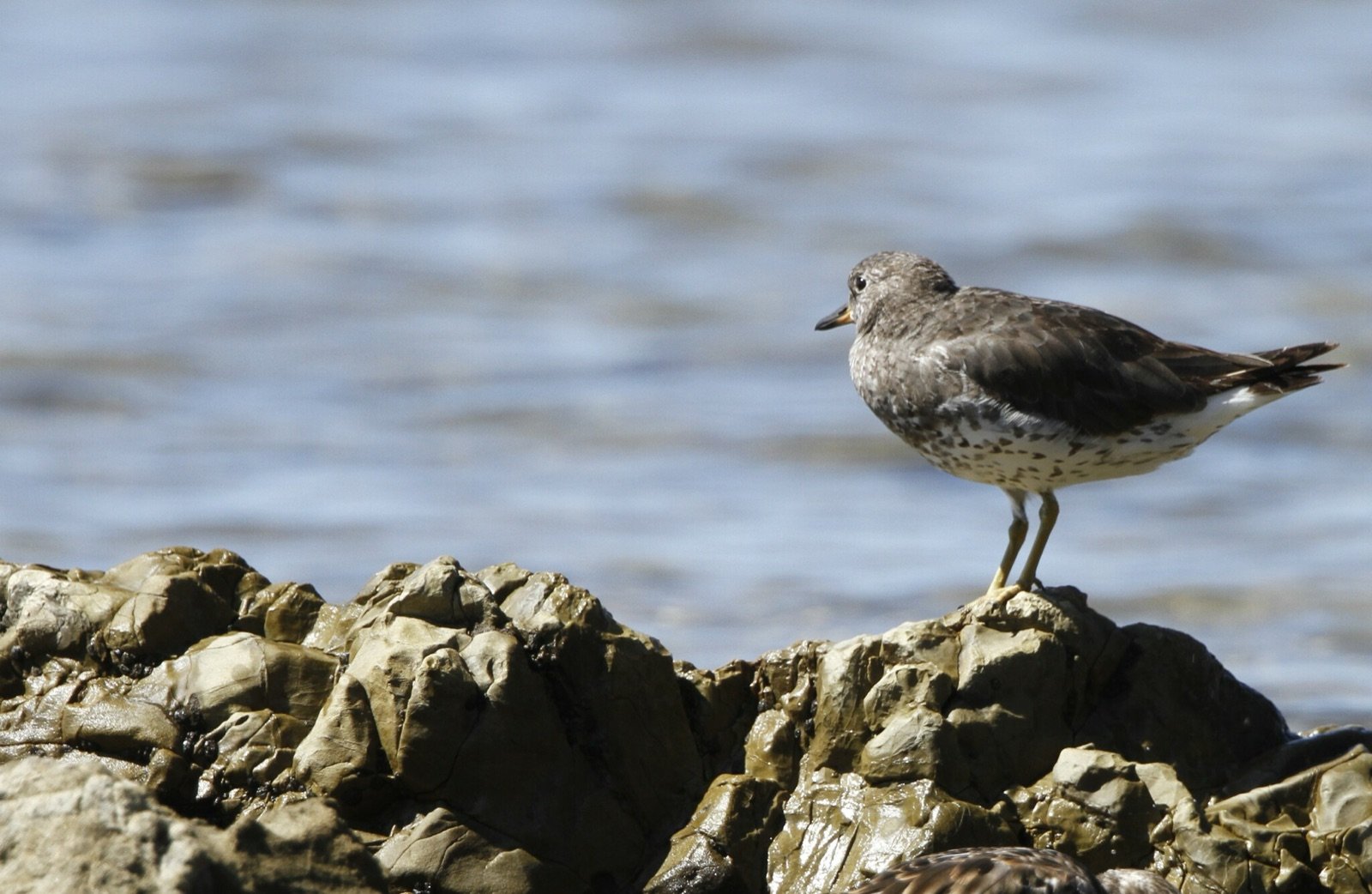
Birds seen in Costa Rica are likely to be in winter plumage, or young birds, so expect a plain look:
Upperparts and breast mostly grey.
Underparts white with streaking.
Bill short and blunt, golden-orange at the base and black at the tip.
Legs yellow.
In flight, a black band at the end of the white rump.
Breeding birds look quite different, with dark streaks on the head and breast, dark spots on the white underparts and rusty patches on the wings, but birds in Costa Rica are usually in the plainer grey non-breeding plumage. The two-toned bill is one of the most useful marks, because it sets the Surfbird apart from Black Turnstone, Wandering Tattler and other rocky-shore sandpipers that share its habitat.
Behaviour and diet
Away from the breeding grounds, Surfbirds feed on shellfish such as mussels and barnacles, plus algae. They work right at the surf line and take little notice of flying spray from the waves.
They scramble over rocks on pounded coastlines, often just out of reach of the water. At high tide they roost on rock jetties or other hard-to-reach spots, often with turnstones and tattlers. As the tide falls they spread out over the exposed rocks to feed. Outside the breeding season they usually go in small flocks, often alongside turnstones.
Where it lives
Outside the breeding season the Surfbird is a rocky shore specialist. It feeds on rocky shores, reefs and ledges along the coast, from the spray zone at the water's edge to just above the tide line.
In Costa Rica it is rarely seen inland and prefers rocky shores bathed by splashing waves. The place to look is the Pacific coast, where the rocky shoreline at Dominicalito is a known spot.
When to see it
A Costa Rican birding blogger suggests visiting the rocky Dominicalito coast between late August and October. Range-wide, Surfbirds can be on their wintering grounds from late July to early May, and on the southern Pacific coast the one clear peak in migrant numbers is in spring, mainly April.
Similar birds
Surfbirds can be mistaken for turnstones, so check the black band at the end of the white rump and the yellow legs. The Great Knot looks much like a larger, longer-billed and somewhat darker Surfbird, so check bill length and the coastal rocky habitat.
Names and lore in Costa Rica
The official Costa Rican Spanish name is Chorlito de Rompientes. Other Spanish names used elsewhere include Playero Brincaolas in Honduras and Mexico, Rompientero in Ecuador and Panama, and Playero roquero, Playero de rompiente and Correlimos de rompientes.
Status and conservation
The AOCR list marks the Surfbird as a migrant (M), a Costa Rican birding guide calls it an uncommon passage migrant, and its global conservation status is Least Concern.
How we know this 15 sources, each read on the date shown
- Manuel Antonio Birding (Johan Chaves) read 2026-11-04
https://manuelantoniobirding.wordpress.com/tag/surfbird/ - Wikipedia read 2026-11-04
https://en.wikipedia.org/wiki/Surfbird - Cornell Birds of the World read 2026-11-04
https://birdsoftheworld.org/bow/species/surfbi/cur/foodhabits - Birding for Conservation read 2026-11-04
https://www.birdingforconservation.com/2019/02/birding-costa-rica-central-pacific/ - All About Birds, Cornell Lab read 2026-11-04
https://www.allaboutbirds.org/guide/Surfbird/overview - South Dakota Birds and Birding read 2026-11-04
https://www.sdakotabirds.com/species/surfbird_info.htm - Oiseaux-Birds read 2026-11-04
https://www.oiseaux-birds.com/card-surfbird.html - All Birds Wiki read 2026-11-04
https://allbirdswiki.miraheze.org/wiki/Surfbird - Birda species guide read 2026-11-04
https://app.birda.org/species-guide/6672/Surfbird - SIMoN (Sanctuary Integrated Monitoring Network) read 2026-11-04
https://sanctuarysimon.org/dbtools/species-database/species-info-ajax.php?sID=870 - Avibase read 2026-11-04
https://avibase.bsc-eoc.org/species.jsp?avibaseid=11CF8C9A9638ADFC - Birds Colombia (Wikipedia text) read 2026-11-04
https://birdscolombia.com/2022/05/19/chorlo-de-rompientes-surfbird-calidris-virgata/ - Audubon Field Guide read 2026-11-04
https://www.audubon.org/field-guide/bird/surfbird - ArgentiNat read 2026-11-05
https://www.argentinat.org/taxa/339592-Calidris-virgata - Lista Oficial de las Aves de Costa Rica (AOCR) read 2026-11-05
https://listaoficialavesdecostarica.wordpress.com/lista-oficial/lista-oficial-online/