Family Turdidae
Ruddy-capped Nightingale-Thrush
Catharus frantzii
In Spanish: Zorzal Gorrirojizo (Jilguerillo de Montaña, Jilguerillo de Ronda)
- Resident
A shy, rusty-crowned thrush of the highland forest floor, heard long before it is seen.
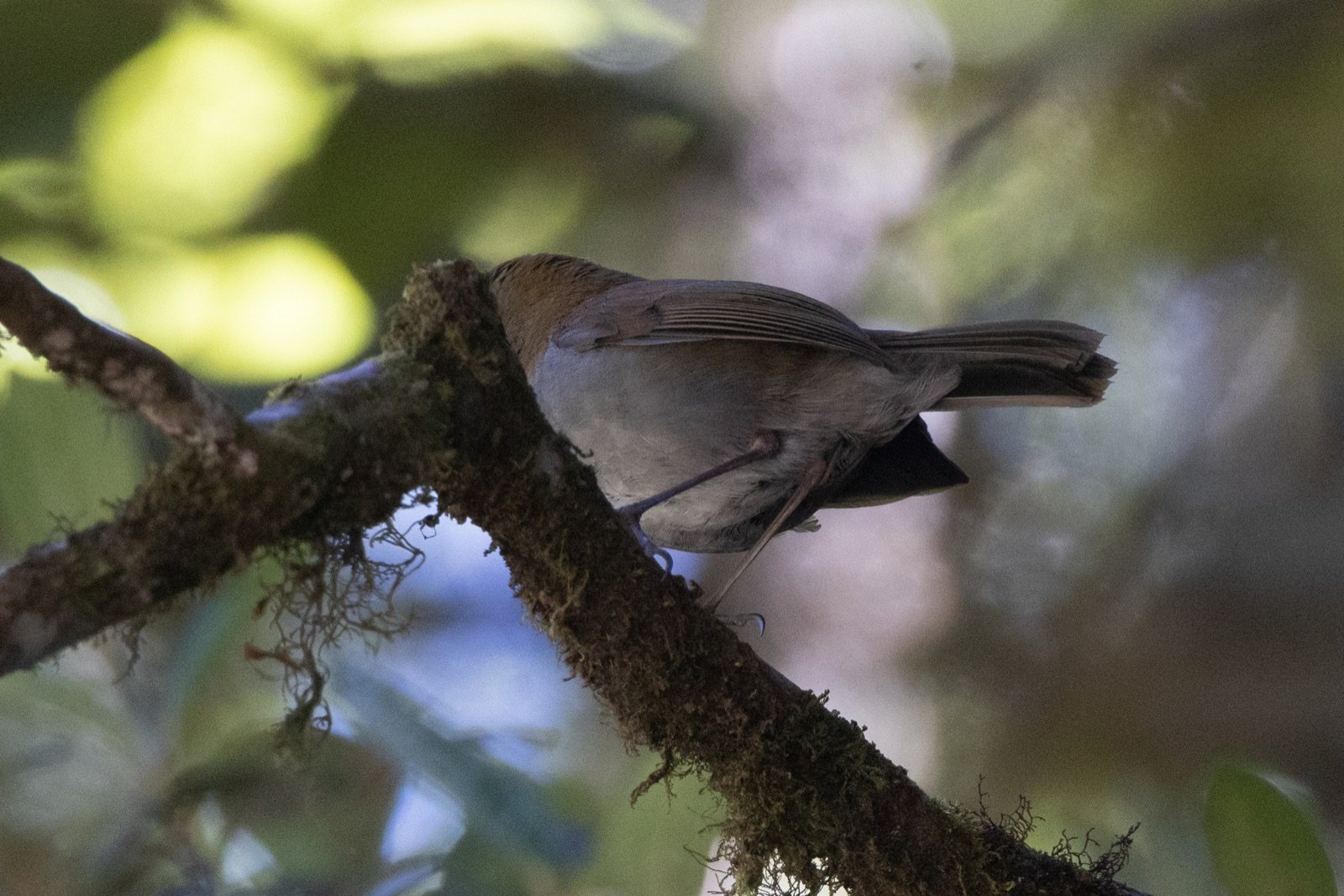
The Ruddy-capped Nightingale-Thrush (Zorzal Gorrirojizo, Catharus frantzii) is a small thrush with a rusty-red crown and an orange lower bill. In Costa Rica it lives in the mountains on both slopes, between about 1,500 and 2,500 m.
It keeps to dense undergrowth, so most birders meet it by ear first. Expect a song drifting from thick cover rather than a bird sitting in the open.
The species was first described from specimens collected on Irazú Volcano, which is its type locality. On a trip we build, guests can meet it in the cloud forest gardens and trails of San Gerardo de Dota.
How to find it
Listen first, because it is often heard before it is seen and comes from dense undergrowth. Walk a forest trail slowly and quietly in early morning or late afternoon, when the birds are more likely to feed in the open. Song is mostly heard in the mornings and evenings. Birders get the best chance with call playback. Check roadsides and pastures bordered by tall vegetation, though the bird stays close to cover. Watch for army ant swarms, which it follows.
How to recognise it
This is a small thrush, about 15 to 18 cm long and about 30 g. Look for these marks:
Adults have an olive-brown back, a rusty-red crown and nape, and a grayish face. The crown is usually clearly brighter than the back. The underparts are pale gray, turning whitish on the belly. The bill is two-toned, with a black upper half and an orange lower half. There is no orange eye ring.
Young birds have a darker face and pale centers on the back feathers. Their breast and flanks are brownish, and the belly may show dark bars or spots.
What it sounds like
Recording: Hersson Ramírez, CC BY 4.0, source, read 4 Nov 2026.
Behaviour and diet
It forages alone or in pairs on the forest floor, moving by hops and quick dashes with frequent pauses. It eats many kinds of insects, spiders and other small invertebrates, and it also takes berries. It follows army ant swarms.
It is a shy, solitary bird of dense, dark forest. It sometimes shows on roadsides and in pastures bordered by tall vegetation, but it stays close to cover.
Where it lives
In Costa Rica it lives between about 1,500 and 2,500 m elevation, in the mountains on both slopes. It avoids the Guanacaste and Tilarán Cordilleras. In the northern ranges it occurs above about 1,350 m, while in the Central Volcanic and Talamanca ranges it is found at about 1,500 to 2,500 m.
Across its range it uses the undergrowth of wet mountain forest, cloud forest, oak and conifer forest, and second growth. It also uses dense forest in deep canyons near water.
When to see it
In Costa Rica it breeds from April to June, so nests and singing birds are most likely then. Singing in the Cordillera Central was noted mostly from March to August, and it may sing more at the start of the rainy season.
Similar birds
Orange-billed Nightingale-Thrush looks much like it but has a bright orange eye ring, and a strongly orange bill, legs and toes. Ruddy-capped shows only a little orange at the base of the lower bill. On Costa Rican and Panamanian mountains, Orange-billed lives lower and Black-billed lives higher, with Ruddy-capped filling the middle band.
Names and lore in Costa Rica
Besides the official Zorzal Gorrirojizo, Costa Rican names include Jilguerillo de Montaña and Jilguerillo de Ronda. Zorzalito de Frantzius is another Spanish name in use.
Status and conservation
The official Costa Rica list gives it as a resident (R), the IUCN rates it Least Concern, and it is considered common in Costa Rica.
Photography tips
Slow, quiet walking on a forest trail in early morning or late afternoon gives the best chance of a bird feeding in the open. Roadsides and pasture edges with tall vegetation nearby can also show it, close to cover.
How we know this 17 sources, each read on the date shown
- Earthlife read 2026-11-04
https://earthlife.net/ruddy-capped-nightingale-thrush/ - Wikipedia read 2026-11-04
https://en.wikipedia.org/wiki/Ruddy-capped_nightingale-thrush - Birda read 2026-11-04
https://app.birda.org/species-guide/29867/Ruddy-capped_Nightingale-Thrush - Oiseaux-Birds read 2026-11-04
https://www.oiseaux-birds.com/card-ruddy-capped-nightingale-thrush.html - Birds of the World read 2026-11-04
https://birdsoftheworld.org/bow/species/rcnthr1/cur/breeding - EcoRegistros read 2026-11-04
https://www.ecoregistros.org/ficha/Catharus-frantzii - Alamy read 2026-11-04
https://www.alamy.com/stock-photo-frantzius-nightingale-thrush-or-ruddy-capped-nightingale-thrush-catharus-78959156.html - Cloudbridge Nature Reserve bird list read 2026-11-04
https://www.cloudbridge.org/wp-content/uploads/2020/04/Bird-Species-List-Costa-Rica-13-April-2020.pdf - Lista Oficial de las Aves de Costa Rica read 2026-11-04
https://listaoficialavesdecostarica.wordpress.com/lista-oficial/lista-oficial-online/ - Aves de Costa Rica read 2026-11-04
https://www.avesdecostarica.com/Catharus-frantzii.html - Cornell Birds of the World read 2026-11-04
https://birdsoftheworld.org/bow/species/obnthr1/cur/introduction - Cornell Birds of the World read 2026-11-04
https://birdsoftheworld.org/bow/species/rcnthr1/cur/introduction - 10,000 Birds read 2026-11-04
https://www.10000birds.com/nightingale-thrushes.htm - Aves Costa Rica (avesibericas.es) read 2026-11-04
https://www.avesibericas.es/costaricaaves8.htm - Avibase read 2026-11-04
https://avibase.bsc-eoc.org/species.jsp?avibaseid=AE3380AF47C78675 - Museo Nacional de Costa Rica read 2026-11-04
https://www.museocostarica.go.cr/nuestro-trabajo/investigaciones/historia-natural/volcan-irazu/biodiversidad-de-irazu-aves/ - Enchanted by the Wild (Thomas Bancroft) read 2026-11-04
https://thomasbancroft.org/the-song-of-the-ruddy-capped-nightingale-thrush/