Family Anatidae
Ruddy Duck
Oxyura jamaicensis
In Spanish: Pato Cariblanco
- A
A small stiff-tailed diving duck, accidental here since 2010.
The Ruddy Duck is not a bird to plan a trip around, and that is part of its interest. The official Costa Rican bird list marks it A, an accidental visitor, so it is not a resident here.
It became an official Costa Rican species in 2011. The first record was a single bird diving, swimming and feeding in a pond on a prawn farm in Carrillo, Guanacaste, seen on 13 November 2010.
For a beginning birder it is still a useful duck to know, because the resident Masked Duck can be confused with it. Learning the difference sharpens your eye on every marshy pond you visit.
How to find it
Look on open water rather than along the marsh edge, since this duck is very aquatic. Scan ponds and reservoirs for a small duck with an upright tail. Be patient, because an alarmed bird may sink or dive out of sight instead of flying. A wintering bird is unlikely to call, so do not count on sound to locate it. Check any dark-faced duck carefully against the Masked Duck, which is resident and more likely to be the bird in front of you.
How to recognise it
This is a small, compact diving duck with a big head and a thick neck. It often holds its tail upright while swimming, which is the quickest clue at a distance.
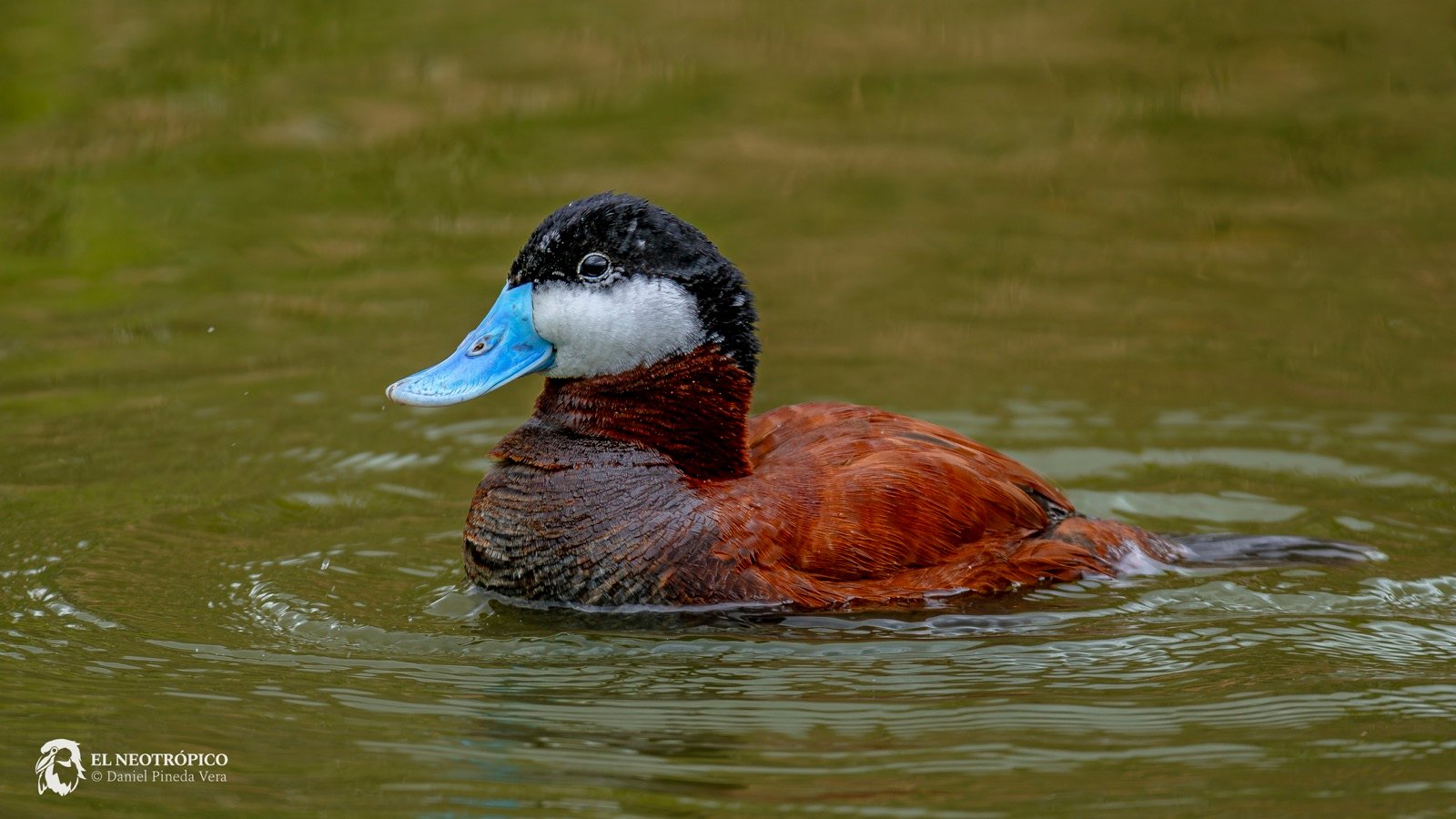
Breeding males are rusty red with a blue bill, a white face and a black cap. The sky-blue bill of the breeding season turns duller outside it.
Females and young are grayish brown with a pale grayish face, a dark cap and a dark cheek stripe.
The first Costa Rican bird was in winter plumage, so a duller bird is more likely here than a bright rusty male. In flight a Ruddy Duck's wings are all dark.
What it sounds like
Recording: Tero Linjama, CC BY 4.0, source, read 4 Nov 2026.
Behaviour and diet
This duck feeds mainly by diving, and when alarmed it is more likely to dive or hide in marsh plants than to fly. It is very aquatic and can sink slowly out of sight like a grebe. Its legs sit far back on its body, which makes it an excellent swimmer but awkward on land. Takeoff needs a long run across the water, with very fast wingbeats. On the breeding grounds pairs form, which is unusual for ducks, and males give comical courtship displays. Females lay large white eggs in well-hidden nests over water.
Where it lives
Across most of North America the Ruddy Duck breeds on marshy lakes and ponds, nesting in dense marsh plants near water. Its usual wintering areas are in northern Central America or Mexico, so Costa Rica lies beyond its normal range.
In Costa Rica the sightings were at wetlands, including aquaculture ponds and reservoirs, which fits that liking for marshy water.
When to see it
The Costa Rican records came from winter seasons between 2010 and 2013. The first was on 13 November 2010 at Carrillo, and another bird was seen there on 21 November 2011.
Similar birds
The Masked Duck is the only other stiff-tailed duck on the Costa Rican list, and it is marked R, a resident. Female and young Ruddy Ducks have one dark stripe across the cheek, while Masked Ducks have two dark face stripes. A male Masked Duck has a black face, while a male Ruddy has a white cheek. In flight a Masked Duck shows a white wing patch, and it is smaller and takes off from water much more easily.
Names and lore in Costa Rica
Costa Rica's official Spanish name is Pato Cariblanco. A Costa Rican newspaper report on the 2011 addition to the national list called it the pato rufo. Other Spanish names for the species include malvasía canela and pato zambullidor grande.
Status and conservation
The official Costa Rican list (AOCR, updated June 2026) marks the Ruddy Duck as A, an accidental visitor, and it has been an official species since 2011.
Photography tips
Look for the bird on open water, where it is diving. Takeoff needs a long run across the water, and an alarmed bird is more likely to dive than to fly, so a flight shot is unlikely. Be ready for it to surface, since it can sink out of sight.
How we know this 19 sources, each read on the date shown
- Lista Oficial de las Aves de Costa Rica (AOCR) read 2026-11-04
https://listaoficialavesdecostarica.wordpress.com/lista-oficial/lista-oficial-online/ - La Nación read 2026-11-04
https://www.nacion.com/viva/cultura/pato-golondrina-y-chorlito-se-suman-a-la-lista-de-especies-ticas/C2SYSBKFYZFV3AK7ILI3FMTDHI/story/ - Check List (via ResearchGate) read 2026-11-04
https://www.researchgate.net/figure/Wetlands-where-Redhead-and-Ruddy-Ducks-were-observed-in-Costa-Rica-1-Carrillo-2-Pelon_fig1_280213567 - Check List (Zenodo record) read 2026-11-04
https://zenodo.org/records/1141682 - Aves de Costa Rica read 2026-11-04
https://avesdecostarica.com/Oxyura-jamaicensis.html - A-Z Animals read 2026-11-04
https://a-z-animals.com/animals/ruddy-duck/ - Birds of the World (Cornell Lab) read 2026-11-04
https://birdsoftheworld.org/bow/species/rudduc/cur/introduction - Wikipedia read 2026-11-04
https://en.wikipedia.org/wiki/Ruddy_duck - Cornell Birds of the World read 2026-11-04
https://birdsoftheworld.org/bow/species/rudduc/cur/sounds - Homestead on the Range read 2026-11-04
https://homesteadontherange.com/2023/08/15/ruddy-duck/ - Boreal Birds read 2026-11-04
https://www.borealbirds.org/bird/ruddy-duck - Avibase read 2026-11-04
https://avibase.bsc-eoc.org/species.jsp?lang=EN&=&avibaseid=avibase-675EEA7F - Flickr (Spanish Wikipedia text) read 2026-11-04
https://www.flickr.com/photos/gogolac/52281299639 - Montana Field Guide read 2026-11-04
https://fieldguide.mt.gov/speciesDetail.aspx?elcode=ABNJB22030 - Ducks Unlimited read 2026-11-04
https://www.ducks.org/hunting/waterfowl-id/ruddy-duck - Field the Call read 2026-11-04
https://fieldthecall.com/species/ruddy-duck/ - Audubon Field Guide read 2026-11-04
https://www.audubon.org/field-guide/bird/masked-duck - Birdzilla read 2026-11-04
https://www.birdzilla.com/birds/ruddy-duck/ - Catálogo de la biodiversidad (Colombia) read 2026-11-04
https://catalogo.biodiversidad.co/file/56cc6fd3207ecea54a561e2b/summary