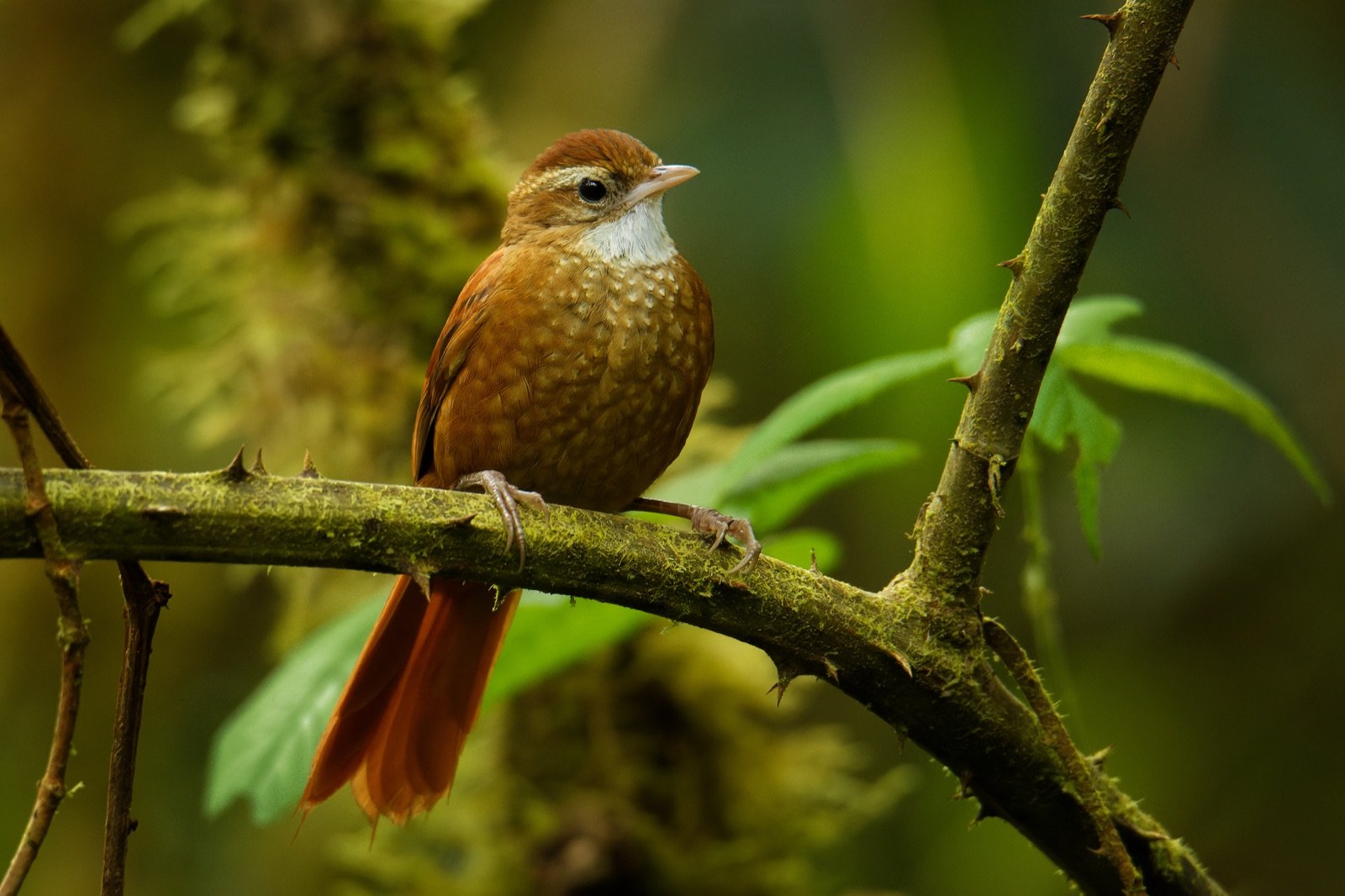
 Ruddy Treerunner
Family Furnariidae
Ruddy Treerunner
Margarornis rubiginosus
In Spanish: Subepalo Rojizo (Chupamusgo)
- Resident
- Regional endemic
Small rufous moss-prober of highland mixed flocks, endemic to Costa Rica and western Panama
The Ruddy Treerunner is a common resident of Costa Rica's high mountains, and it is endemic to the highlands of Costa Rica and western Panama. It is a small, bright rufous bird that works through moss and epiphytes on branches.
It is a bird you find by watching the flock rather than the tree, because it often joins mixed flocks that include bush tanagers.
On a trip we build, you can meet it in mixed flocks in the oak forest of the Savegre Valley, and in the lusher cloud forest at Santa Elena.
How to find it
Check mixed flocks of bush tanagers in highland forest, and look for the treerunner working through moss and epiphyte clumps on branches. Guides on Costa Rica tours have found it by watching mixed flocks in highland oak forest in the Savegre Valley and in cloud forest at Santa Elena. Look for it in canopy flocks that move along trails. A flock may carry it past while other birds linger, so be ready to follow the flock.
How to recognise it
This is a small bird, about 16 cm and 18 g.
Look for these marks:
- bright rufous upperparts
- a white eyebrow stripe
- a white throat
- tawny underparts, with fine pale spots edged in black on the breast
- a flesh colored bill with a dusky base on the upper ridge
Young birds look almost the same as adults, so there are no age plumages to puzzle over. Across its range it looks like a small woodcreeper with a short bill, and its tail ends in soft spines rather than stiff ones.
Behaviour and diet
The Ruddy Treerunner specialises in foraging among epiphytes. It pokes its bill into moss, lichen and dead leaves caught in vines, hunting small insects and spiders, plus their eggs and larvae.
Birds are found alone or in pairs. They often join mixed flocks that include Chlorospingus (bush tanagers).
Where it lives
In Costa Rica this treerunner is a common resident of high mountains. It starts at about 1200 m in the Guanacaste range, 1500 m in Tilarán, and 1850 m in the Central Volcanic and Talamanca ranges, and it reaches the upper forest limit. It ranges lower on the Caribbean slope than on the Pacific slope.
It uses all levels of montane forest up to the mid canopy. It also visits forest margins, scrub, and clearings with scattered trees.
When to see it
Newly fledged young have been seen between May and July at Villa Mills on Cerro de la Muerte. The breeding season is not fully defined across its range, but seems to run from March to May.
Similar birds
At a glance it can be taken for a small woodcreeper, since it climbs in a similar way. The short bill, the white eyebrow stripe and the white throat help set it apart, as do the soft-spined tail tips.
Names and lore in Costa Rica
Besides the AOCR name Subepalo Rojizo, Costa Rican bird lists use the nickname Chupamusgo. One reserve list also gives Trepamusgo Rojizo, and another Spanish name for the species is pijuí rojizo.
Status and conservation
The AOCR lists it as a resident endemic (R-END), and it is rated Least Concern with a stable population.
Photography tips
Watch for canopy flocks moving through the forest along trails, and be ready to follow the flock as it passes, since the treerunner may move on while other birds linger.
How we know this 16 sources, each read on the date shown
- Flickr (natural history text, Costa Rica) read 2026-11-04
https://www.flickr.com/photos/jobando/23469846288 - Wikipedia (Spanish) read 2026-11-04
https://es.wikipedia.org/wiki/Margarornis_rubiginosus - EcoRegistros read 2026-11-04
https://www.ecoregistros.org/ficha/Margarornis-rubiginosus - iNaturalist Mexico checklist read 2026-11-04
https://mexico.inaturalist.org/check_lists/155150-Chirrip--Check-List - Cloudbridge Nature Reserve bird list read 2026-11-04
https://www.cloudbridge.org/wp-content/uploads/2020/04/Especies-de-Aves-Costa-Rica-13-April-2020.pdf - Wikipedia read 2026-11-04
https://en.wikipedia.org/wiki/Ruddy_treerunner - Cornell Birds of the World read 2026-11-04
https://birdsoftheworld.org/bow/species/rudtre1/cur/introduction - Animalia.bio read 2026-11-04
https://animalia.bio/ruddy-treerunner - Field Guides Birding Tours, Costa Rica 2018 trip list read 2026-11-04
https://fieldguides.com/triplists/cos18.html - Field Guides Birding Tours, Costa Rica 2019 trip list read 2026-11-04
https://fieldguides.com/triplists/cos19.html - ArgentiNat read 2026-11-04
https://www.argentinat.org/taxa/10911-Margarornis-rubiginosus - Creagrus Costa Rica trip report read 2026-11-04
http://creagrus.home.montereybay.com/CostaRica07c.html - Fossilworks Ecological Register read 2026-11-04
https://fossilworks.org/?a=taxonPage&genus=Margarornis&species=rubiginosus - Wing and Song blog read 2026-11-04
https://wingandsong.wordpress.com/2009/01/26/birding-savegre-mountain-hotel/ - Tropical Birding read 2026-11-04
https://www.tropicalbirding.com/centralamericacostaricaintrotour - Costa Rica Guide read 2026-11-04
https://costa-rica-guide.com/photos/national-parks-photos/savegre-national-park/