Family Tyrannidae
Rufous Mourner
Rhytipterna holerythra
In Spanish: Plañidera Rojiza
- Resident
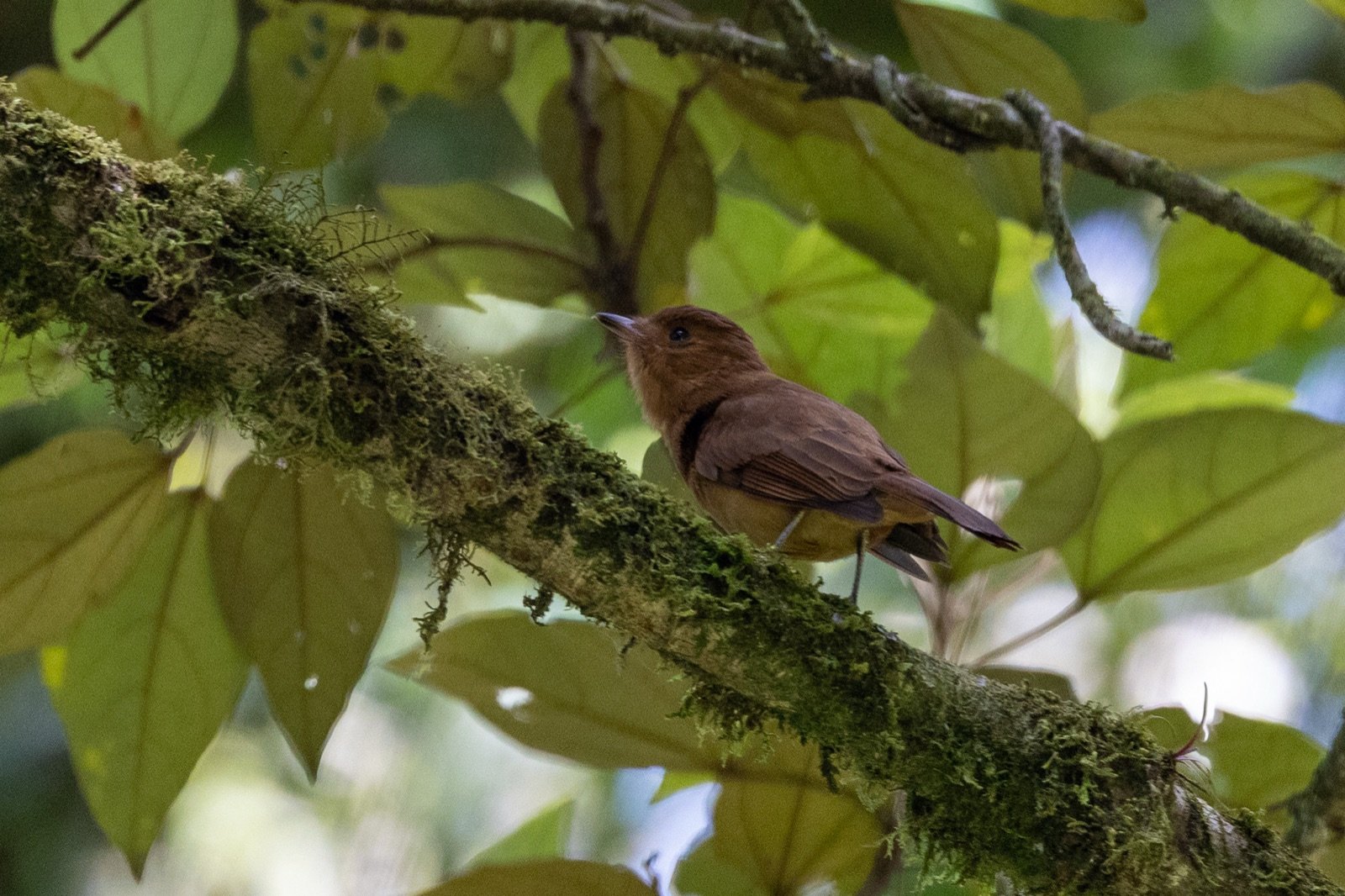
A still, plain rufous bird with a mournful whistle, in humid lowland forest.
The Rufous Mourner (Plañidera Rojiza, Rhytipterna holerythra) is a common resident in the lowlands and foothills of the Caribbean slope. It is a plain rufous bird about 20 cm long, and it is easy to overlook because it spends long spells perched quietly inside the vegetation.
Guided birding groups have met it at La Selva, once in a mixed-species flock with a woodpecker, an antshrike and Great Green Macaws. Look up into the canopy and along the forest edge, and listen for a slow, sad whistle.
How to find it
Look up into the canopy and along forest edges, not only at ground level. Watch for a still, plain rufous bird sitting inside the vegetation, then be ready for a sudden dash after a caterpillar. Mixed-species flocks are worth checking, since it joins them. Listen for the slow whistle, because you may hear it more than you see it. A guided group saw it well on the La Selva entrance road on a first morning of birding.
How to recognise it
Think plain rufous, about 20 cm long.
Cinnamon-brown above, brighter cinnamon below, with a darker breast.
Wings browner than the body.
Bill slightly hooked and black, with a pale base on the lower part.
Males and females look alike.
Juveniles are brighter rufous above and paler, buffy cinnamon below than adults.
With no bold marks to lean on, the overall rufous colour, the pale bill base and the habit of sitting very still do the work.
What it sounds like
Recording: Ryan F. Mandelbaum, CC BY 4.0, source, read 4 Nov 2026.
Behaviour and diet
It is often seen alone or in family groups, and sometimes joins mixed-species flocks. It perches on twigs inside the vegetation, looking around and sometimes tilting its head at odd angles. Then it darts out suddenly to grab large, slow caterpillars from the foliage. On an October Caribbean slope tour it was among the birds in busy flocks that moved through all levels of the forest. Breeding in Costa Rica is recorded from March to June, and it mostly nests in tree cavities such as old woodpecker holes.
Where it lives
In Costa Rica it ranges from sea level up to about 1,200 m. It lives in humid evergreen forest and mature secondary forest in the lowlands, in the canopy and at forest edges, in nearby older secondary forest and in tree plantations. It is common on the Caribbean slope. On the Pacific side it is found in the south, and it reaches that side through low passes in the Guanacaste mountain range. It is absent from the northwest lowlands and the Central Valley.
Similar birds
The Rufous Piha (Lipaugus unirufus) is the bird most easily confused with it. The mourner is smaller and slimmer, with a relatively longer tail and a pale base to the bill. The piha is slightly bigger, with a bushier face and paler throat, and its voice is very different from the mourner's.
Names and lore in Costa Rica
In Costa Rica it is called Plañidera Rojiza. Other Spanish names used elsewhere include plañidera rufa (Panama, Colombia, Ecuador) and mosquero canelo or plañidera alazán (Mexico).
Status and conservation
Listed as a resident (R) on the AOCR list, it is considered fairly common in Costa Rica and is Least Concern globally, though the population is thought to be declining.
Photography tips
It favors the middle and upper levels inside forest and sits still for long periods, so patience pays. A scope helps, since a digiscoped photo was taken at La Selva.
How we know this 18 sources, each read on the date shown
- Aves de Costa Rica read 2026-11-04
https://avesdecostarica.com/Rhytipterna-holerythra.html - Wikipedia read 2026-11-04
https://en.wikipedia.org/wiki/Rufous_mourner - Wilson Journal of Ornithology read 2026-11-04
https://bioone.org/journals/the-wilson-journal-of-ornithology/volume-129/issue-3/16-147.1/The-Nest-and-Eggs-of-the-Rufous-Mourner-Rhytipterna-h/10.1676/16-147.1.short - EcoRegistros read 2026-11-04
https://www.ecoregistros.org/ficha/Rhytipterna-holerythra - Aves en azul y verde read 2026-11-04
https://avesazulyverde.blogspot.com/2020/04/costa-rica-v-volcan-arenal.html?m=1 - Birda read 2026-11-04
https://app.birda.org/species-guide/17861/Rufous_Mourner - Flickr (Aves de Costa Rica natural history text) read 2026-11-04
https://www.flickr.com/photos/jobando/31696277663 - Field Guides Birding Tours, Costa Rica 2019 trip list read 2026-11-04
https://fieldguides.com/triplists/cos19.html - Eagle-Eye Tours, Costa Rica Sampler 2022 trip report read 2026-11-04
https://www.eagle-eye.com/blog/costa-rica-sampler-2022-trip-report/ - Eagle-Eye Tours, Caribbean Mountains to Coast October 2021 read 2026-11-04
https://www.eagle-eye.com/blog/costa-rica-caribbean-mountains-to-coast-october-2021/ - Birds of Passage blog read 2026-11-04
https://birdsofpassage.wordpress.com/2014/05/11/monteverde-costa-rica/ - Field Guides Birding Tours, Costa Rica 2017 trip list read 2026-11-04
https://fieldguides.com/triplists/cos17.html - Wikipedia (es) read 2026-11-04
https://es.wikipedia.org/wiki/Rhytipterna_holerythra - Dibird read 2026-11-04
https://dibird.com/species/rufous-mourner/ - Flickr, species description read 2026-11-04
https://www.flickr.com/photos/crunchie-carruthers/54456891103 - Cornell Birds of the World summary read 2026-11-04
https://www.hbw.com/ibc/species/rufous-mourner-rhytipterna-holerythra - STRI Research Portal read 2026-11-04
https://panamabiota.org/stri/taxa/index.php?taxauthid=1&taxon=3604&clid=6 - Flickr read 2026-11-04
https://www.flickr.com/photos/antpitta/36322334956/