Family Cotingidae
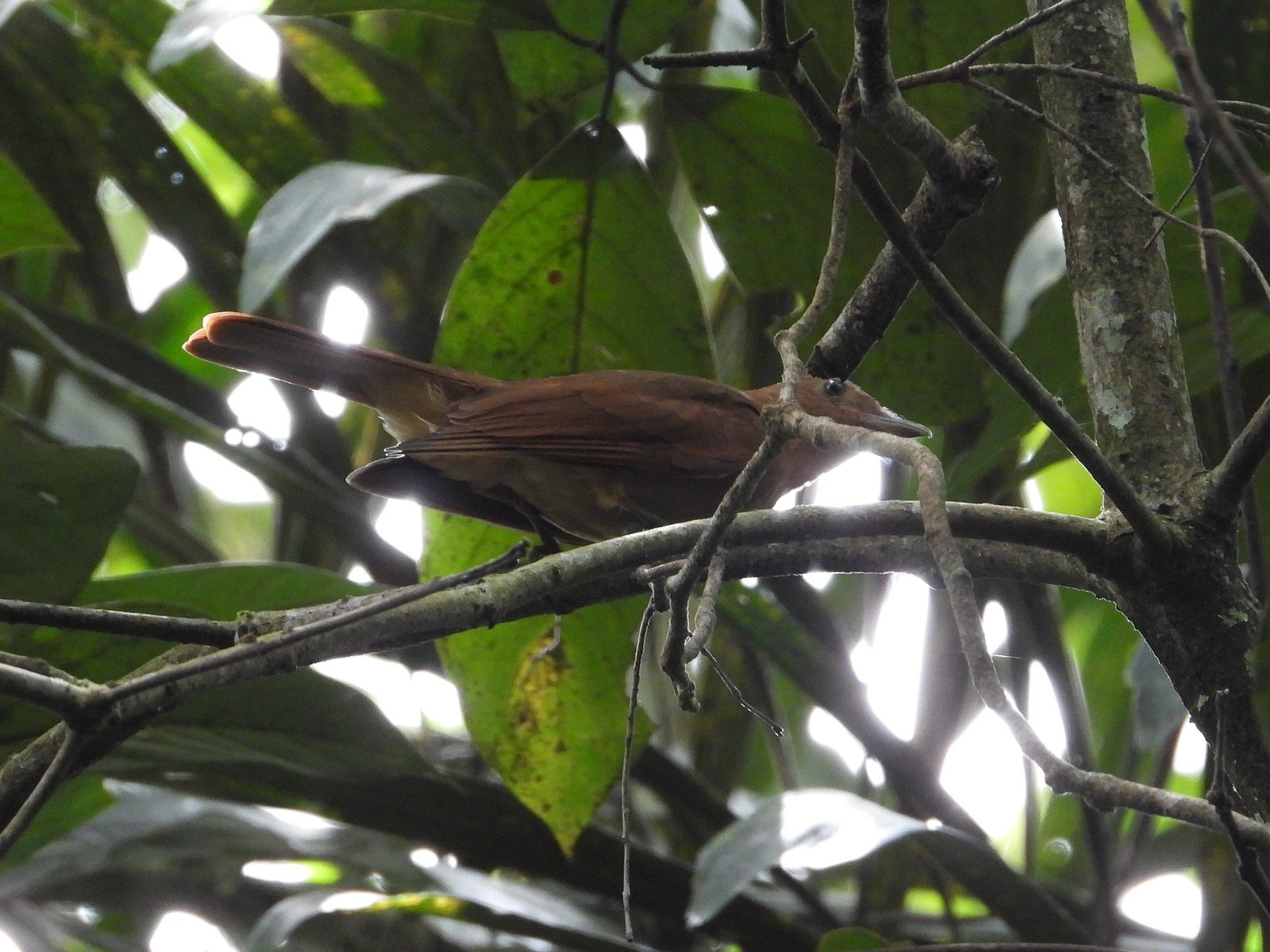
Rufous Piha
Lipaugus unirufus
In Spanish: Piha Rojiza
- Resident
A cinnamon forest bird you will hear long before you see it.
The Rufous Piha (Piha Rojiza, Lipaugus unirufus) is a bird you meet with your ears first. Its song is easier to notice and recognise than the bird itself, because it is so well camouflaged in the forest.
In Costa Rica it lives in humid forest from sea level up to about 1,200 m, on the Caribbean slope and, separately, on the Pacific slope. It is fairly common on the Pacific side and uncommon on the Caribbean side.
On a trip we build, it is a forest bird of the Pacific south and the Caribbean side, so learning its voice is the best way in.
How to find it
Listen first: the call is a loud whistled 'pee-hah' that carries through the trees. A hand clap or other sharp noise may prompt it to call. Calls come at long, unpredictable gaps, so give each spot time. Look in the middle and lower levels of humid forest, where it perches leaning forward before darting out for fruit. Carara National Park is named as a target species site in a Costa Rica birding guide.
How to recognise it
The adult is about 23.5 cm long, and males and females look alike.
The upperparts are an even reddish cinnamon. The underparts are a little paler, with the throat palest of all. The bill is broad.
A Costa Rican natural history text describes it as nearly uniform rufous, with the size and shape of a Turdus thrush but a bigger head and a thicker bill. It calls it more robust than the Rufous Mourner. The overall build is compact and small-headed, which gives it a thrush-like look.
Because the plumage is so plain and so well matched to the forest, shape, bill and colour tone are what to note if you do get a view.
What it sounds like
Recording: Niels Krabbe, CC BY-SA 4.0, source, read 5 Nov 2026.
Behaviour and diet
The piha perches for long spells leaning forward and looking around, then darts out to snatch a fruit, insect or spider from leaves, often hovering briefly.
It rarely drops to the ground, and when it takes food there it flies back up to eat it.
Males and females do not form pairs. Birds usually live in small, scattered groups, not tight flocks. The species is polygynous, and males apparently court females.
Where it lives
The Rufous Piha lives in the middle and lower levels of humid forest. In Costa Rica it ranges from sea level up to about 1,200 m.
It occurs on the Caribbean slope and separately on the Pacific slope, from central Costa Rica south into Panama. A Costa Rican natural history account says it climbs slopes to about 600 m in the northern and central areas, while in the south, on both slopes, it reaches about 1,200 m.
When to see it
Breeding in Costa Rica runs from March to August. The female builds the nest alone, a light cup on thin horizontal branches 5 to 10 m up, and lays one egg.
Similar birds
It looks like the Rufous Mourner, but the piha has a compact, small-headed, thrush-like shape, not the flycatcher look of the mourner. It is also browner, with a contrast between the back and wings and the front.
Names and lore in Costa Rica
In Costa Rica the bird goes by Piha Rojiza or Pía Rojiza. Elsewhere in its range it is also called Guardabosques Rojizo or Guardabosques Rufo.
Status and conservation
The AOCR official list gives it as a resident species; it is fairly common on the Pacific slope, uncommon on the Caribbean slope, and rated Least Concern by IUCN.
How we know this 17 sources, each read on the date shown
- Birds Colombia (Wikipedia text) read 2026-11-04
https://birdscolombia.com/2018/04/22/guardabosque-rufo-rufous-piha-lipaugus-unirufus/ - Cornell Birds of the World read 2026-11-04
https://birdsoftheworld.org/bow/species/rufpih1/cur/introduction - Flickr (Costa Rica natural history text) read 2026-11-04
https://www.flickr.com/photos/jobando/49045726753 - Wikipedia read 2026-11-04
https://en.wikipedia.org/wiki/Rufous_piha - EcoRegistros read 2026-11-04
https://www.ecoregistros.org/ficha/Lipaugus-unirufus - Aves Ibericas read 2026-11-04
https://www.avesibericas.es/costaricaaves7.htm - PlanetScott read 2026-11-04
http://www.planetscott.com/speciesdetail/4471/rufous-piha-(lipaugus-unirufus) - AOCR Lista Oficial read 2026-11-04
https://listaoficialavesdecostarica.wordpress.com/lista-oficial/lista-oficial-online/ - Cornell Birds of the World read 2026-11-04
https://birdsoftheworld.org/bow/species/rufpih1/cur/sounds - Hotel Rivel blog read 2026-11-04
https://hotelrivel.online/a-flash-of-rust-in-the-rainforest-unveiling-the-rufous-piha/ - Birdingcraft read 2026-11-04
https://birdingcraft.com/wordpress/tag/birding/page/21/ - Birds of Costa Rica (birdsofcolombia.org) read 2026-11-04
https://www.birdsofcolombia.org/costarica/Lipaugus.html - Wickersham's Conscience read 2026-11-04
https://wickershamsconscience.wordpress.com/2024/11/16/return-of-bird-of-the-week-rufous-piha/ - Bird Songs of Las Cruces Biological Station read 2026-11-04
https://tropicalstudies.org/sonidosaveslc/Bird%20Songs%20of%20LCBS-recording%20info%20&%20credits.pdf - Wikipedia (es) read 2026-11-04
https://es.wikipedia.org/wiki/Lipaugus_unirufus - EcoRegistros read 2026-11-04
https://www.ecoregistros.org/sheet/Lipaugus-unirufus - Wikipedia (translated view) read 2026-11-04
https://en-wikipedia-org.translate.goog/wiki/Rufous_piha?_x_tr_sl=en&_x_tr_tl=es&_x_tr_hl=es&_x_tr_pto=tc