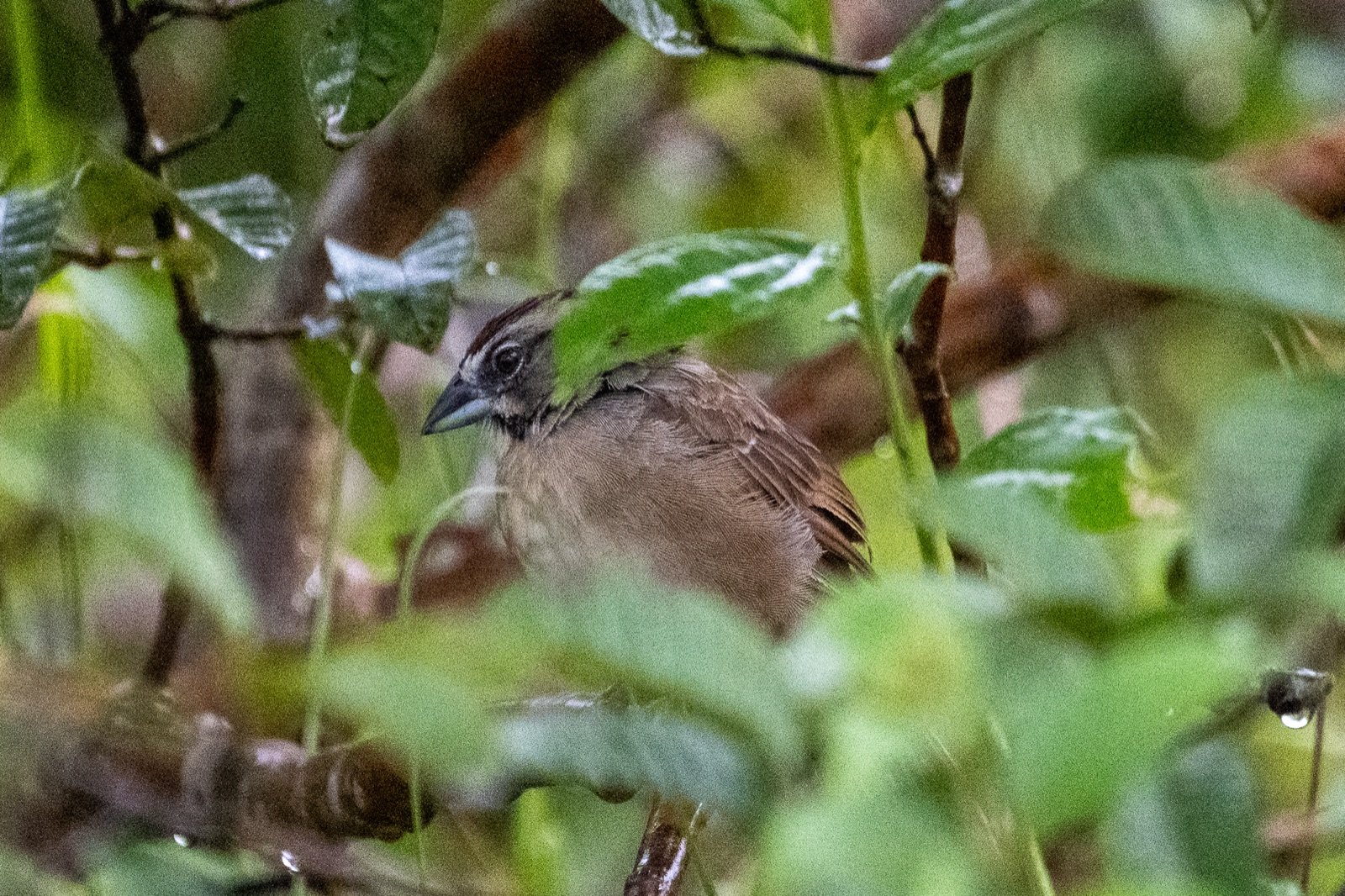
Family Passerellidae
Rusty Sparrow
Aimophila rufescens
In Spanish: Sabanero Rojizo
- Resident
Uncommon chestnut-crowned sparrow of stony, bushy hillsides; listen for the singer.
The Rusty Sparrow (Sabanero Rojizo, Aimophila rufescens) is a large sparrow with a chestnut crown. In Costa Rica it is a bird of open, stony hillsides rather than of the forest itself, and it is uncommon and local, which suits a birder who enjoys a little detective work.
Two areas matter. The usual population lives on the Pacific slope of the Cordillera de Guanacaste in the northwest. A separate, isolated group lives in the mountains south of San José, near San Ignacio de Acosta.
On a trip we build, visitors can look for it around Acosta, where thick forest surrounds the stony, bushy openings it prefers, and in the grassland of Rincon de la Vieja National Park. Listen for the singer first.
How to find it
Listen for the singing male first, since in the morning he perches high and sings steadily. At Rincon de la Vieja the sparrows live in grassland reached by the long Waterfall Trails, and by the time a hiker gets there the birds are probably no longer active, so go early. In Acosta, check pastures, bean fields, scrub and tangled vines. Birders reach the San José population by driving rural roads south of the capital through Acosta, and a local guide helped in one reported trip. Near Bijagua, two local guides took a back road from the Bagaces area and found one on a log beside the road.
How to recognise it
This is a large sparrow, about 16 to 20 cm long across its range. Look for these marks:
A chestnut crown streaked black, with a thin pale central stripe.
A white eye-ring.
A dark stripe on the side of the throat.
Costa Rican text describes two black lines from the base of the bill, one over the eye and one down the side of the throat, and says the sexes look alike.
Juveniles are duller and buffier than adults. They have a brown crown with black streaks and a pale yellowish wash on the breast and flanks, so a plainer bird with that wash is likely a young one.
Behaviour and diet
In Costa Rica it feeds on the ground, usually alone or in pairs, and it is known to eat seeds and small invertebrates. It forages mostly by hopping and also searches for insects in low foliage. It flies in a jerky way and flicks its tail up and down.
In the morning the male perches on a high branch and sings steadily. The rest of the time it usually stays low in shrubs and thickets, so the singer is the first thing to find.
Where it lives
In Costa Rica it sticks to grassy slopes dotted with boulders, dense shrubs and small trees. The habitat is not the forest itself but the stony hillsides next to forest, with bushes and scattered trees. It also likes pastures with scattered trees and some dense thickets.
In Acosta it uses open ground such as pastures and bean fields, plus patches of secondary growth like scrub and tangled vines. Its recorded Costa Rican elevation is about 500 to 1,100 m, and the Guanacaste birds sit at roughly 600 to 900 m.
When to see it
A Costa Rica birding guide says July may be the best month at Rincon de la Vieja, when there is less wind and the uncommon Rusty Sparrow is easier to find than in other months.
Similar birds
Rufous-crowned and Oaxaca Sparrows are the birds to compare. Rusty has a larger bill, fainter back markings, and brighter edges on the tertials in good light.
Names and lore in Costa Rica
The Costa Rican Spanish name is Sabanero Rojizo. Other Spanish names used elsewhere include Zacatonero Canelo and Zacatonero Rojizo, and the Mexican Nahuatl name is ilamatōtōtl. A Costa Rican local paper links the sparrow to the family of buntings and calls it a relative of the Comemaíz, the Spanish name for a seed-eating finch.
Status and conservation
The AOCR lists it as a resident (R); it is considered rare in Costa Rica and uncommon even in its usual Guanacaste area, though the IUCN rates it Least Concern.
Photography tips
Because the male sings from a high perch in the morning, that is the best moment for a clear view. The rest of the time the bird hops on the ground and works low foliage, so patience at the edge of a thicket helps. A jerky flight and a flicking tail can help you pick it out. At one Acosta site the photographer got good close-up shots of one of three birds found.
How we know this 12 sources, each read on the date shown
- Wikipedia (via iNaturalist) read 2026-11-04
https://www.inaturalist.org/taxa/9978-Aimophila-rufescens - Birds for Beer (Paul Pickering) read 2026-11-04
https://birdsforbeer.com/2016/07/19/rusty-sparrow/ - Mr Birding Guide read 2026-11-04
https://mrbirdingguide.school.blog/2020/08/17/en-busca-de-un-ave-con-la-cabeza-oxidada/ - BioFotos read 2026-11-04
https://biofotos.org/DetalleAves.aspx?Cod=917 - EcoRegistros read 2026-11-04
https://ecoregistros.org/sheet/Aimophila-rufescens?-rufescens= - Cornell Birds of the World read 2026-11-04
https://birdsoftheworld.org/bow/species/russpa1/cur/introduction - Birding Craft (Costa Rica bird finding guide) read 2026-11-04
https://birdingcraft.com/wordpress/category/costa-rica-bird-finding-guide/ - El Jornal (Acosta) read 2026-11-04
http://eljornalcr.com/el-sabanero-rojizo-visto-en-acosta/ - Tripadvisor Costa Rica Forum read 2026-11-04
https://www.tripadvisor.com/ShowTopic-g291982-i813-k11319623-o40-Where_to_go_in_Costa_Rica_to_see_the_birds_you_want_to_see-Costa_Rica.html - Birding Craft (Guanacaste) read 2026-11-04
https://birdingcraft.com/wordpress/category/guanacaste/ - Wikipedia read 2026-11-04
https://en.wikipedia.org/wiki/Rusty_Sparrow - Flickr (Historia Natural text) read 2026-11-04
https://www.flickr.com/photos/jobando/32654525136