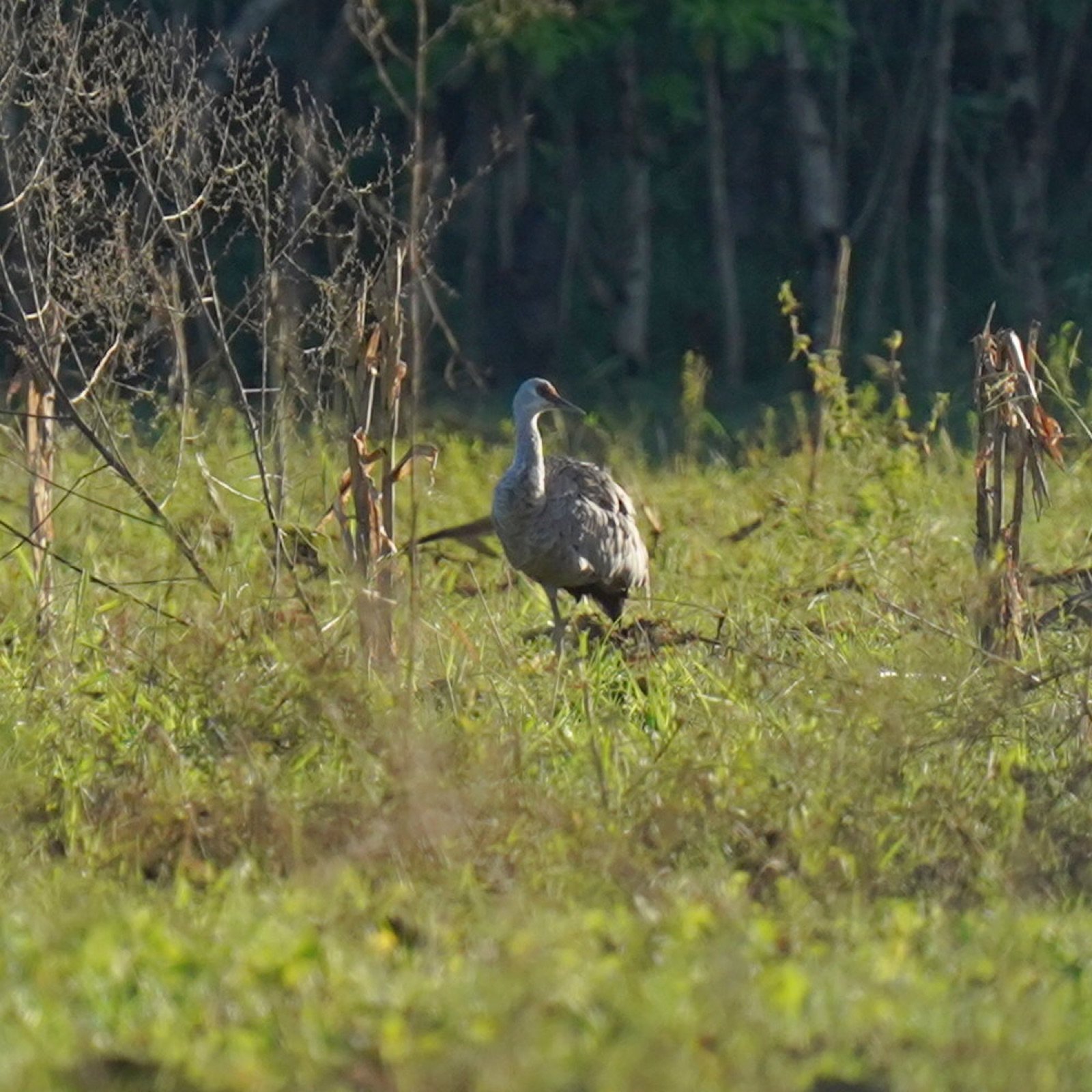
Family Gruidae
Sandhill Crane
Antigone canadensis
In Spanish: Grulla Gris
- A
A tall gray vagrant that overwintered in Costa Rican farm fields in 2025 and 2026.
The Sandhill Crane (Grulla Gris) is not a bird you plan a trip around. It is the only member of the crane family on the official Costa Rican bird list, where it carries status code A.
A November 2025 birding blog calls a crane seen that month the first documented record for Costa Rica, and a trip report calls it the first Sandhill Crane for Central America. It is a vagrant, a stray far from its normal range, not a resident or a regular visitor.
That is what makes it worth knowing. This page shows what the bird looks like, how to tell it from a heron, and where the Costa Rican bird was found, so a rare-bird report makes sense when you read one.
How to find it
Treat any search as a long shot, because this is a vagrant and not a regular visitor. Look in open, wet farm fields, where the Costa Rican bird was found, rather than in forest. In January 2026 the crane was still being reported from farm fields near Mistico. The birders who found it were led on foot a few hundred meters to the spot. Scan open ground for a tall gray bird and listen for the loud, low, carrying call. In flight, a crane holds its neck stretched out straight, which helps pick it out.
How to recognise it
Look for a tall, long-legged gray bird that looks a bit like a heron. These marks describe the species in general:
- Adults wear a red crown, a red patch on the head.
- The cheek is white.
- The bill is long, dark and pointed.
- Some birds look rust-colored, because they work iron-rich water into their feathers with the bill. Staining on the body feathers can make a gray bird look rusty-brown.
- Young birds lack the red forehead and have reddish-brown upperparts with gray underparts.
The finder of the Costa Rican bird first took it for just another Great Blue Heron. It looked more evenly colored than that heron, with a reddish or rusty front.
What it sounds like
Behaviour and diet
Across its range the Sandhill Crane is an omnivore that probes the ground with its bill. Cultivated grains are its main food on migration and in winter, and it also eats seeds, berries, insects and small animals.
Birds gather in large flocks at migration stopovers and wintering sites, and pairs mate for life and stay together year-round. That social side is why the Costa Rican bird stood out. A birder who watched it saw it shed feathers and call often, and thought it looked restless and lonely, since cranes are normally social, dancing birds.
Where it lives
In migration and winter the species uses shallow wetlands, lake edges, harvested crop fields, hayfields and pastures. That describes its habits across its range rather than Costa Rica in particular.
In Costa Rica the bird was found in an open, wet farm field near Mistico. A Costa Rican guide notes that the species normally winters no farther south than central Mexico, which puts a bird here a long way off course.
When to see it
The first documented Costa Rican crane arrived around mid-November 2025. A guide wrote that it might have left, but it was reported again in January 2026, so it overwintered. A trip report covering 17 November to 4 December 2025 records birders seeing it in that period.
Similar birds
The bird most likely to be confused with a crane here is a heron, since Costa Rican sources describe the crane as heron-like. In flight the difference is easy to see. Cranes hold the neck stretched out straight, while herons fold the neck back into an S shape. Cranes also have shorter bills than herons, and drooping feathers over the rear end that herons lack.
Names and lore in Costa Rica
The official Spanish name is Grulla Gris. A Costa Rican bird site also uses Grulla Canadiense as an alternative, and lists the crane among its newest species uploads, with a photo taken at Tárcoles.
Status and conservation
The official Costa Rican bird list includes the Sandhill Crane with status code A and does not mark it as a resident or regional endemic, while across its range the IUCN rates it Least Concern.
Photography tips
The crane fed in quite long vegetation in a wet field, and visitors had to walk some distance from the farm. Once found, birders watched and photographed it for a while. Birders who went the day after the discovery got no close looks, and some saw it only in flight, so a long lens and patience help.
How we know this 12 sources, each read on the date shown
- Lista Oficial de las Aves de Costa Rica (AOCR) read 2026-11-04
https://listaoficialavesdecostarica.wordpress.com/lista-oficial/lista-oficial-online/ - Aves de Costa Rica read 2026-11-04
https://avesdecostarica.com/Antigone-canadensis.html - Wikipedia read 2026-11-04
https://en.wikipedia.org/wiki/Sandhill_crane - US Fish and Wildlife Service read 2026-11-04
https://www.fws.gov/species/sandhill-crane-grus-canadensis - Cornell Lab, All About Birds read 2026-11-04
https://www.allaboutbirds.org/guide/Sandhill_Crane/overview - Birding Craft (Costa Rica Birding News) read 2026-11-04
https://birdingcraft.com/wordpress/2025/11/23/november-december-costa-rica-birding-news/ - Birding Craft (Costa Rica Birding News) read 2026-11-04
https://birdingcraft.com/wordpress/author/admin/page/3/ - Birding Craft read 2026-11-04
https://birdingcraft.com/wordpress/tag/sandhill-crane-in-costa-rica/ - Caligata trip report read 2026-11-05
https://www.caligata.com/tripreports/costa-rica-xi-xii-2025-2 - Costa Rica Living and Birding read 2026-11-05
https://birdingcraft.com/wordpress/2025/11/16/a-new-and-unexpected-bird-for-costa-rica/ - Sacramento Audubon Society read 2026-11-05
https://www.sacramentoaudubon.org/kids-corner/meet-the-sandhill-crane - EcoRegistros read 2026-11-05
https://www.ecoregistros.org/ficha/Antigone-canadensis?sp=Grus-canadensis-pratensis