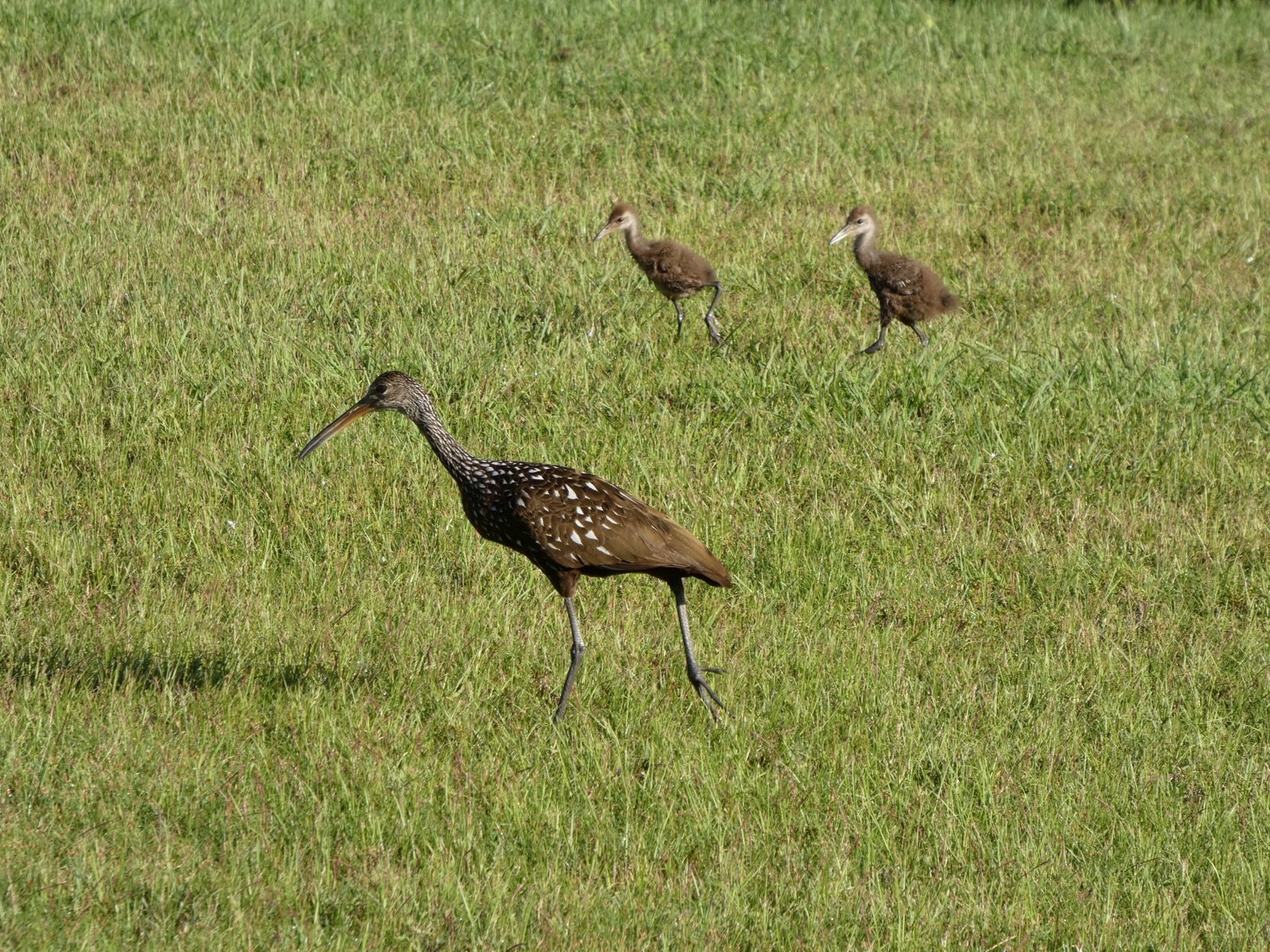
 Limpkin
Family Aramidae
Limpkin
Aramus guarauna
In Spanish: Carao (Correa)
- Resident
A heron-shaped wetland bird with a wild wail and a taste for apple snails
The Limpkin looks like a large heron or ibis, yet it is more closely related to rails and cranes. In Costa Rica it is a resident of open freshwater wetlands, and its voice often reaches you before the bird does.
It is most numerous, at least in some seasons, in the Tempisque River basin and the Río Frío region. On a trip we build to the largest wetland in Costa Rica, on the northern plains near the Nicaragua border, Limpkins are seen from the water, from a canoe, kayak or small flat-bottomed boat.
That slow drift past the banks is a gentle way for a beginner to meet a bird that is hard to spot but easy to hear.
How to find it
Look along oxbows, quiet river backwaters, marsh edges and lake shores where large snails live. Calls at dawn and dusk are often the first clue, so listen first, then scan the likely edges. Where apple snails are present, Limpkins tend to be found. Boat, canoe or kayak trips in the northern wetlands let you drift past sandy banks where other waders live alongside the Limpkin. Check old logs and banks for piles of empty snail shells, since Limpkins bring snails to favorite spots.
How to recognise it
Think of a heron, then adjust.
- Shape: heron-like, but the neck is shorter and thicker.
- Size: about 66 cm long.
- Bill: long, flattened from the sides and slightly curved. Range-wide it is described as yellowish and curving gently downward. The tip often bends slightly right, which helps with a snail's coiled shell.
- Plumage: brown with white spots and streaks, densest on the head and neck.
Costa Rican birds belong to the 'Speckled Limpkin' group, heavily streaked over the head and neck. The darker 'Brown-backed' form lives in South America and central and eastern Panama, and the two may meet in Panama.
What it sounds like
Behaviour and diet
Limpkins are alert and solitary in Costa Rica, and they often call loudly once an observer comes into view. They are usually seen alone or in pairs. They walk slowly in search of snails, carry each one to a favorite spot and pick the shell open to eat the flesh. Piles of empty shells around an old log or on a bank show where one has been feeding. It can also feed at night, especially under a bright moon. In Costa Rica it makes clear local movements that follow changes in water levels.
Where it lives
The Limpkin lives in open freshwater marshes, ponds, river edges and sometimes swamps with trees. In Costa Rica it is most numerous, at least in some seasons, in the Tempisque River basin and the Río Frío region. It is local elsewhere in Guanacaste and on the north Caribbean slope, and rare and sporadic in the lowlands of other regions. It reaches 1500 m in the Central Valley. Its range has been growing south along the Pacific lowlands to southern Costa Rica and into Panama since the early 2000s.
When to see it
In Costa Rica it breeds from the middle of the rainy season into the early dry season.
Similar birds
People often take it for a brown heron, but it is not related to herons. It belongs to its own family, Aramidae, which is closest to cranes and rails. Compared with a heron, look for the shorter, thicker neck, the white streaking on the head and neck, and the long curved bill. At a glance it can also pass for an ibis.
Names and lore in Costa Rica
Costa Rican bird listings give three common names: correa, garza morena (brown heron) and carao. The AOCR list uses Carao (Correa). The names show how often people liken it to a heron.
Status and conservation
The AOCR list gives the Limpkin as a resident (R), and it is a resident species in Costa Rica with local movements that follow water levels.
Photography tips
Watch a bird that has caught a snail. It walks up onto dry ground, sets the snail down and shakes the flesh out in a few quick motions, a good moment for a photo or an observation. Calls at dawn and dusk help you find it first.
How we know this 20 sources, each read on the date shown
- Flickr (quoting Costa Rican species account) read 2026-11-04
https://www.flickr.com/photos/jobando/35715954292 - Flickr (Yeray Sáenz) read 2026-11-04
https://www.flickr.com/photos/ysaenz/6861171258/ - Birdfinding.info read 2026-11-04
https://birdfinding.info/limpkin/ - Flickr (Limpkin description) read 2026-11-04
https://www.flickr.com/photos/crunchie-carruthers/54159274668/ - Animal Diversity Web read 2026-11-04
https://animaldiversity.org/accounts/Aramus_guarauna/ - Naturalist Wiki read 2026-11-04
https://naturalist.fandom.com/wiki/Limpkin_(Aramus_guarauna) - Wikipedia read 2026-11-04
https://en.wikipedia.org/wiki/Limpkin - Aves de Costa Rica read 2026-11-04
https://avesdecostarica.com/Aramus-guarauna.html - C-Ludik read 2026-11-04
https://c-ludik.fr/en/north-and-central-america/costa-rica-en/cano-negro-refuge-teeth-feathers-along-water/ - Bird Photography read 2026-11-04
https://birdphotography.com/species-guides/limpkin/ - Historia natural del carau (ResearchGate) read 2026-11-04
https://www.researchgate.net/publication/331162611_Historia_natural_del_carau_Aramus_guarauna - All About Birds (Cornell Lab) read 2026-11-04
https://www.allaboutbirds.org/guide/Limpkin/sounds - Wild Atlas Guide read 2026-11-04
https://wildatlasguide.com/es/birds/carrao/ - GBIF read 2026-11-04
https://www.gbif.org/taxon/G532 - Avibase read 2026-11-04
https://avibase.bsc-eoc.org/species.jsp?avibaseid=316C4CCFAC7F68F5 - Costa Rica Focus read 2026-11-04
https://www.costaricafocus.com/best-birding-lodges-costa-rica/ - Animalia.bio read 2026-11-04
https://animalia.bio/es/limpkin?environment=13 - Aves de Puerto Rico read 2026-11-04
https://avespuertorico.com/sonidos/sonido-de-la-gallareta-y-el-pollo-de-mangle - El Universo read 2026-11-04
https://www.eluniverso.com/larevista/ecologia/el-carrao-ave-montuvia-habitante-de-los-humedales-y-pajones-de-la-costa-ecuatoriana-nota/ - Cannundrums read 2026-11-04
http://cannundrum.blogspot.com/2018/02/limpkin.html