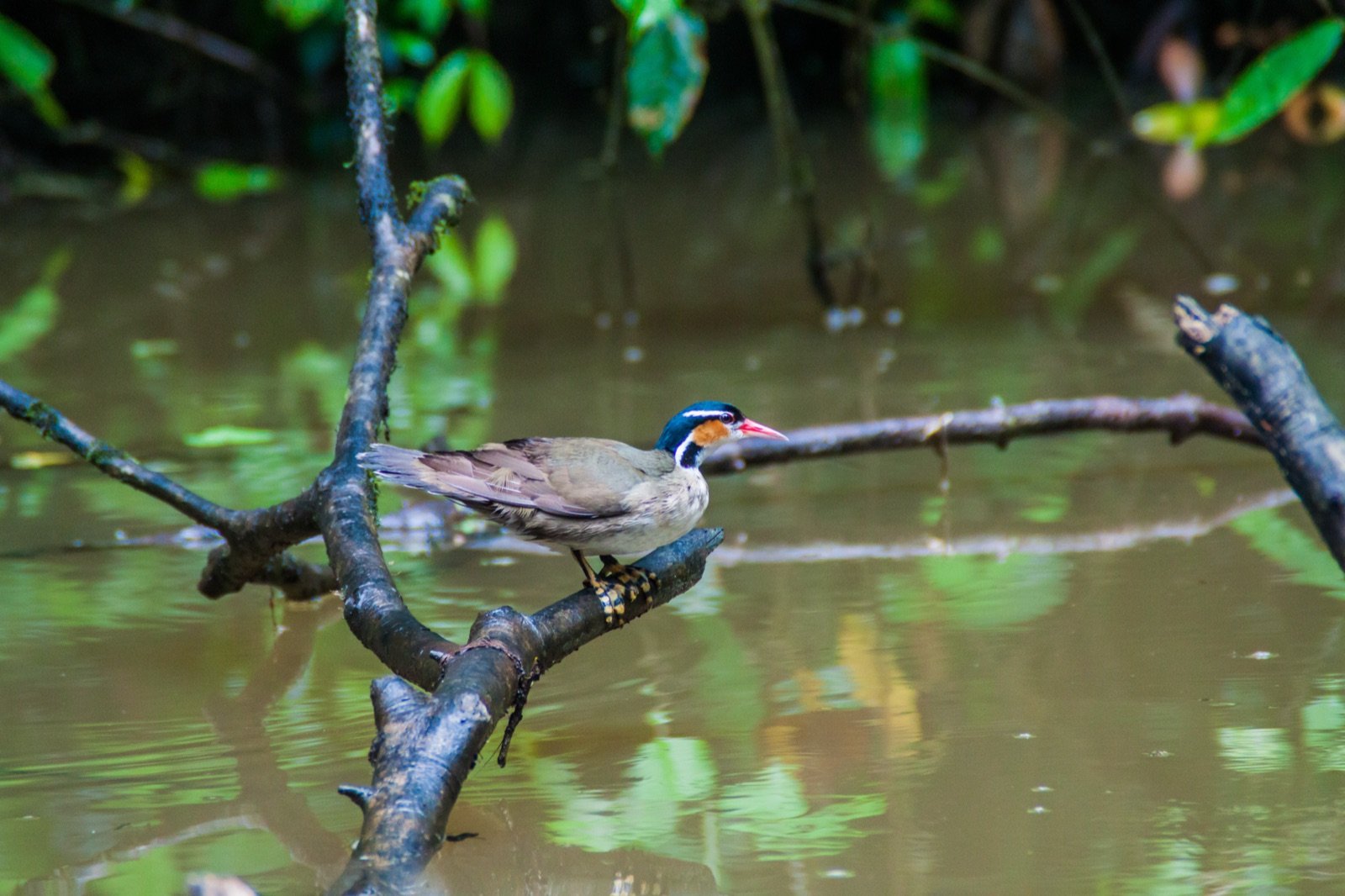
 Sungrebe
Family Heliornithidae
Sungrebe
Heliornis fulica
In Spanish: Pato Cantil (Perrito de Agua, Toboba)
- Resident
A shy, striped-headed swimmer of quiet lowland rivers and canals.
The Sungrebe (Pato Cantil) is a small, slender water bird with bold black and white stripes on its head and neck. It is described as one of the hardest water birds to see in Costa Rica, because it keeps to shaded banks and swims low with only its head and neck showing.
In Costa Rica it is local and patchy, reported mainly in the north and the Caribbean regions. On a trip we build, guests meet it from boats on the canals and rivers of the Caribbean slope, such as Tortuguero, and in the northern plains.
The Costa Rican bird list gives it resident status, and it is the only member of its family recorded in the country.
How to find it
Look along the shaded edges of quiet waterways for a low-swimming bird with only head and neck showing. Boat trips on quiet side channels with overhanging vegetation in Tortuguero are described as the best chance. The northern plains in the wet season are also productive. One tour itinerary lists a river boat trip there as a chance for Sungrebe, if water levels are not high. A 2024 Tortuguero study found none in the busy park canals, where they had been confirmed in 2021 and 2022, but three upriver on the Río Penitencia. Boat traffic may disturb them, so ask your guide about quieter stretches.
How to recognise it
The Sungrebe is about 28 cm long and slender.
Look for these marks:
- Head and neck with bold black and white stripes.
- Back olive brown.
- Belly white.
- Tail blackish with a pale tip.
Across its range, males have plain white cheeks and females have orangey cheeks, so check the face if you get a clear view. The feet have broad lobes banded in yellow and black, a clear field mark when visible. Seeing them is uncommon, since the bird usually shows only head and neck above the water.
Behaviour and diet
The Sungrebe swims with a forward and back motion of the head and seldom dives. It stays close to banks with dense roots, fallen logs or hanging plants.
It hunts by searching the dense bank vegetation. Males have skin folds under the wings used to protect and carry chicks. Across its range, a frightened bird often slips into overhanging cover rather than flying. It can climb up the bank into the vegetation, rests at midday and sleeps at night on branches hanging over the water.
Where it lives
In Costa Rica this is a lowland bird, from sea level to about 600 m, rarely to 800 m, with most records below 300 m. It lives on streams, rivers and swamps, mostly in wooded country with logs and tangles.
It likes dense vegetation hanging over the water and avoids fast currents, so it is absent from the mountains. It is local and patchy, found in the northern plains, the canals and rivers of the Caribbean slope, and the Osa Peninsula in the south Pacific.
When to see it
Breeding starts at the beginning of the rainy season, and one source says it is easier to detect from May to August, when it is more vocal. The early wet season is also said to give the best water levels for finding it.
Similar birds
The Sungrebe is similar in size to the Least Grebe (pato de agua), but it looks bigger because of its longer pointed wings and broad tail. Young grebes have a different head pattern, short wings and no visible tail. At a distance it looks like a grebe, though it is more closely related to the rails. It is also not the Sunbittern, which can live along rocky streams, while the Sungrebe needs slow lowland rivers and wetlands.
Names and lore in Costa Rica
Costa Rican names for the Sungrebe include pato cantil, perrito de agua and toboba. One source also lists punpún and avesol americano.
Status and conservation
The Costa Rican bird list gives the Sungrebe resident (R) status, and it is Least Concern worldwide.
Photography tips
Sungrebes usually stay behind brush along canals, out of the sun and away from people, which made them very difficult to photograph at Tortuguero. A Costa Rican photo guide says it is uncommon to see one perched where its patterned feet are visible. Photos from Tortuguero show one swimming with its head leaning forward like a coot.
How we know this 20 sources, each read on the date shown
- AvesTikas read 2026-11-04
https://avestikas.com/2022/04/20/heliornis-fulica/ - Parques Nacionales de Costa Rica (areasyparques.com) read 2026-11-04
https://areasyparques.com/peligroextincion/pato-cantil-perrito-de-agua/ - Aves de Costa Rica read 2026-11-04
https://avesdecostarica.com/Heliornis-fulica.html - Birds for Beer read 2026-11-04
https://birdsforbeer.com/2022/02/11/sungrebe-a-new-species-for-cartago-province/ - Costa Rica Focus read 2026-11-04
https://www.costaricafocus.com/bird-species/sungrebe/ - Área de Conservación Tortuguero (ACTO) read 2026-11-04
https://www.acto.go.cr/estudio-del-pato-cantil-heliornis-fulica-en-el-parque-nacional-tortuguero-informe-2024/ - Birds & Wildlife tour page read 2026-11-04
https://birdswildlife.com/costa-rica-the-ultimate-tour-feb-20th-09th-march-2027/ - Flickr (photo caption, Caño Negro) read 2026-11-04
https://www.flickr.com/photos/crunchie-carruthers/54758416904/ - DiBird read 2026-11-04
https://dibird.com/species/sungrebe/ - Wikipedia read 2026-11-04
https://en.wikipedia.org/wiki/Sungrebe - Extinción Animal read 2026-11-04
https://extincionanimal.org/pato-cantil/ - Oiseaux-Birds read 2026-11-04
https://www.oiseaux-birds.com/card-sungrebe.html - Featherscan read 2026-11-04
https://www.featherscan.com/birds/sungrebe - Aves acuáticas amenazadas de Costa Rica (blog) read 2026-11-04
http://ta13kordel.blogspot.com/2012/06/el-pato-candil_17.html - Aves de Costa Rica (avesdecostarica.org) read 2026-11-04
https://www.avesdecostarica.org/heliornithidae.html - Birdingcraft read 2026-11-04
https://birdingcraft.com/wordpress/2014/03/13/some-definitions-for-costa-rican-bird-names/ - Wildlife Worldwide read 2026-11-04
https://www.wildlifeworldwide.com/group-tours/costa-rica-cloud-rainforest-photography - Lista Oficial de las Aves de Costa Rica (AOCR) read 2026-11-04
https://listaoficialavesdecostarica.wordpress.com/lista-oficial/lista-oficial-online/ - Retired in Costa Rica read 2026-11-04
https://www.charliedoggett.net/2023/02/14/sungrebe-the-rarest-bird-seen-yesterday/ - Costa Rica Guide read 2026-11-04
https://costa-rica-guide.com/photos/wildlife-reserves/cano-negro-photos/