Family Icteridae
Scarlet-rumped Cacique
Cacicus uropygialis
In Spanish: Cacique Lomiescarlata (Sargento, Plío)
- Resident
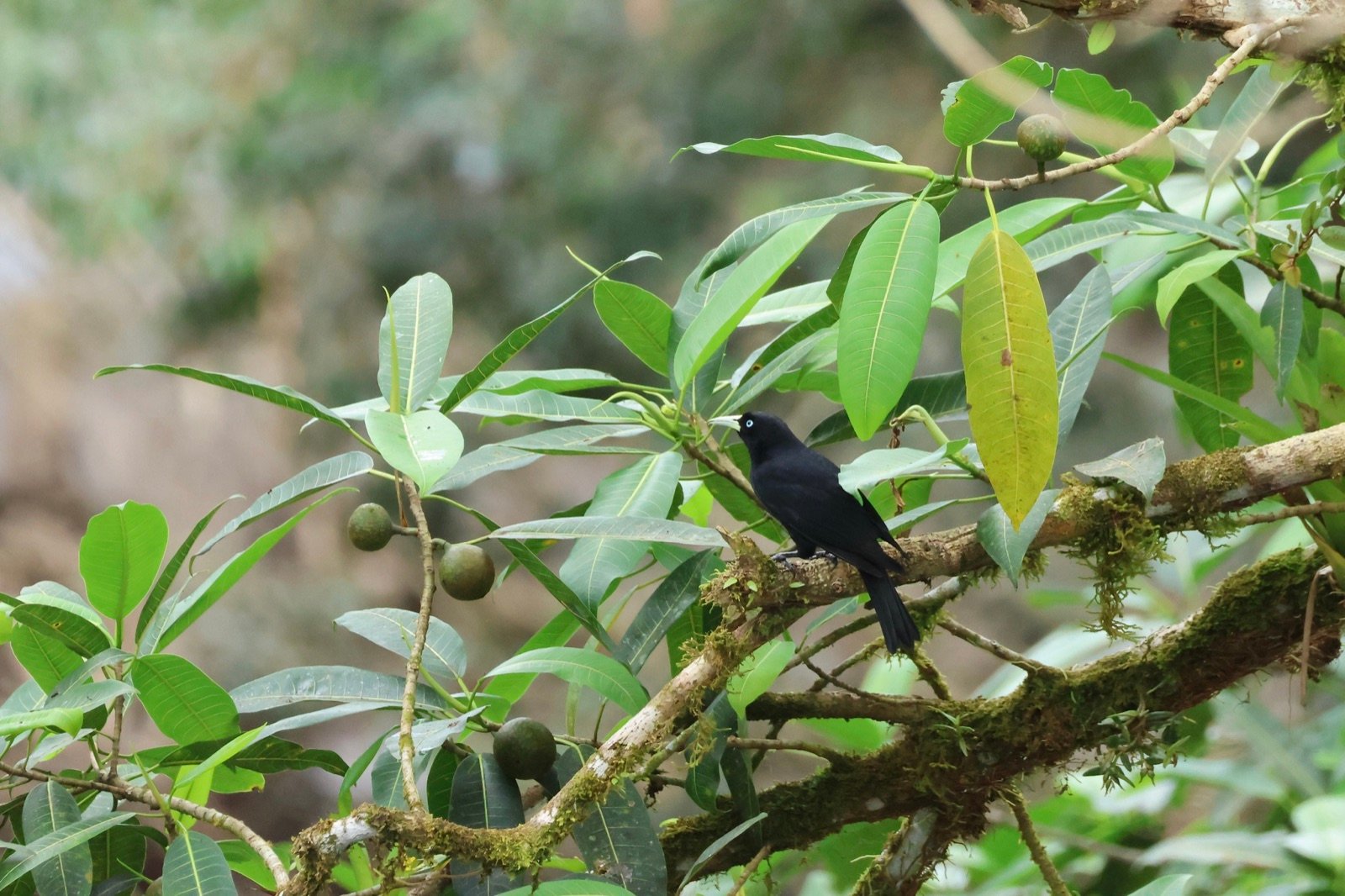
Black cacique with a scarlet rump, blue eyes and a pale ivory bill.
The Scarlet-rumped Cacique (Cacique Lomiescarlata) is a mostly black bird with a bright scarlet patch on the lower back and upper rump. Add blue eyes and a pale, pointed bill, and it is hard to mistake once it turns in the light.
Costa Ricans also call it Sargento or Plío. It is a resident on the AOCR list, and records reach from the Caribbean lowlands and foothills to the Osa Peninsula.
It hunts in the canopy in small flocks, so a good first step is to learn its whistles and watch for busy, noisy flocks overhead.
How to find it
Scan the canopy of humid lowland forest rather than the understory. Older secondary forest counts as well as primary forest, and the bird is found up to about 1,000 m. Listen for whistles that rise and end in a sharper note, and for faster rattling series. Watch for noisy mixed flocks with other icterids and Black-faced Grosbeaks, because these busy canopy flocks can also attract trogons and flycatchers. Calling birds may draw in a second one, so listen as well as look. Once you find a flock, scan for the pale bill and the scarlet rump.
How to recognise it
Look for a mostly black bird with a bright scarlet patch on the lower back and upper rump.
The eyes are blue. The bill is pale yellow to ivory and pointed. The wings are long and the tail is fairly short.
Males are larger than females, at roughly 28 to 30 cm and about 68 to 70 g. Females measure about 24 cm and weigh about 53 to 54 g, and they are smaller and duller black than males. These sizes describe the species across its whole range, not Costa Rica alone.
Young birds look brownish and have a brownish-orange rump instead of the bright scarlet one. A bird high in the canopy may hide its rump, so check the pale bill and blue eye against the black plumage.
What it sounds like
Recording: Michael Bakker Paiva, CC BY 4.0, source, read 4 Nov 2026.
Behaviour and diet
This cacique hunts in the canopy in small flocks. It takes large insects, spiders and small vertebrates, plus some fruit. It gleans insects from leaves and branches, probes bark crevices and sometimes catches insects in the air.
It joins noisy mixed flocks with other rowdy songbirds, such as other icterids and Black-faced Grosbeaks. Unlike many caciques, it does not usually nest in colonies. It typically breeds alone or in loose groups, and the nest is a long hanging bag, 36 to 64 cm long, hung from a branch tip.
Where it lives
It lives in humid lowland primary forest or older secondary forest, up to about 1,000 m elevation. Its range runs from Honduras through Nicaragua and Costa Rica to Panama, excluding Darién, and Costa Rica is within the range of the Scarlet-rumped form.
In Costa Rica it has been recorded in the Caribbean lowlands at La Selva, in Limón province near Guápiles and at Gandoca-Manzanillo, and around La Fortuna in the Arenal area. It has also turned up on the Osa Peninsula and around Turrialba.
When to see it
Dated photo records in Costa Rica include August, September and February, and a tour group recorded it on the southern Caribbean slope in early October.
Similar birds
Some authorities split this species in two. The name Scarlet-rumped Cacique then applies to the Central American form, while the South American Andean form is called Subtropical Cacique. The Spanish name Cacique Subtropical is also used.
Names and lore in Costa Rica
Costa Rican lists give the Spanish name Cacique Lomiescarlata and add the local names Sargento and Plío. Elsewhere in the region it is Cacique Rabirrojo in Nicaragua and Cacique rabadilla escarlata in Honduras, and Cacique subtropical is another name.
Status and conservation
It is a resident (R) on the AOCR list, and BirdLife International lists the species as Least Concern.
Photography tips
Watch for a busy, noisy canopy flock of icterids and Black-faced Grosbeaks. Trogons and flycatchers may join the same flock, so one good spot can give you several species. Once you find a flock, look for the pale bill and scarlet rump.
How we know this 16 sources, each read on the date shown
- Wikipedia (Spanish) read 2026-11-04
https://es.wikipedia.org/wiki/Cacicus_uropygialis - Animalia.bio (from Wikipedia) read 2026-11-04
https://animalia.bio/scarlet-rumped-cacique - Aves Costa Rica (avesibericas.es) read 2026-11-04
https://www.avesibericas.es/costaricaaves10.htm - EcoRegistros read 2026-11-04
https://www.ecoregistros.org/ficha/Cacicus-uropygialis - Naturesongs.com via Animal Diversity Web read 2026-11-04
https://animaldiversity.org/collections/contributors/naturesongs/srca3/ - EcoRegistros read 2026-11-04
https://www.ecoregistros.org/sheet/Cacicus-uropygialis - Avibase read 2026-11-04
https://avibase.bsc-eoc.org/species.jsp?avibaseid=BD9FCAA17319DD3D - Beauty of Birds read 2026-11-04
https://www.beautyofbirds.com/scarletrumpedcaciques.html - Earthlife read 2026-11-04
https://earthlife.net/scarlet-rumped-caciques/ - Wikipedia read 2026-11-04
https://en.wikipedia.org/wiki/Scarlet-rumped_cacique - Cornell Birds of the World read 2026-11-04
https://birdsoftheworld.org/bow/ornith-notes/JN100369 - Eagle-Eye Tours trip report read 2026-11-05
https://www.eagle-eye.com/blog/costa-rica-caribbean-mountains-to-coast-2025-trip-report-oct-1-12/ - Field Guides Classic Costa Rica itinerary read 2026-11-05
https://fieldguides.com/itineraries/cos26-ITIN.pdf - Birding Craft read 2026-11-05
https://birdingcraft.com/wordpress/tag/caribbean-slope/ - Birding Craft read 2026-11-05
https://birdingcraft.com/wordpress/category/costa-rica-beaches/ - Bird Watching Costa Rica read 2026-11-05
https://www.birdwatchingcostarica.com/ave/scarlet-rumped-cacique/