Family Fringillidae
Scrub Euphonia
Euphonia affinis
In Spanish: Eufonia Gargantinegra (Finito, Agüío, Monjita Fina)
- Resident
Tiny black-throated euphonia of the dry Pacific northwest, found at mistletoe
The Scrub Euphonia is a tiny bird, and in Costa Rica it belongs to the Pacific side. The official bird list marks it as a resident (R), and on that side it reaches the northwest, with the southern edge of its range at the Tárcoles district in Puntarenas Province.
It is fairly common in the lowlands but uncommon in the foothills, so it rewards a little patience and the right tree. Look for clumps of mistletoe, where it feeds with other euphonias.
On a trip we build around Guanacaste and the central Pacific, Santa Rosa National Park and Carara National Park are the places where guides and trip reports name it.
How to find it
Look for pairs or small groups in open woodland, forest edge and clearings with trees. Search for mistletoe clumps, because it feeds there with other euphonias and readily joins them. Check any Yellow-throated Euphonias you find, since the two often feed together. It is a tiny bird that is hard to see at a distance, so scan carefully through the foliage. Listen for the doubled 'dee' calls, but do not rely on hearing alone. Do not expect it to be easy everywhere.
How to recognise it
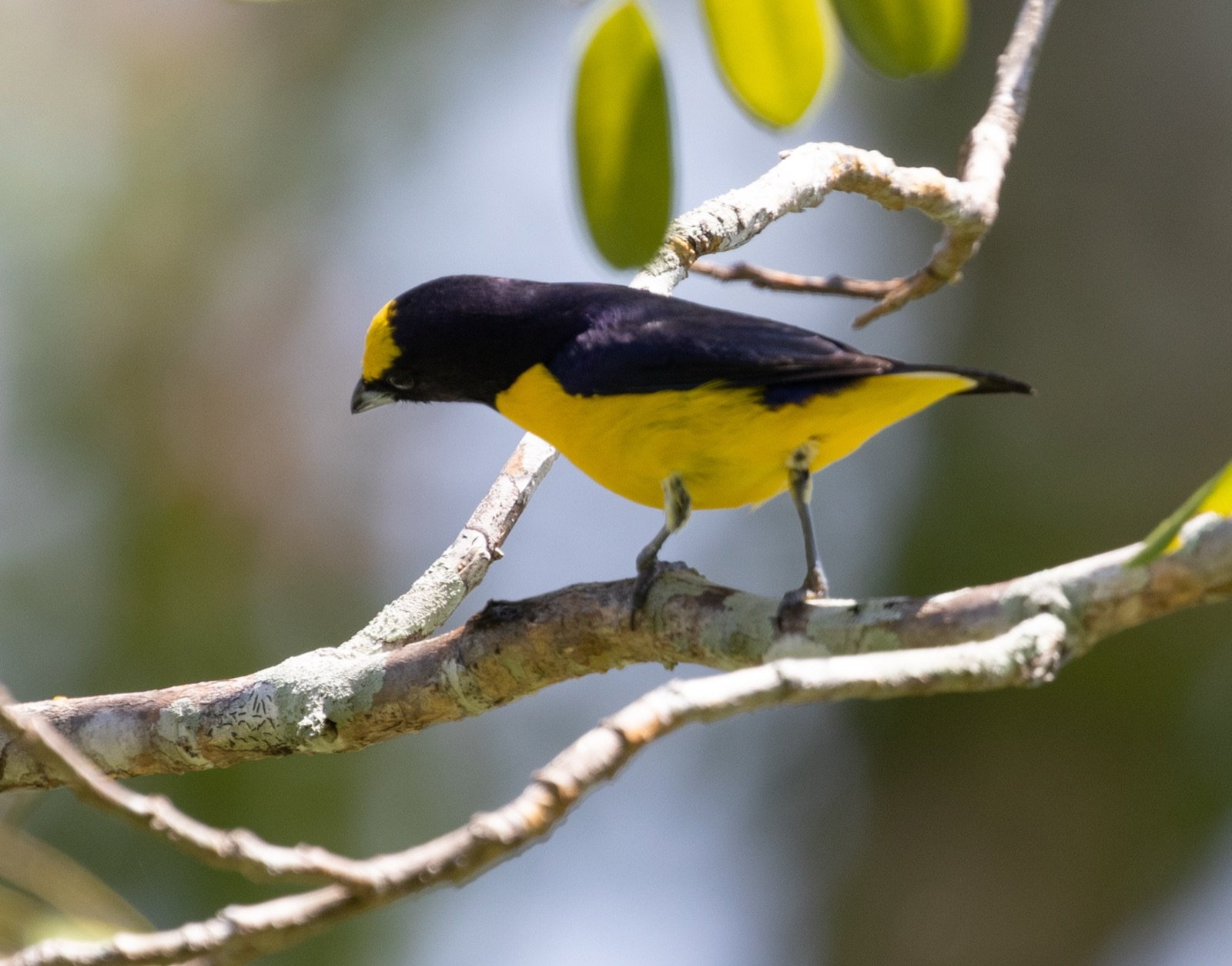
The male is a tiny bird with a blue-black head, upperparts and chest. He has a yellow forecrown and yellow underparts. In photos he looks very dark blue, almost black.
The black throat separates him from the similar Yellow-throated Euphonia, which has a yellow throat.
From below, look for a white undertail with a yellow vent.
The female is duller: pale yellow below and greenish-gray above, with a greyish head and nape in photos. She can be mistaken for a female manakin.
She is the harder bird, because female Scrub, Thick-billed and Yellow-crowned Euphonias are all yellowish-green to yellow underneath. Range and company help to sort them out.
What it sounds like
Recording: David Umanzor, CC BY 4.0, source, read 4 Nov 2026.
Behaviour and diet
Like other euphonias, the Scrub Euphonia often joins mixed flocks of fruit-eating birds. It forages mostly in pairs and small groups, often with Yellow-throated Euphonias, and both sexes of the two species often feed together at mistletoe.
When you find one euphonia flock, check every bird in it rather than stopping at the first one you identify.
Where it lives
In Costa Rica it is found only up to about 1,000 m (3,300 ft) elevation. It is fairly common in the lowlands and uncommon in the foothills.
On the Pacific side it reaches northwestern Costa Rica, with its southern edge at the Tárcoles district in Puntarenas Province. One tour company describes it as a dry-country specialist and found it in the dry Pacific lowlands.
Across its whole range it uses forest from dry to humid, scrubby woodland, farmland with scattered trees and fruiting trees in villages.
When to see it
The breeding season in Costa Rica runs from November to April.
Similar birds
The Yellow-throated Euphonia looks similar but has a yellow throat, while the Scrub has a black throat. The female Scrub lacks the vested look of the slightly larger female Yellow-throated, whose throat, breast centre and belly are whitish or pale grey with yellow flanks.
Do not confuse it with the Yellow-crowned Euphonia, a Caribbean slope endemic whose female is all yellow below, like the female Thick-billed. Check the range first.
Names and lore in Costa Rica
The official Costa Rican list gives the Spanish name Eufonia Gargantinegra. Costa Ricans also use the nicknames Finito, Agüío and Monjita Fina for it.
Status and conservation
The official Costa Rica bird list marks the Scrub Euphonia as a resident species (R), fairly common in the lowlands.
Photography tips
It is a tiny bird that is hard to see at a distance, and one tour only heard them because they stayed too far away. Look for mistletoe clumps, where it feeds with other euphonias, and wait there.
How we know this 17 sources, each read on the date shown
- Lista Oficial de las Aves de Costa Rica (AOCR) read 2026-11-04
https://listaoficialavesdecostarica.wordpress.com/lista-oficial/lista-oficial-online/ - Wikipedia read 2026-11-04
https://en.wikipedia.org/wiki/Scrub_euphonia - Cornell Birds of the World read 2026-11-04
https://birdsoftheworld.org/bow/species/screup1/cur/introduction - HandWiki (from Wikipedia) read 2026-11-04
https://handwiki.org/wiki/Biology:Scrub_euphonia - Beauty of Birds read 2026-11-04
https://beautyofbirds.com/scrubeuphonias/ - HBW Alive / Birds of the World read 2026-11-04
https://www.hbw.com/ibc/species/scrub-euphonia-euphonia-affinis - Wikipedia read 2026-11-04
https://en.wikipedia.org/wiki/Yellow-throated_euphonia - Eagle-Eye Tours trip report read 2026-11-04
https://www.eagle-eye.com/blog/costa-rica-birding-trip-report-jan-11-27-2026/ - Costa Rica Focus read 2026-11-04
https://www.costaricafocus.com/birding-guanacaste-costa-rica-a-complete-guide/ - Exotic Birding read 2026-11-04
http://www.exoticbirding.com/costarica/carara/special-birds.html - Birding Craft read 2026-11-04
https://birdingcraft.com/wordpress/tag/carara-national-park/ - Birds of Colombia (Costa Rica pages) read 2026-11-04
https://www.birdsofcolombia.org/costarica/Euphonia.html - Avibase read 2026-11-04
https://avibase.bsc-eoc.org/species.jsp?avibaseid=C29CE0E7C367CD41 - Field Guides tour report 2020 read 2026-11-04
https://fieldguides.com/triplists/cr220.html - Birdfinders trip report 2011 read 2026-11-04
https://birdfinders.co.uk/pdf/costa-rica-2011.pdf - Field Guides tour report 2018 read 2026-11-04
https://fieldguides.com/triplists/cos18.html - Animalia.bio read 2026-11-04
https://animalia.bio/scrub-euphonia/1000