Family Thraupidae
Shining Honeycreeper
Cyanerpes lucidus
In Spanish: Mielero Luciente (Picudo Patiamarillo)
- Resident
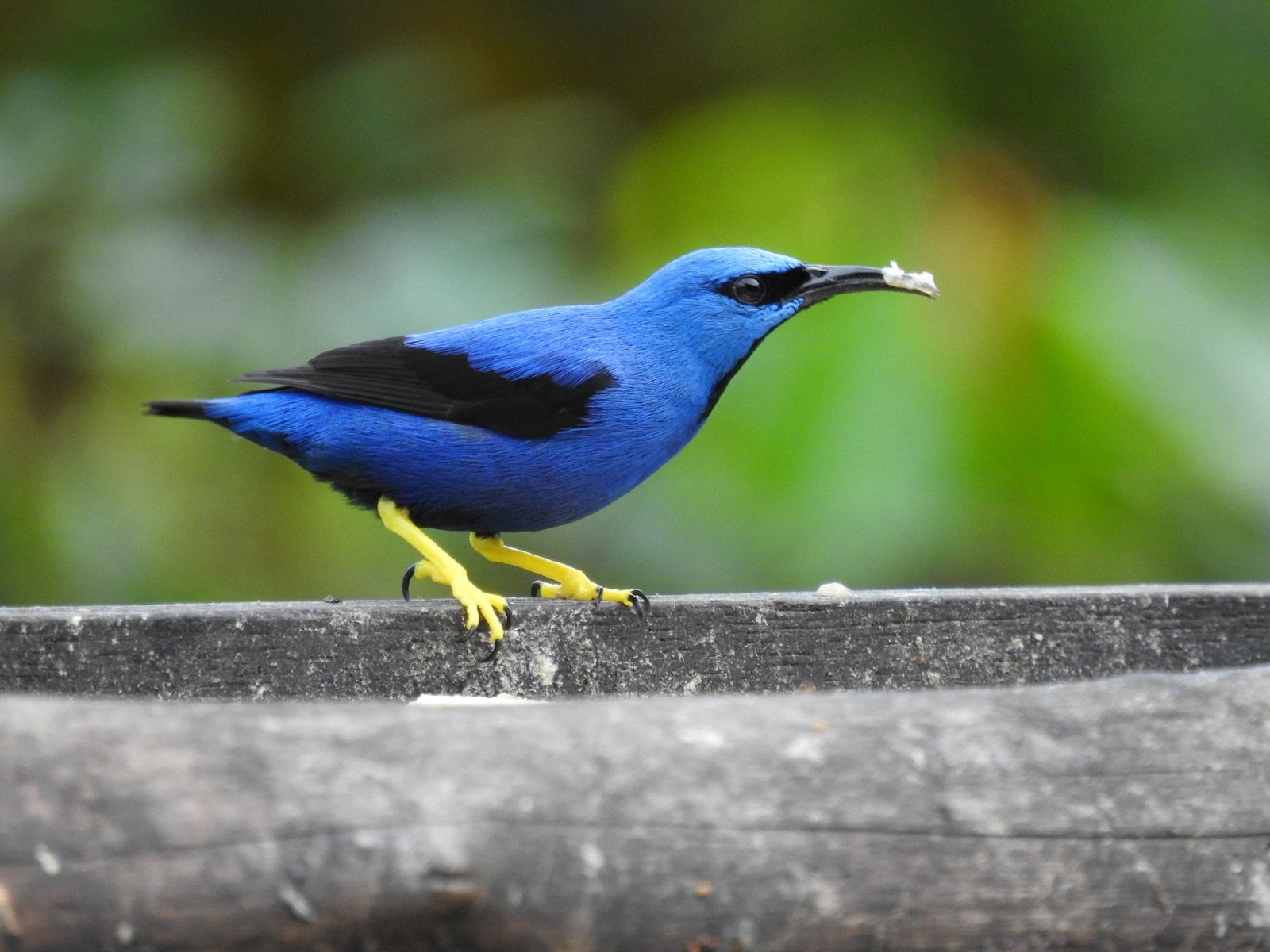
Tiny purple-blue canopy bird with yellow legs, common on the Caribbean slope
The Shining Honeycreeper (Mielero Luciente) is a tiny bird, about 10 to 11 cm long and around 11 g. It is easy to overlook because it likes the canopy, yet even 100 feet up the male's bright yellow legs and the female's streaked underparts stand out.
In Costa Rica it is a resident, locally common to abundant in the lowlands and foothills of the Caribbean slope. A separate population lives in the south of the Pacific slope.
On a trip we build through the Caribbean lowlands, lodge feeders and fruiting trees are the places to give it a look. Check the legs first, and the rest of the identification falls into place.
How to find it
Start at feeders, because like the Red-legged Honeycreeper it is drawn to artificial ones. Scan the canopy for the male's yellow legs and the female's streaked underparts, which show even high up. Fruiting trees near parking areas can pay off, and a pair has shown well in one in the foothills. Flowering trees in gardens are worth a look too, as are mixed flocks of small birds. It is reported to answer readily to the call of the Ferruginous Pygmy-Owl, which birders can use to draw it in.
How to recognise it
Male:
- purple-blue body
- black wings, tail and throat
- bright yellow legs
Female:
- green upperparts
- greenish-blue head
- buff throat
- bluish underparts streaked with buff, with a heavily streaked breast
Both sexes have a long, black, downcurved bill. The bird is tiny, about 10 to 11 cm long and around 11 g, with a short tail and no yellow on the wings. The male's black throat and the female's streaked breast both help separate it from the Red-legged Honeycreeper.
Behaviour and diet
It feeds mainly in the canopy and is seen alone, in pairs or in family groups. Unlike the Red-legged Honeycreeper, it never forms flocks of its own, though in Costa Rica it often joins mixed flocks of warblers, greenlets and similar small birds.
It eats many berries and arillate seeds, and sips nectar by pushing its bill into flowers while perched. It also takes insects and small spiders from thin hanging vines. It often hangs upside down while feeding, which shows off its bright yellow legs.
Where it lives
In Costa Rica it lives on the Caribbean slope, where it is most numerous in the lowlands and foothills. A guide says it is most common at humid lowland sites on both slopes, and seen more often in lowland rainforest than in foothills.
A separate population lives on the Pacific slope, from central Puntarenas and western San José provinces south into western Panama. In the north it becomes scarce as far as Carara National Park. It also uses flowering trees in gardens and plantations, and in Costa Rica it reaches only about 1,200 m elevation.
When to see it
It breeds from April to September in Costa Rica, sometimes into October. Fledglings have been seen leaving the nest in May, July and October.
Similar birds
The male looks much like the Red-legged Honeycreeper but has yellow legs instead of red. It is also smaller, has a short tail and lacks yellow on the wings. The photographic guide to Costa Rican birds notes a resemblance to the Purple Honeycreeper too, but the Costa Rican bird has yellow legs. Check the legs first.
Names and lore in Costa Rica
In Costa Rica the usual Spanish name is Mielero Luciente, and a Costa Rican bird list gives Picudo Patiamarillo as the local alternative. Elsewhere it is called mielero brillante in Colombia, mielero colicorto in Nicaragua and mielero relumbroso in Honduras.
Status and conservation
The AOCR list marks it as a resident (R), the IUCN rates it Least Concern, and it is described as fairly common in Costa Rica.
Photography tips
Look at forest edges and clearings beside forest, where a Costa Rican nest is a shallow cup of fine dark strips slung from a thin horizontal branch 6 to 9 m up. Feeders and fruiting trees give lower, closer views than the canopy, and hanging upside down shows off the yellow legs.
How we know this 16 sources, each read on the date shown
- Wikipedia read 2026-11-04
https://en.wikipedia.org/wiki/Cyanerpes_lucidus - Diversidad y un poco de todo read 2026-11-04
https://www.diversidadyunpocodetodo.com/mielerito-reluciente-cyanerpes-lucidus/ - Macaulay Library read 2026-11-04
https://macaulaylibrary.org/asset/201572271 - EcoRegistros read 2026-11-04
https://www.ecoregistros.org/site_en/imagen.php?id=400604 - Flickr (natural history text, Mielero Luciente) read 2026-11-04
https://www.flickr.com/photos/jobando/27705676262 - Project Noah read 2026-11-04
https://projectnoah.org/spottings/shining-honeycreeper-male - Birding Craft read 2026-11-04
https://birdingcraft.com/wordpress/2012/01/30/where-to-see-honeycreepers-and-dacnises-when-birding-costa-rica/ - Birda read 2026-11-04
https://app.birda.org/species-guide/110945/Shining_Honeycreeper - Field Guides trip list read 2026-11-04
https://fieldguides.com/triplists/crh22b.html - Aves Ibericas, Aves Costa Rica read 2026-11-04
https://www.avesibericas.es/costaricaaves9.htm - Wikipedia (Spanish) read 2026-11-04
https://es.wikipedia.org/wiki/Cyanerpes_lucidus - DiBird read 2026-11-04
https://dibird.com/species/shining-honeycreeper/ - Retired in Costa Rica read 2026-11-04
https://www.charliedoggett.net/2020/07/04/honeycreepers/ - Birding Craft read 2026-11-04
https://birdingcraft.com/wordpress/tag/shining-honeycreeper/ - Birds of Costa Rica (birdsofcolombia.org) read 2026-11-04
https://www.birdsofcolombia.org/costarica/Cyanerpes.html - Aves y Ventanas Costa Rica read 2026-11-04
https://avesyventanascostarica.wordpress.com/algunas-aves-que-han-golpeado-contra-ventanas-en-costa-rica/