Family Charadriidae
Snowy Plover
Anarhynchus nivosus
In Spanish: Chorlitejo Patinegro (Chorlito, Turillo)
- Migrant
A tiny, pale, rarely reported migrant plover of sandy shores.
The Snowy Plover is a small, plump, pale plover, about 15 to 17 cm long, and in Costa Rica it is a rarity. The national bird list marks it M, a migrant, so it visits the country and does not nest here as a resident.
A Costa Rican birder describes it as a bird that only passes through, breeding in northern North America and wintering in the Amazon. One birding blog calls a bird at the Tárcoles river mouth a mega rarity.
For a beginning birder it is a bird to hope for rather than expect. On a trip we build, the way to give yourself a chance is to spend time on open sandy shores, not in forest, and to scan for small pale shapes running over the sand.
How to find it
It is small and pale and often goes unnoticed, so scan pale, open sand for small running shapes rather than looking for a bird that stands out. Its pale back matches dry sand and salt flats, and the colour hides it well. Expect a walk on the beach, since at Tárcoles one bird sat just beyond scrubby mangroves and birders had to hike out to the river mouth to reach it. If a small plover flushes after a short repeated ti, watch where it goes.
How to recognise it
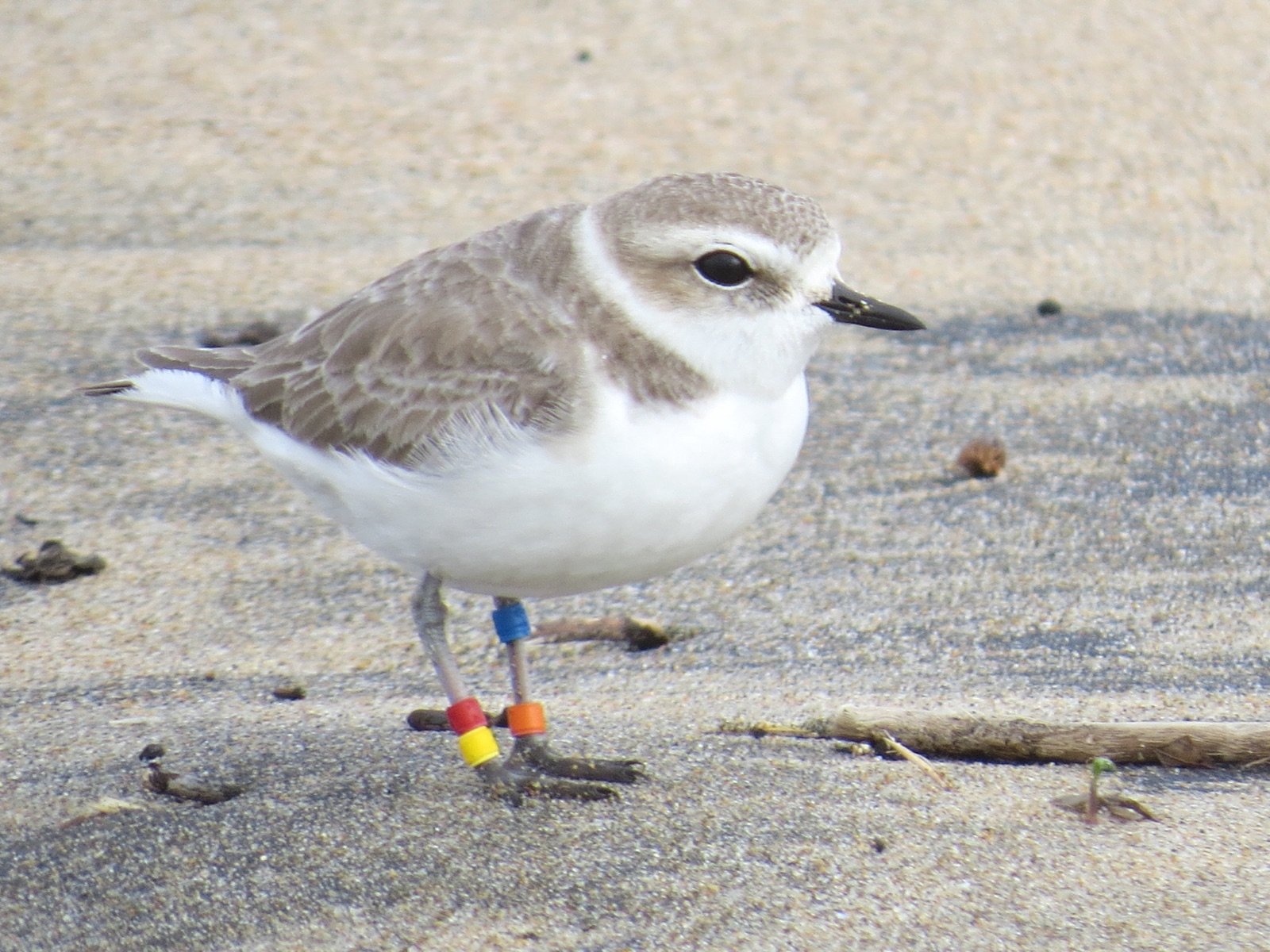
Think small, plump and pale. The bird has a large head, a short slender bill, and a short neck and tail. It is pale brown above and white below, with a white band on the hind neck.
Breeding males show black patches behind the eye, on the sides of the neck and on the forehead. Outside the breeding season these patches fade to pale.
The best mark is the breast band. The dark neck patches rarely meet in front, so the band looks broken, while many other plovers have a complete band. The bill is thin and all black, and the legs are gray to black. In flight, a white wing stripe stands out clearly.
What it sounds like
Behaviour and diet
This plover moves in short bursts. It runs a few steps, stops, then runs again, pecking at the ground when it spots food. It scans by standing briefly, then runs and grabs prey. It also probes the ground and shakes one foot in shallow water to stir up prey, and it sometimes drags a foot over sand or mud to startle small animals.
Outside the breeding season it feeds alone or in loose flocks of 20 to 30, and it sometimes joins larger mixed-species flocks. It also catches flies with its bill held open.
Where it lives
The species lives in open areas with little or no plant cover, especially sandy coastal beaches and the shores of salt or soda lakes. Across its whole range it is mostly a Pacific coast bird, with a few records on the Caribbean coast of Central America.
For a Costa Rica trip, look on open sandy shores, not in forest. The records we know point to the Pacific side, at Tárcoles and near Quepos in Puntarenas.
When to see it
Reports at the Tárcoles river mouth come from October 2023 and December 2024, and a bird near Quepos was photographed on 26 January 2014. Beyond that, it is seldom reported during migration.
Similar birds
Tell it from similar plovers by its thin, all-black bill and gray to black legs. Piping, Collared and Semipalmated Plovers have orange or yellow legs. Wilson's Plover has a longer, thicker bill. The broken breast band also separates it from the many plovers with a complete band.
Names and lore in Costa Rica
The official Costa Rican list gives Chorlitejo Patinegro as the Spanish name, with Chorlito and Turillo as popular names used in different regions. An older list version used Chorlitejo Blanco o Patinegro. In 2017-2018 the national bird committee standardised Spanish names so each species keeps one, and this plover was set as Chorlitejo Patinegro.
Status and conservation
The Costa Rican bird list marks it M, a migrant, and globally the IUCN lists it as Near Threatened.
Photography tips
Its pale back matches dry sand, so search pale open ground carefully, since the colour hides it well. Expect a walk on the beach to reach one, as at Tárcoles.
How we know this 12 sources, each read on the date shown
- Birdwatching in Costa Rica bird list read 2026-11-04
https://birdwatchingincostarica.com/bird-lists/ - Wikipedia read 2026-11-04
https://en.wikipedia.org/wiki/Snowy_plover - Wikipedia (mirrored on The Bio Files) read 2026-11-04
https://thebiofiles.com/info/4503 - Tica Birding Adventure read 2026-11-04
http://ticabirdingadventure.blogspot.com/2018/05/top-10-my-favorite-species-during-my.html - Flickr (Costa Rican bird photo notes) read 2026-11-04
https://www.flickr.com/photos/jobando/25452981848/ - Birding Craft (Costa Rica birding blog) read 2026-11-04
https://birdingcraft.com/wordpress/2023/10/03/october-the-most-exciting-month-for-birding-in-costa-rica/ - Blog de Aves read 2026-11-04
https://blogdeaves.com/charadriidae/chorlitejo-patinegro/ - Lista Oficial de las Aves de Costa Rica (AOCR) read 2026-11-04
https://listaoficialavesdecostarica.wordpress.com/lista-oficial/lista-oficial-online/ - Lista Oficial de las Aves de Costa Rica (AOCR), registros read 2026-11-04
https://listaoficialavesdecostarica.wordpress.com/nuevos-registros/ - Costa Rica Living and Birding read 2026-11-04
https://birdingcraft.com/wordpress/page/8/ - Francisco Javier Torres Goberna blog read 2026-11-04
http://oestrymnio.blogspot.com/2015/04/chorlitejo-patinegro-charadrius.html - Naturalista Costa Rica (IUCN status) read 2026-11-04
https://costarica.inaturalist.org/taxa/1506450-Anarhynchus-nivosus-occidentalis