Family Troglodytidae
Song Wren
Cyphorhinus phaeocephalus
In Spanish: Soterré Canoro
- Resident
A forest floor wren with a blue eye patch and a pan pipe song.
The Song Wren (Soterré Canoro, Cyphorhinus phaeocephalus) is a small, plain, dark reddish-brown wren, and its voice is the reason to look for it. The song is known for being like pan pipes, and the bird is a remarkable singer.
In Costa Rica it is a resident (R) on the AOCR list, and the race found here, infuscatus, lives in the Caribbean lowlands. It spends most of its time on the forest floor, so most first meetings happen by ear.
On a trip we build, a Caribbean slope forest walk, such as in the Arenal area, is where you may hear it from forest edge near lodge grounds.
How to find it
Listen first, because the bird is hard to see in the understory and the song will usually give it away. On an early walk before breakfast, one birder found a family group in secondary forest beside manicured lodge gardens. Forest edge near lodge grounds on a Caribbean slope walk, such as in the Arenal area, is a good place to try. The bird prefers forest interior, so look low in shaded understory rather than in open edges. Watch for small family groups moving on the ground, and for antbirds that follow army ants, since the wren sometimes joins those swarms.
How to recognise it
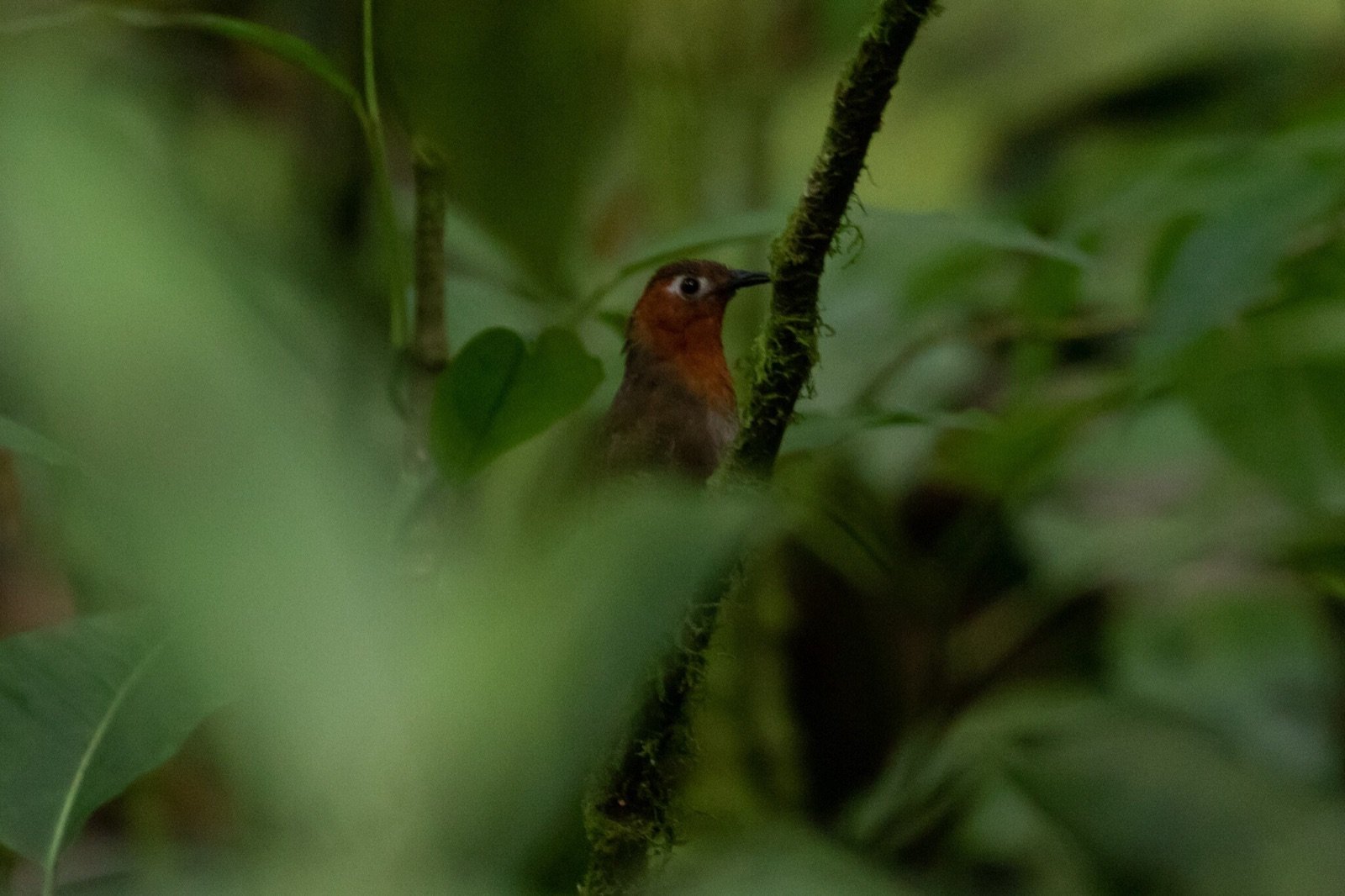
Look for a small, plain, dark reddish-brown wren.
The face, throat and breast are chestnut-orange.
A noticeable patch of bare blue skin surrounds the eye.
The wings and tail are barred with black.
The bill is thick for a wren.
The Costa Rican race, infuscatus, is darker than other races and has a more clearly black crown. Because the bird keeps to shaded undergrowth, the blue eye patch and the orange face are the details to watch for when it hops into a gap in the vegetation.
What it sounds like
Recording: Ryan F. Mandelbaum, CC BY 4.0, source, read 4 Nov 2026.
Behaviour and diet
The Song Wren spends most of its time on the forest floor, foraging in small family groups. It hops through leaf litter and understory looking for insects, spiders and other small invertebrates, among them millipedes, crickets and beetles. It sometimes follows army ant swarms.
The nest is a ball with a side entrance, built 1 to 2.5 m above ground. The clutch is 2 white eggs speckled with brown, and the pair also build roosting nests.
Where it lives
It lives in the understory of humid lowland forest and wet second growth, and it prefers the interior of wet forest. Across its range it is seen from sea level to about 700 m, sometimes up to 1000 m. It is usually absent from the dry forests of the Pacific coast.
In Costa Rica the infuscatus race lives in the Caribbean lowlands. Records come from the Arenal area, the Volcán Tenorio area, Turrialba, the Sarapiquí region and the Cahuita area of the south Caribbean coast.
Names and lore in Costa Rica
In Costa Rica the bird is called soterrey canoro, which the AOCR list spells Soterré Canoro. Other countries use different names: chochín cariazul in Nicaragua, cucarachero gaitero in Colombia, colchonero cantor in Honduras and sotorrey canoro in Panama.
The Spanish name breaks into three parts. Soto comes from sotobosque (undergrowth), rey means king, and canoro means melodious singer, a fit for a bird that stays on the forest floor and sings so well.
Status and conservation
The AOCR list marks it as a resident (R), and the IUCN rates the species Least Concern, described as fairly common in lowland wet forest across its range.
Photography tips
Look low in shaded understory and not in open edges, since the bird prefers forest interior and spends most of its time on the ground in small family groups. Follow the song to locate the group, then wait quietly for it to hop into a gap.
How we know this 14 sources, each read on the date shown
- Birds Colombia read 2026-11-04
https://birdscolombia.com/2018/07/31/cucarachero-gaitero-song-wren-cyphorhinus-phaeocephalus/ - Oiseaux-Birds read 2026-11-04
https://www.oiseaux-birds.com/card-song-wren.html - Birdernaturalist blog read 2026-11-04
http://birdernaturalist.blogspot.com/2015/04/a-full-day-at-costa-ricas-la-selva.html - Wikipedia (es) read 2026-11-04
https://es.wikipedia.org/wiki/Cyphorhinus_phaeocephalus - Municipalidad de Turrialba, bird list read 2026-11-04
https://www.muniturrialba.go.cr/docs/turismo/Guia%20de%20Aves%20de%20Turrialba%202020.pdf - Field Guides trip list read 2026-11-04
https://fieldguides.com/triplists/cr223PRINT.html - Aves Costa Rica (avesibericas) read 2026-11-04
https://www.avesibericas.es/costaricaaves7.htm - Aves del Tercer Planeta read 2026-11-04
https://avesdeltercerplaneta.blogspot.com/2014/02/cucarachero-canoro-cyphorhinus.html - Conservation Birding read 2026-11-05
http://www.conservationbirding.com/abouttirimbina.html - Naturalist Journeys trip report read 2026-11-05
https://www.naturalistjourneys.com/pdf/trip-reports/299-201801-central_america-costa_rica-species_list.pdf - Birding Craft read 2026-11-05
https://birdingcraft.com/wordpress/costa-rica-birding-hotels/ - Listening to Birds blog read 2026-11-05
https://thecanadianwarbler.blogspot.com/2025/03/costa-rica.html - Costa Rica Focus read 2026-11-05
https://www.costaricafocus.com/birding-group-tours/target-list-trek/ - Birding Craft read 2026-11-05
http://birdingcraft.com/wordpress/category/caribbean-slope/