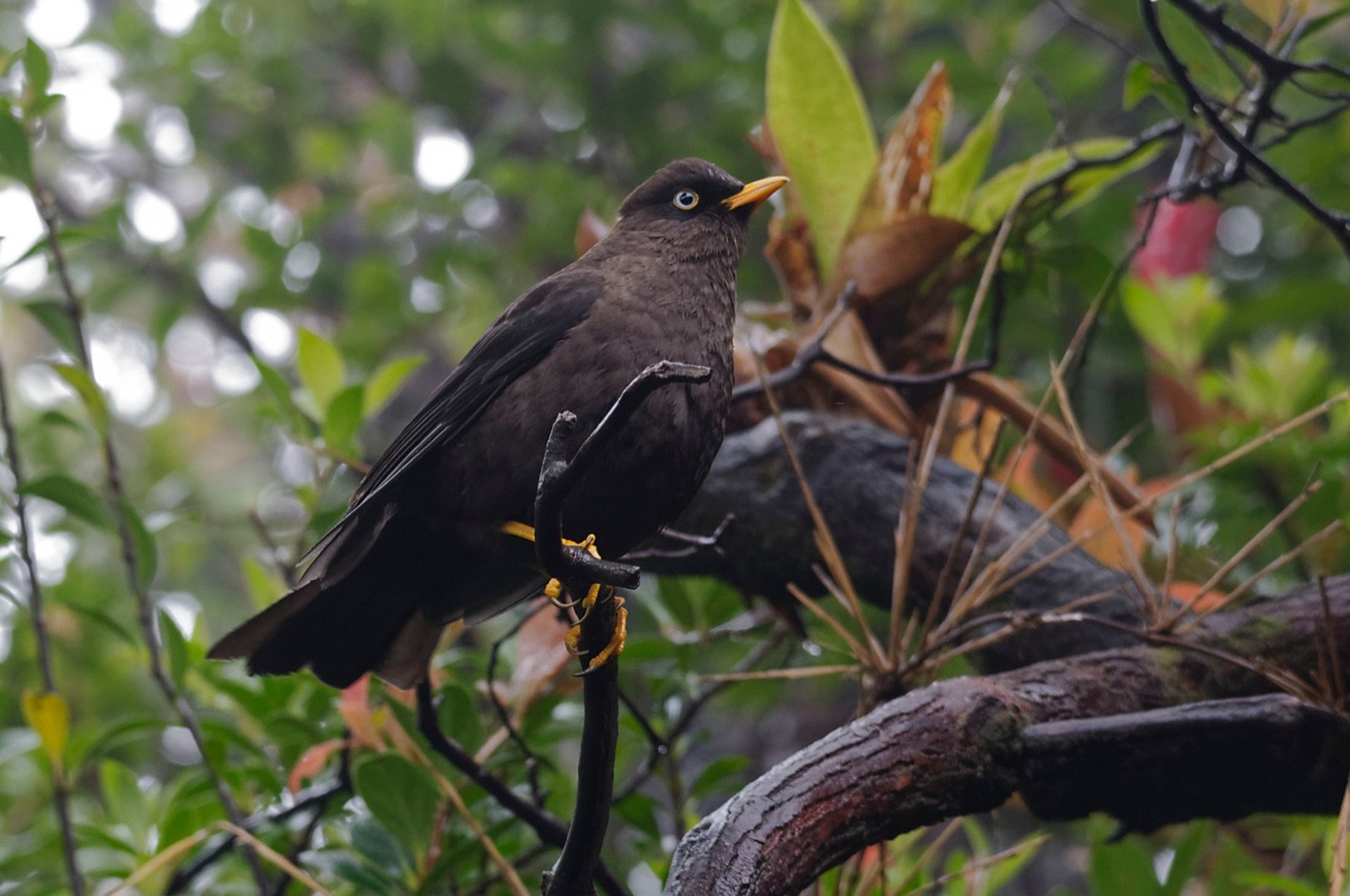
 Sooty Thrush
Family Turdidae
Sooty Thrush
Turdus nigrescens
In Spanish: Mirlo Negruzco (Yigüirro Escarchero, Escarchado)
- Resident
- Regional endemic
A blackish thrush with a bright orange bill, common on high volcano slopes.
The Sooty Thrush is a large, dark thrush with a bright orange bill, legs and eye ring. In Costa Rica it lives in the high Central Volcanic and Talamanca ranges, and it occurs only in the highlands of Costa Rica and western Panama.
Cerro de la Muerte on the Pan-American Highway is a standard stop on guided Costa Rica tours, and Sooty Thrush is a listed target there. With a good guide, most visitors can see it alongside Volcano Junco, Volcano Hummingbird and Timberline Wren.
Where to see it
How to find it
Go early in the morning: one birder found it on the Robledal trail at Km 70 on the Pan-American Highway. In the Savegre Valley it was numerous and easy to notice from about 8,000 feet upward. On Irazú Volcano, tour groups have had good views near the summit parking lot and in flowering bushes. Listen for it in dense shrubs, since it may sing from cover.
How to recognise it
This is a large, dark thrush, about 25 cm long. Adults are uniformly blackish brown, with a bright orange bill, orange legs and an orange bare eye ring, plus a pale grey eye. The female looks like the male but is browner and paler overall, and her bare parts are yellow-orange rather than bright orange. Young birds look like the adult female but have buff or orange streaks on the head and dark spots underneath. The bright orange against the dark body is the quickest way to tell an adult male from other thrushes in the highlands.
What it sounds like
Recording: River Ahlquist, CC BY 4.0, source, read 4 Nov 2026.
Behaviour and diet
It feeds mostly on the ground, hopping and flipping fallen leaves with its bill to find insects and spiders. It also eats many berries and small fruits. It pairs up to nest, but is usually seen alone or in loose groups where food is good. It often sings from inside dense shrubs or low trees rather than an open perch, so you may hear it before you see it. A photo shows one in a tree in a pasture at about 3,000 m.
Where it lives
The Sooty Thrush lives in open high-elevation places: páramo, dense scrub around volcano cones, clear bogs, pastures and low second growth. It also enters oak forest, mostly along edges and openings. It is a resident, common to abundant in the high Central Volcanic and Talamanca ranges, above about 2,150 m. After breeding, birds move down the mountain slopes, from about 2,500 m to about 2,150 m.
When to see it
It breeds from March to May in Costa Rica, building a bulky cup nest 2 to 8 m up and laying two blue-green eggs.
Similar birds
The Mountain Thrush is plain brown with dark bare parts, and the Clay-colored Thrush is much paler with a yellow bill. The Sooty Thrush's orange bill and legs set it apart from both.
Names and lore in Costa Rica
Costa Ricans call it escarchado or escarchero. The AOCR Spanish name is Mirlo Negruzco, with Yigüirro Escarchero and Escarchado as the listed alternatives.
Status and conservation
The AOCR list marks it R-END, a resident endemic, and the IUCN rates it Least Concern.
Photography tips
Look for it in open farmed highland country, where it may perch in a tree in a pasture. Early mornings on forest trails and near volcano summit car parks have produced good views.
How we know this 21 sources, each read on the date shown
- Aves de Costa Rica read 2026-11-04
https://avesdecostarica.com/Turdus-nigrescens.html - Wikipedia (Spanish) read 2026-11-04
https://es.wikipedia.org/wiki/Turdus_nigrescens - Beauty of Birds read 2026-11-04
https://www.beautyofbirds.com/sootyrobins.html - Flickr caption (Costa Rican natural history text) read 2026-11-04
https://www.flickr.com/photos/jobando/34747929093 - Wikipedia read 2026-11-04
https://en.wikipedia.org/wiki/Sooty_thrush - Avestikas read 2026-11-04
https://avestikas.com/2023/06/01/turdus-nigrescens/ - EcoRegistros read 2026-11-04
https://www.ecoregistros.org/site/imagen.php?id=543347 - Wikipedia read 2026-11-04
https://en.wikipedia.org/wiki/Costa_Rican_p%C3%A1ramo - Earthlife.net read 2026-11-04
https://earthlife.net/sooty-robins/ - Birds of Passage blog read 2026-11-04
https://birdsofpassage.wordpress.com/2014/04/25/cerro-de-la-muerte-providencia-mirador-de-quetzales/ - Field Guides tour report read 2026-11-04
https://fieldguides.com/triplists/cos17.html - Field Guides tour report read 2026-11-04
https://fieldguides.com/triplists/crh21b.html - Field Guides itinerary read 2026-11-04
https://fieldguides.com/itineraries/cos26-ITIN.pdf - Costa Rica Focus read 2026-11-04
https://www.costaricafocus.com/birding-san-jose-province-costa-rica-a-complete-guide/ - Field Guides tour report read 2026-11-04
https://fieldguides.com/triplists/cr118.html - Birdquest tour report 2025 read 2026-11-04
https://www.birdquest-tours.com/wp-content/uploads/2025/07/costa-rica-classic-2025-text.pdf?v=1766840199 - Animalia read 2026-11-04
https://animalia.bio/sooty-thrush - IOC World Bird Names read 2026-11-04
https://www.worldbirdnames.com/bird/sooty-thrush/25876.html - Ecosistemas de Costa Rica read 2026-11-04
https://ecosistemasdecostarica.blogspot.com/2012/11/reserva-biologica-cerro-vueltas.html - Cloudbridge Nature Reserve read 2026-11-04
https://www.cloudbridge.org/wp-content/uploads/2020/04/Bird-Species-List-Costa-Rica-13-April-2020.pdf - Aves y Ventanas Costa Rica read 2026-11-04
https://avesyventanascostarica.wordpress.com/algunas-aves-que-han-golpeado-contra-ventanas-en-costa-rica/