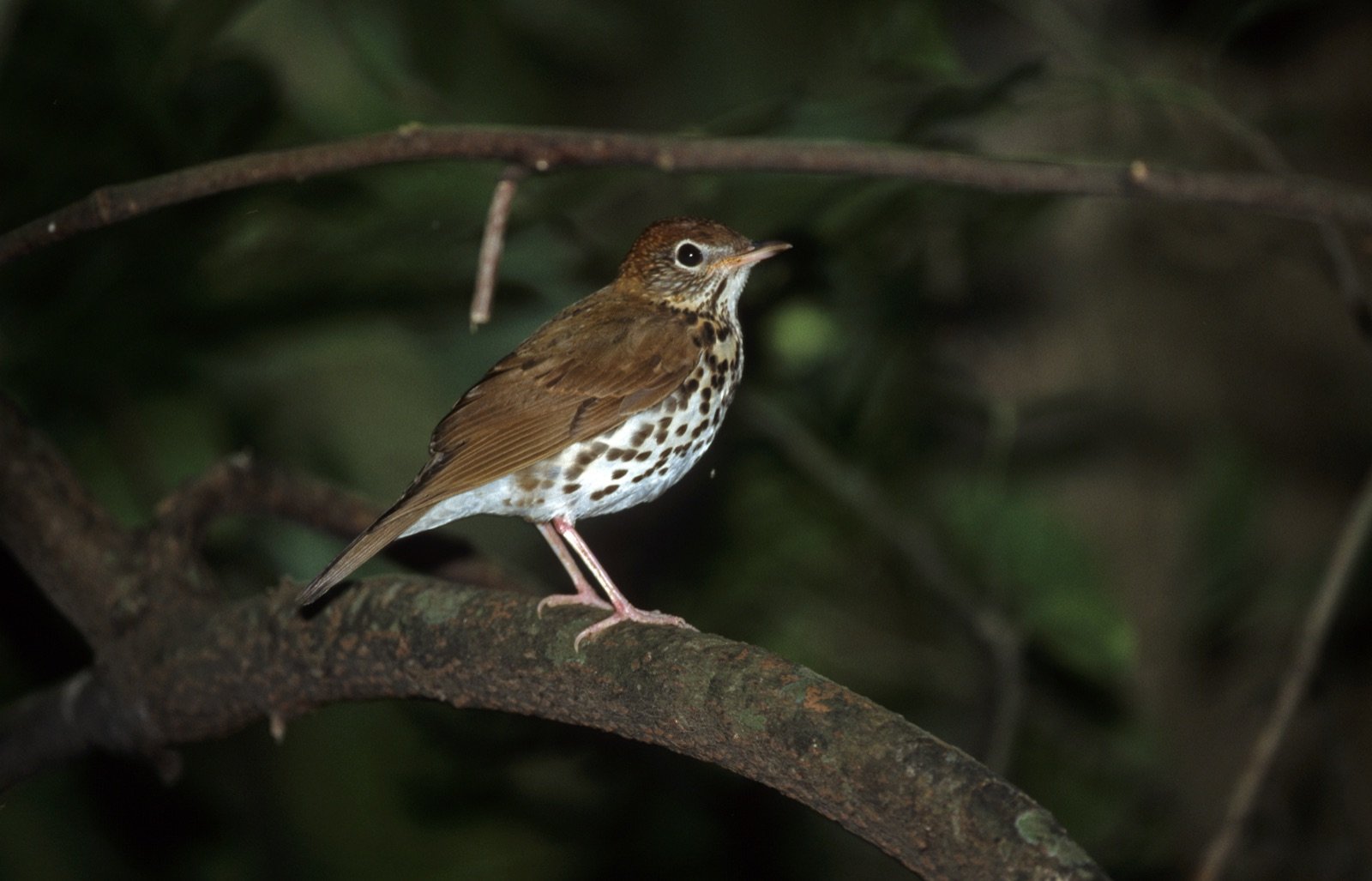
 Wood Thrush
Family Turdidae
Wood Thrush
Hylocichla mustelina
In Spanish: Zorzal del Bosque
- Migrant
A spotted, rufous winter thrush of wet forest floors and edges
The Wood Thrush (Zorzal del Bosque, Hylocichla mustelina) is a migrant that winters in Costa Rica, and the AOCR list marks it M. It is often easier to hear than to see, so it rewards a slow walk along a forest trail.
On a far-north trip, a wintering Wood Thrush was recorded on Sendero Bogarín, one of the thrush species seen there. On another, one was listed in a hotel botanical garden in San José, in the Central Valley, on the first day.
Look low: it hops along the ground and flips leaves to find its food.
How to find it
Listen first, since it is often easier to hear than to see. Then scan the forest floor for a bird hopping along the ground, searching for earthworms, beetles and other invertebrates. It prefers dense foliage over open spaces and stays in wooded areas. In Costa Rican wet forest, wintering birds were found more often in open shrubby areas and forest edge, which may be easier places to look. Trail edges are worth checking, as on Sendero Bogarín. In the north, favour the wetter forest.
How to recognise it
The Wood Thrush is a medium-sized thrush with brown upperparts and white underparts marked with brown spots.
The head, back, wings and tail are a rich reddish brown.
In Costa Rica, three marks help most:
- bolder, more extensive spotting on the white underparts than on the other migrant thrushes
- a white eye ring
- a rufous head
Watch the forest floor, because that is where it spends much of its time.
What it sounds like
Behaviour and diet
It feeds mainly on the forest floor, flipping over leaves to uncover insects. It eats insects, spiders, earthworms and snails, plus berries and other small fruits, especially from late summer through winter.
It is mostly solitary, though in winter it sometimes joins mixed-species flocks.
In Costa Rica, wintering birds defend feeding territories against other thrushes and return to the same territory. This is strongest in large forest fragments and continuous forest.
Where it lives
In northern Costa Rica, Wood Thrushes were found more often in wetter places. Occupancy was highest in open shrubby areas and forest edge, then old-growth forest, then secondary forest.
A study in the Guanacaste Conservation Area covered dry forest, cloud forest and wet forest. In the Atlantic lowlands, one study recorded the bird only inside forest.
Across its winter range it uses many forest types, from humid lowland to dry or humid mountain forest, and also cacao plantations, scrub, thickets and second growth. It prefers wet primary forest with little to moderate disturbance.
When to see it
Migrants pass through Costa Rica from late September to mid-November and again in March and April. Spring passage is barely noticeable in most of the country, but easier to notice along the Caribbean coast. At Pitilla, birds were at about 60 percent of survey points in the wet forest in November and December.
Similar birds
Other migrant thrushes visit Costa Rica, but the Wood Thrush shows bolder, more extensive spotting on its white underparts. Add the white eye ring and the rufous head, and it stands apart from its relatives on the forest floor.
Names and lore in Costa Rica
In Costa Rica the bird is called zorzal del bosque. Other Spanish-speaking countries use different names, such as zorzal de bosque in Colombia, zorzal grande in Nicaragua and zorzalito maculado in Mexico.
Status and conservation
The AOCR list marks it M, a migrant, and a Costa Rican source calls it an uncommon to fairly common fall migrant and an uncommon winter resident.
Photography tips
Wood Thrushes are hard enough to see in dense tropical understory, and harder to photograph there. In the wet forest, wintering birds were more often found in open shrubby areas and forest edge, which may be easier places to look.
How we know this 16 sources, each read on the date shown
- Revista de Biología Tropical (SciELO Costa Rica) read 2026-11-04
https://www.scielo.sa.cr/scielo.php?script=sci_arttext&pid=S0034-77442024000100010 - NatureServe Explorer read 2026-11-04
https://explorer.natureserve.org/Taxon/ELEMENT_GLOBAL.2.106491/Hylocichla_mustelina - Smithsonian National Zoo fact sheet read 2026-11-04
https://nationalzoo.si.edu/sites/default/files/documents/wood_thrush_1-20-12.pdf - Wikipedia read 2026-11-04
https://en.wikipedia.org/wiki/Wood_thrush - Kern Audubon Society read 2026-11-04
https://www.kernaudubonsociety.org/bird-of-the-week-wood-thrush/ - Periódico Mensaje Guanacaste read 2026-11-04
https://periodicomensaje.com/ambientales/7163-mensaje-verde-2 - Hotel Rivel (Costa Rica lodge blog) read 2026-11-04
https://hotelrivel.online/es/un-canto-en-la-selva-tropical-el-zorzal-pardo-encantador/ - Aves de Costa Rica read 2026-11-04
https://avesdecostarica.com/Hylocichla-mustelina.html - Field Guides Birding Tours read 2026-11-04
https://fieldguides.com/triplists/cr220.html - John Gordon, Listening to Birds read 2026-11-04
https://thecanadianwarbler.blogspot.com/2025/03/costa-rica.html - Partners in Flight read 2026-11-04
https://partnersinflight.org/species/wood-thrush/wood-thrush-winter-habitat-2/ - Birds Colombia read 2026-11-04
https://birdscolombia.com/2020/11/26/zorzal-de-bosque-wood-thrush-hylocichla-mustelina/ - Wikipedia (es) read 2026-11-04
https://es.wikipedia.org/wiki/Hylocichla_mustelina - Bird Biologist blog read 2026-11-04
https://birdbiologist.wordpress.com/tag/wood-thrush/ - Conservation Biology (Stanley et al.) read 2026-11-04
https://conbio.onlinelibrary.wiley.com/doi/epdf/10.1111/cobi.12352 - Revista de Biología Tropical read 2026-11-04
https://www.scielo.sa.cr/pdf/rbt/v72n1/0034-7744-rbt-72-01-e55265.pdf