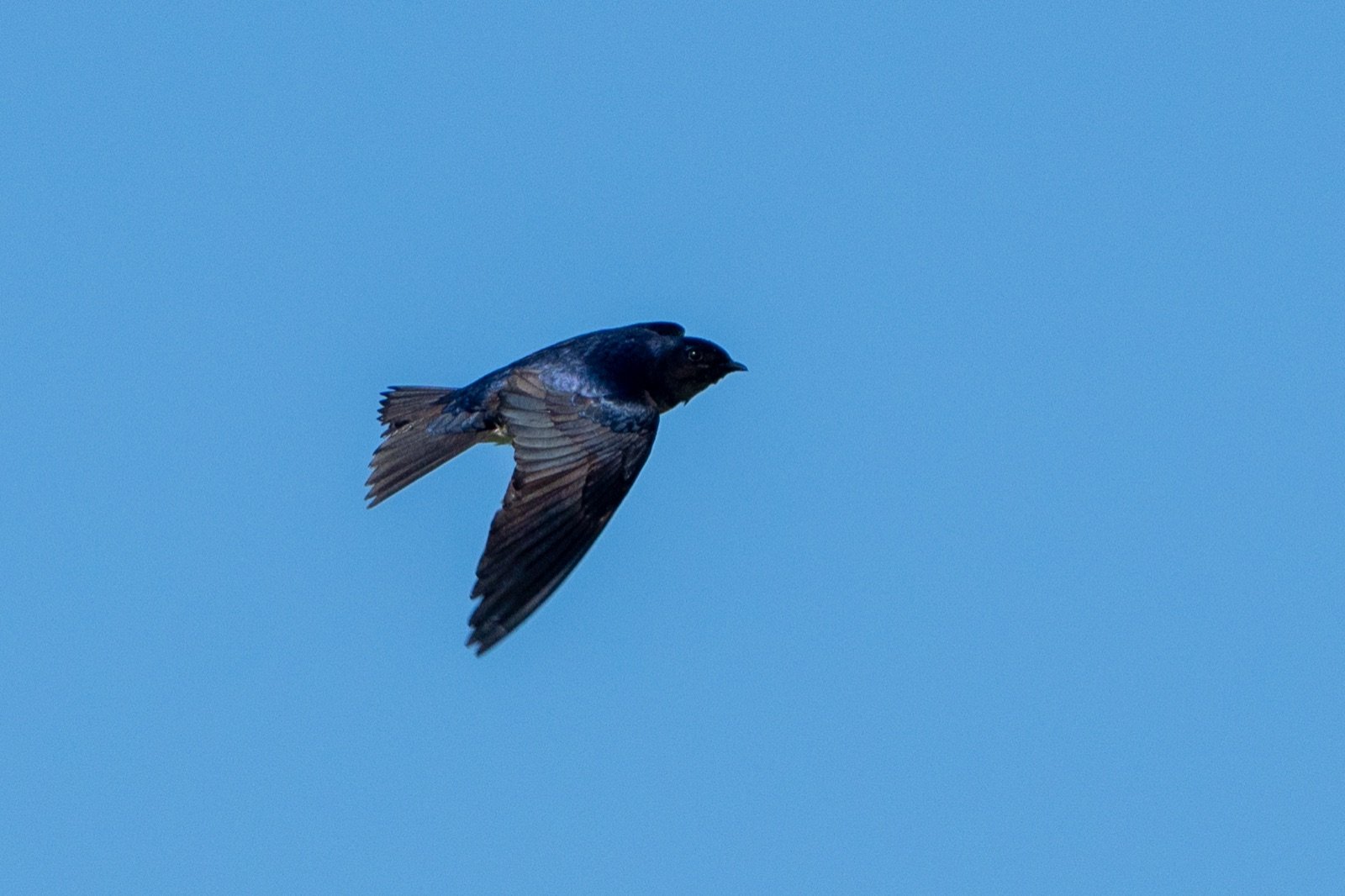
Family Hirundinidae
Southern Martin
Progne elegans
In Spanish: Martín Sureño (Golondrina)
- A
A big, dark swallow that strays to Costa Rica only by accident.
Southern Martin is not a bird to plan a Costa Rican trip around. The official Costa Rican list gives it status A, meaning accidental. It is not a resident, and the list marks it as a vagrant, so a sighting here would be a major rarity.
Its home is far away. It breeds in southern South America and winters in Amazonia, and Costa Rica lies far north of both areas. Globally it is rated Least Concern with a stable trend, so any bird here is a stray from a healthy population.
For a beginning birder the useful lesson is how to look at martins. A dark martin deserves a careful second look, because several Progne martins resemble one another.
How to find it
Costa Rica has no known site for this bird, so finding one comes down to luck and careful looking. Check flocks of dark martins over open country, towns, farmland and water, the kinds of places the species uses elsewhere. Look closely at every dark martin rather than passing over it. Compare each one with the resident Gray-breasted Martin. Note the belly pattern, since brown-edged feathers on a male and black scaling on a female are the marks that help.
How to recognise it
Across its range, Southern Martin is a large, dark, stocky swallow with a long body and a deeply notched tail. The male is about 19 cm long.
Males: glossy bluish-purple, often looking blackish in the field. Some belly and chest feathers have brown edges, which is a clue.
Females: duller blue above (blackish in one description) and dusky brown below. Pale feather edges give a scaly look, with black scaling on the belly. The undertail coverts are white with dusky streaks.
Juveniles: they resemble females.
What it sounds like
Recording: Pablo H Capovilla, CC BY 4.0, source, read 4 Nov 2026.
Behaviour and diet
Across its range, Southern Martin catches flying insects in flight, often in flocks over open country and near water. Outside breeding it may gather in large groups.
In winter it sometimes flocks with Gray-breasted Martins, so a flock of dark martins is worth scanning bird by bird.
Where it lives
Across its range, Southern Martins often use towns, farmland and watercourses. At home they nest in colonies on buildings, bridges and cliffs, and do well in towns.
On the wintering grounds in Amazonia the species feeds high above forested areas. Costa Rica has no known population, so any bird here would be far off course from its normal wintering area in the western Amazon.
When to see it
Costa Rica has no regular season for this bird. In Peru it is expected as a southern migrant from April to October, the austral winter.
Similar birds
Purple Martin is the main look-alike, and a male Southern Martin is very hard to separate from a male Purple Martin in the field. Even experts find it difficult. Gray-breasted Martin is the resident Progne martin in Costa Rica. Brown-chested Martin, the other South American Progne visitor, is also on the Costa Rican list and is a different bird again.
Names and lore in Costa Rica
The official Costa Rican list gives Martín Sureño, with Golondrina in brackets as the everyday word for swallow. Panama, Ecuador and Peru use the same name, while Argentina, Chile, Paraguay, Uruguay and Venezuela say Golondrina Negra, and Colombia says Golondrina Sureña. The genus name Progne comes from a Greek myth about a queen turned into a swallow, and elegans is Latin for elegant or fine.
Status and conservation
The official Costa Rican list gives Southern Martin status A, accidental, so it is a vagrant and not a resident.
How we know this 11 sources, each read on the date shown
- Lista Oficial de las Aves de Costa Rica (AOCR) read 2026-11-04
https://listaoficialavesdecostarica.wordpress.com/lista-oficial/lista-oficial-online/ - Wikipedia read 2026-11-04
https://en.wikipedia.org/wiki/List_of_birds_of_Costa_Rica - Avibase read 2026-11-04
https://avibase.bsc-eoc.org/checklist.jsp?region=CR - Cornell Birds of the World read 2026-11-04
https://birdsoftheworld.org/bow/species/soumar/cur/introduction - Wikipedia read 2026-11-04
https://en.wikipedia.org/wiki/Southern_martin - Peru Aves read 2026-11-04
https://www.peruaves.org/hirundinidae/southern-martin-progne-elegans/ - Birding Puerto Madryn read 2026-11-04
https://birdingpuertomadryn.com/species/southern-martin/ - IUCN Red List read 2026-11-05
https://www.iucnredlist.org/species/22731723/281002872 - Avibase read 2026-11-05
https://avibase.bsc-eoc.org/species.jsp?avibaseid=AF527712EAC38F6F - Aves de Peru read 2026-11-05
https://avesdeperu.org/hirundinidae/martin-sureno-progne-elegans/ - Nemesis Bird read 2026-11-05
https://nemesisbird.com/news/bird-news/prospect-park-progne-mega-martin-mystery/