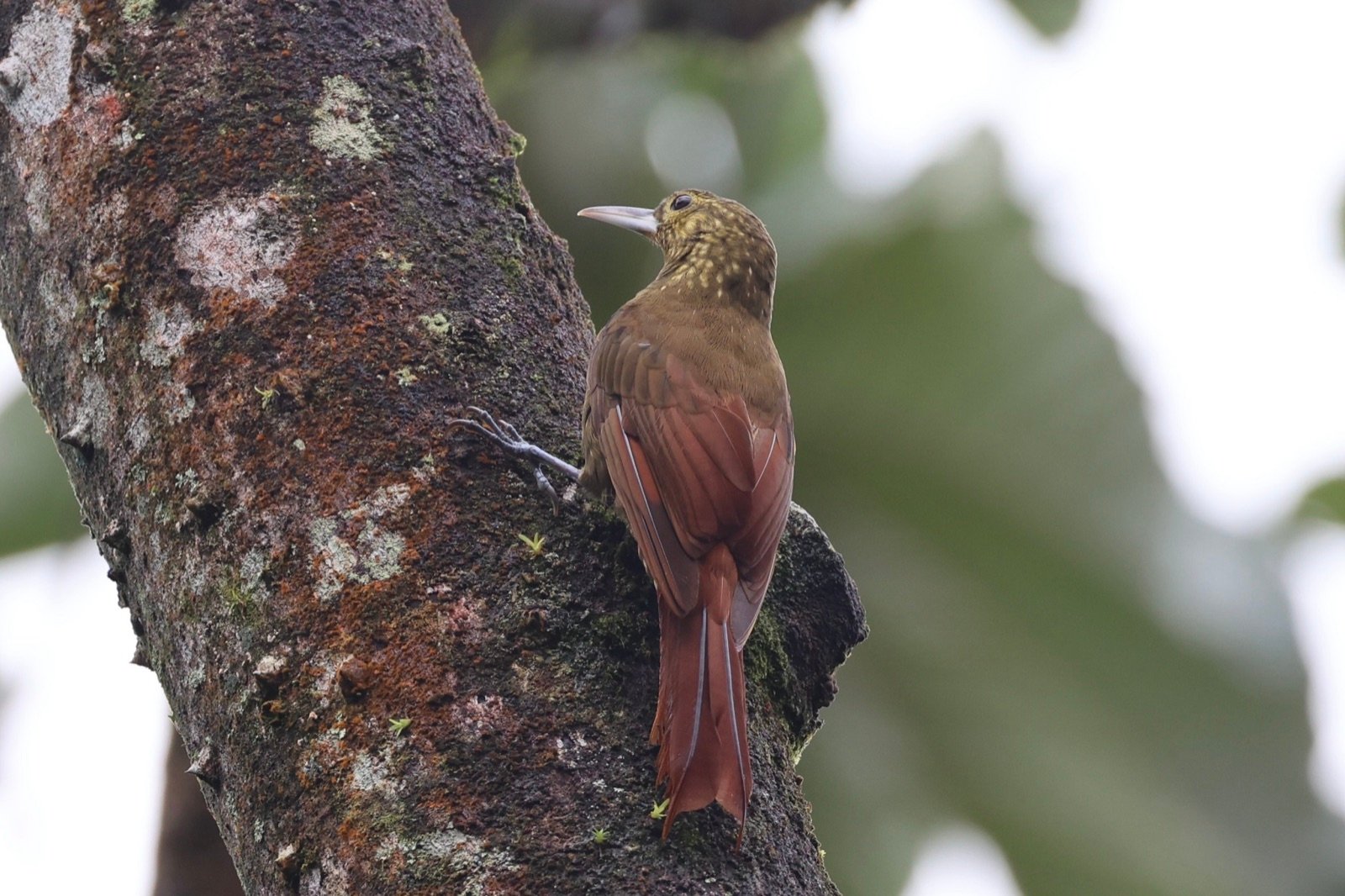
Family Furnariidae
Spotted Woodcreeper
Xiphorhynchus erythropygius
In Spanish: Trepador Manchado
- Resident
A plain, buff-eyed climber of foothill and cloud forest, found by its falling whistles.
The Spotted Woodcreeper, Trepador Manchado in Spanish, is easy to overlook until you hear it. In Costa Rica it is most often seen at middle levels and in the canopy of humid foothill and cloud forest.
Visitors meet it as a common member of mixed flocks in those forests. On a trip we build, early listening pays off, because its descending ringing notes often give away a bird hidden in the dense canopy.
This page covers how to recognise it, how to sort it from similar woodcreepers, and the Costa Rican places where it has been photographed or recorded.
How to find it
Start with your ears, since early morning listening is the best way to detect it. It sings mostly at dawn and dusk. A descending series of ringing notes is one of the most reliable clues, and it often gives away a bird hidden in the dense canopy. Look at middle levels and in the canopy of humid foothill and cloud forest. Check mixed flocks, where it is a common member. Once you hear it, scan epiphyte-laden limbs and bromeliads.
How to recognise it
This is a medium woodcreeper, about 19 to 24 cm long, and a rather plain one.
Look for these marks:
Olive-brown head and back.
A clear buffy eyering.
A pale bill, with the head paler than the back.
Spots on the head and breast, which turn into short streaks on the back.
In Costa Rica it shows diffuse buff spotting. The Costa Rican subspecies, punctigula, ranges from southeastern Nicaragua through Costa Rica into central Panama.
What it sounds like
Recording: Niels Krabbe, CC BY-SA 4.0, source, read 5 Nov 2026.
Behaviour and diet
Across its range it is found at all levels of the forest canopy and often joins mixed-species feeding flocks. It climbs trunks and larger branches in a spiral, and it also creeps along the underside of large limbs. It often visits bromeliads. It is a rather vocal bird, singing mostly at dawn and dusk and less often in the middle of the day. Recordings at Las Cruces Biological Station on the south Pacific slope include a dawn song and two short calls heard at about 10 am.
Where it lives
Across its range it is usually found in the canopy and interior of mature forest, and it also visits forest edges, old second growth and plantations with trees near forest. It seems to prefer forest thick with moss and epiphytes. Most records range-wide are between 600 and 1800 m, locally up to 2200 m, or down to 300 m. In Costa Rica, as in Colombia and Ecuador, it is sometimes found closer to sea level than elsewhere in its range. Southern populations use tall lowland rainforest as well as mountain forest. Here it has been recorded in Puntarenas, Alajuela, and on the Caribbean slope.
When to see it
In Costa Rica and Panama it nests between March and June.
Similar birds
Cocoa Woodcreeper is sometimes confused with it. Cocoa has a plain buffy throat patch and heavy, extensive streaking on the forehead and crown, while Spotted has a heavily spotted throat and spots on the head. Spot-crowned Woodcreeper is the common woodcreeper of high elevation forest, with a thin, slightly downcurved bill and spots on the head. It is rarely found below 1,500 m in Costa Rica, while Spotted is a foothill and cloud forest bird. A plain dark brown woodcreeper with a dark bill and a strong dark moustache stripe is a different bird.
Names and lore in Costa Rica
In Costa Rica the bird is called Trepador Manchado. Other Spanish names are used elsewhere: trepatroncos punteado in Ecuador, trepatroncos moteado in Mexico, and trepador maculado in Nicaragua.
Status and conservation
Listed as resident (R) on the AOCR list; the IUCN does not consider it threatened and describes it as fairly common in its natural forest habitats.
Photography tips
Scan epiphyte-laden limbs, since it feeds on trunks and larger branches and often visits bromeliads. Look beneath horizontal branches as well as on trunks, because it creeps along the underside of large limbs.
How we know this 16 sources, each read on the date shown
- Birds Colombia (from Wikipedia text) read 2026-11-04
https://birdscolombia.com/2022/11/09/trepatroncos-manchado-spotted-woodcreeper-xiphorhynchus-erythropygius/ - Wikipedia read 2026-11-04
https://en.wikipedia.org/wiki/Spotted_woodcreeper - Wikipedia (Spanish) read 2026-11-04
https://es.wikipedia.org/wiki/Xiphorhynchus_erythropygius - EcoRegistros read 2026-11-04
https://www.ecoregistros.org/sheet/Xiphorhynchus-erythropygius - Macaulay Library read 2026-11-04
https://macaulaylibrary.org/asset/252834091 - Cloudbridge Nature Reserve bird list read 2026-11-04
https://www.cloudbridge.org/wp-content/uploads/2020/04/Especies-de-Aves-Costa-Rica-13-April-2020.pdf - BirdForum read 2026-11-04
https://www.birdforum.net/threads/woodcreeper-at-yatama-lodge-caribian-slope-of-costa-rica-in-jan-2025.465899/ - Birds of the World (Cornell) read 2026-11-04
https://birdsoftheworld.org/bow/species/spowoo1/cur/introduction?media=photos - Birding Craft read 2026-11-04
https://birdingcraft.com/wordpress/2011/11/07/tips-on-woodcreeper-identification-when-birding-costa-rica/ - Birding Craft read 2026-11-04
https://birdingcraft.com/wordpress/2021/11/24/which-bird-vocalizations-to-study-for-birding-in-costa-rica/ - Organization for Tropical Studies, Las Cruces bird songs read 2026-11-04
https://tropicalstudies.org/sonidosaveslc/Bird%20Songs%20of%20LCBS-recording%20info%20&%20credits.pdf - Birds of the World read 2026-11-04
https://birdsoftheworld.org/bow/species/spowoo1/cur/introduction - Aves Ibericas, Aves Costa Rica read 2026-11-04
https://www.avesibericas.es/costaricaaves5.htm - BirdForum read 2026-11-04
https://www.birdforum.net/threads/woodcreeper-at-tayutic-mountain-reserve-caribian-slope-of-costa-rica-in-jan-2025.466046/ - Birds of the World (public summary) read 2026-11-04
https://hbw.com/ibc/species/spotted-woodcreeper-xiphorhynchus-erythropygius - Wikipedia read 2026-11-04
https://en.wikipedia.org/wiki/Spot-crowned_woodcreeper