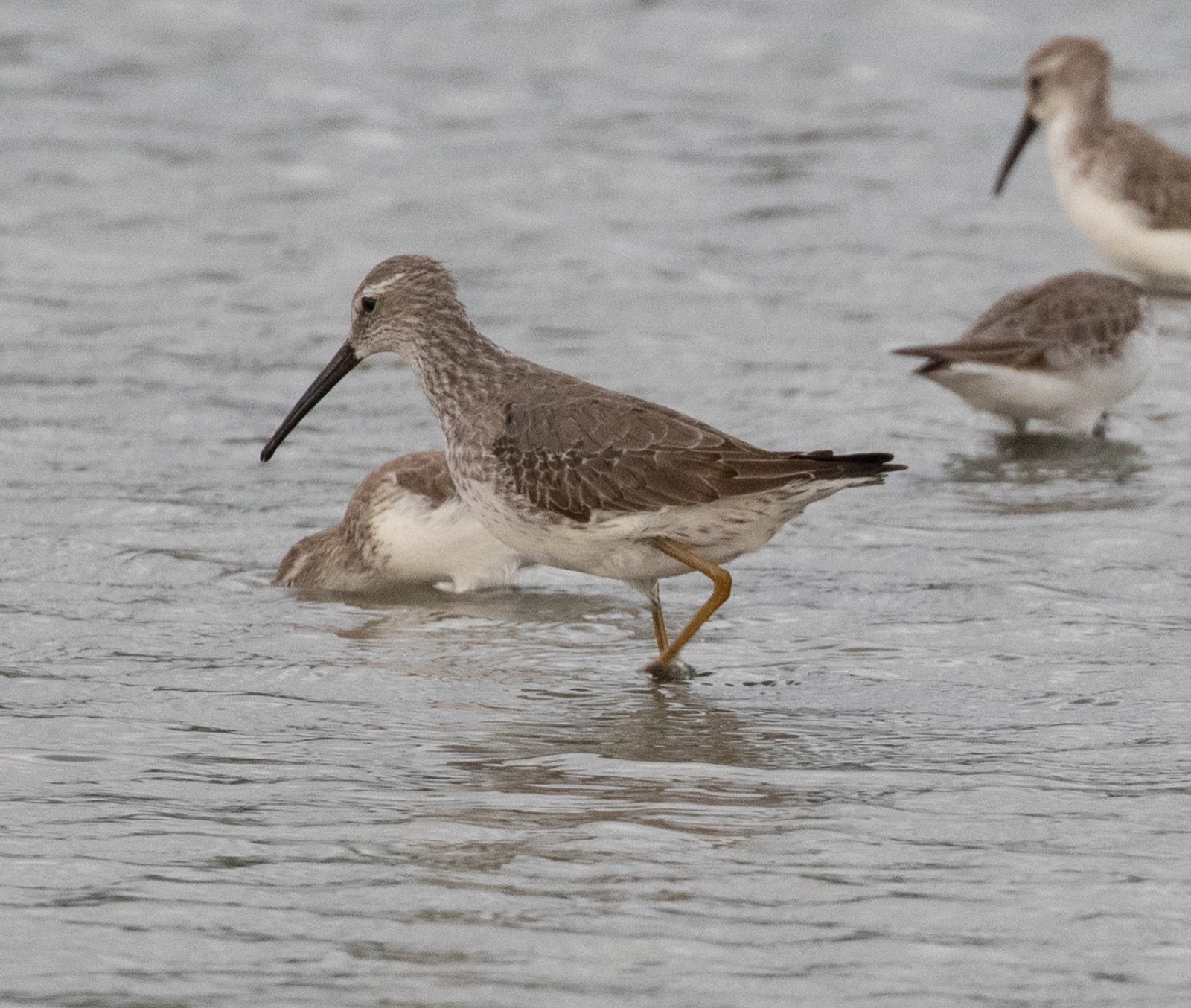
Family Scolopacidae
Stilt Sandpiper
Calidris himantopus
In Spanish: Correlimos Patilargo (Patudo, Becacina)
- Migrant
A long-legged migrant wader of Pacific salt pans and the Gulf of Nicoya
The Stilt Sandpiper (Correlimos Patilargo) breeds in northern Alaska and Canada and winters mainly in southern South America. It also winters regularly in Costa Rica, where it is a fairly common but local migrant on the Pacific slope.
The place to start is the Gulf of Nicoya, where it is rare to locally common as a winter resident. Think of shallow, muddy water: salt pans, pond edges and marshes.
It often feeds in tight flocks, wading belly deep, so a group is easier to pick out than a single bird. That makes it a rewarding wader for a beginner to learn, and the long greenish legs and slightly drooping bill set it apart once you know what to look for.
How to find it
Look on the Pacific side at salt pans and muddy pond edges, especially around the Gulf of Nicoya. Scan for compact groups rather than lone birds, since it often feeds together and the cluster helps you spot it. Watch for birds wading deep with heads dipping underwater. Once you have a group in the scope, check for greenish legs, the slight droop at the bill tip and the pale eyebrow. Timing a visit to the passage periods gives you the best chance.
How to recognise it
This is a starling-sized sandpiper, about 22 cm long. Learn it by these marks:
- Long greenish legs.
- A long bill that droops slightly at the tip.
- No stripe in the wings.
- A white eyebrow in every plumage.
Breeding adults are heavily barred dark on white underneath, with reddish orange patches around the white eyebrow. Winter birds are gray above and white below, and keep the white eyebrow.
These marks describe the species in general, so the plainer winter look may be what you meet on birds passing through Costa Rica.
What it sounds like
Behaviour and diet
The Stilt Sandpiper feeds in tight flocks. Birds wade belly deep, walk slowly, and probe the mud with the bill, sweeping the head and neck side to side underwater.
Its diet includes aquatic insects and larvae, small molluscs, crustaceans and worms, all found in the soft bottoms of the shallow water where it works.
The method resembles a dowitcher's, but the legs are longer, a useful clue when you scan a busy flock of shorebirds.
Where it lives
It uses shallow, muddy-bottomed fresh or salt water, such as salt pans, pond edges and marshes. In Costa Rica it is a bird of the Pacific slope, where it is fairly common but local. The Gulf of Nicoya is its best-known area, with rare to locally common winter residents. A later study also found it in rice fields in Guanacaste.
When to see it
Passage periods run from mid August to late October and from mid March to late May. There are no records for the summer months.
Similar birds
The Curlew Sandpiper is a Costa Rican rarity that looks similar, with a long bill, long neck, pale eyebrow and white rump. The Stilt Sandpiper has a straighter bill, longer greenish-yellow legs rather than black ones, and shows no wingbar in flight. Its wading and mud-probing also resemble the Short-billed Dowitcher, which is on the Costa Rican list, but the Stilt's legs are longer. It seems intermediate between dowitchers and yellowlegs.
Names and lore in Costa Rica
Costa Rican lists give the Spanish names Correlimos Patilargo, Patudo and Becacina. Patudo and Becacina are also used for several other small sandpipers, so they are not specific to this bird. A review of Costa Rican waterbirds uses the spelling Becasina, and in other countries it is also called Playerito Pata Largas.
Status and conservation
The official Costa Rican list marks it as M, a migrant, and the species is listed as Near Threatened on the IUCN scale.
Photography tips
High tide is the key for views. Birds pushed off the mud flats gather in the ponds near the coast, so they are closer and easier to see than at low tide, when most are distant silhouettes.
How we know this 12 sources, each read on the date shown
- Flickr (reposted Costa Rican natural history account) read 2026-11-04
https://www.flickr.com/photos/jobando/39610313940 - Explore Costa Rica blog read 2026-11-04
https://explorecr.blogspot.com/2012/04/colorado-de-abangares.html - Wikipedia (via iNaturalist) read 2026-11-04
https://www.inaturalist.org/taxa/3850-Calidris-himantopus - Guide to Boreal Birds read 2026-11-04
https://www.borealbirds.org/bird/stilt-sandpiper - Lista Oficial de las Aves de Costa Rica (AOCR) read 2026-11-04
https://listaoficialavesdecostarica.wordpress.com/lista-oficial/lista-oficial-online/ - Wikipedia read 2026-11-04
https://en.wikipedia.org/wiki/Stilt_sandpiper - Cornell Lab, All About Birds read 2026-11-04
https://www.allaboutbirds.org/guide/Stilt_Sandpiper/sounds - Aves Costa Rica (avesibericas.es) read 2026-11-04
https://www.avesibericas.es/costaricaaves2.htm - Alvarado & Quesada 2006, Aves acuáticas y humedales de Costa Rica read 2026-11-04
https://www.heronconservation.org/media/JHBC/vol04/art02/resources/alvarado_quesada-2006a.pdf - Birding Craft read 2026-11-05
https://birdingcraft.com/wordpress/2015/11/05/tips-for-birding-in-costa-rica-at-chomes-and-puerto-morales/ - ResearchGate, New Information on Costa Rican Waterbirds read 2026-11-05
https://www.researchgate.net/publication/269579522_New_Information_on_Costa_Rican_Waterbirds - Avibase read 2026-11-05
https://avibase.bsc-eoc.org/species.jsp?avibaseid=ECDE73F2E6E6E622