Family Scolopacidae
Curlew Sandpiper
Calidris ferruginea
In Spanish: Correlimos Zarapitín
- Migrant
A rare Siberian shorebird that hides among the small peeps
The Curlew Sandpiper is a long-distance migrant. It breeds in the Siberian Arctic and winters mainly in Africa, southern Asia and Australasia. Records in the Americas are very occasional, and Costa Rica is no exception.
The official Costa Rican bird list gives it the status M, the code for a migrant. The IUCN lists the country as a place where it has been recorded as a non-breeding vagrant, a stray bird well outside its normal range. One Spanish-language species page for the Costa Rican fauna also lists it as a vagrant, not a regular visitor.
For a beginning birder this is a bird to know about rather than to plan around. Learning the common small sandpipers first is the best preparation for the day one of these turns up among them.
How to find it
Work through flocks of Costa Rica's usual three small peeps (Least, Western and Semipalmated Sandpipers) one bird at a time, because a Curlew Sandpiper can hide among them. The 1984 bird was netted inside a flock of Western and Semipalmated Sandpipers. Look for longer legs, a longer neck and a longer, more smoothly curved bill. Watch for the tilted rear end while it feeds, since the white rump shows from far away and helps pick it out of a flock. Listen too for a softer, rippling call than a Dunlin's.
How to recognise it
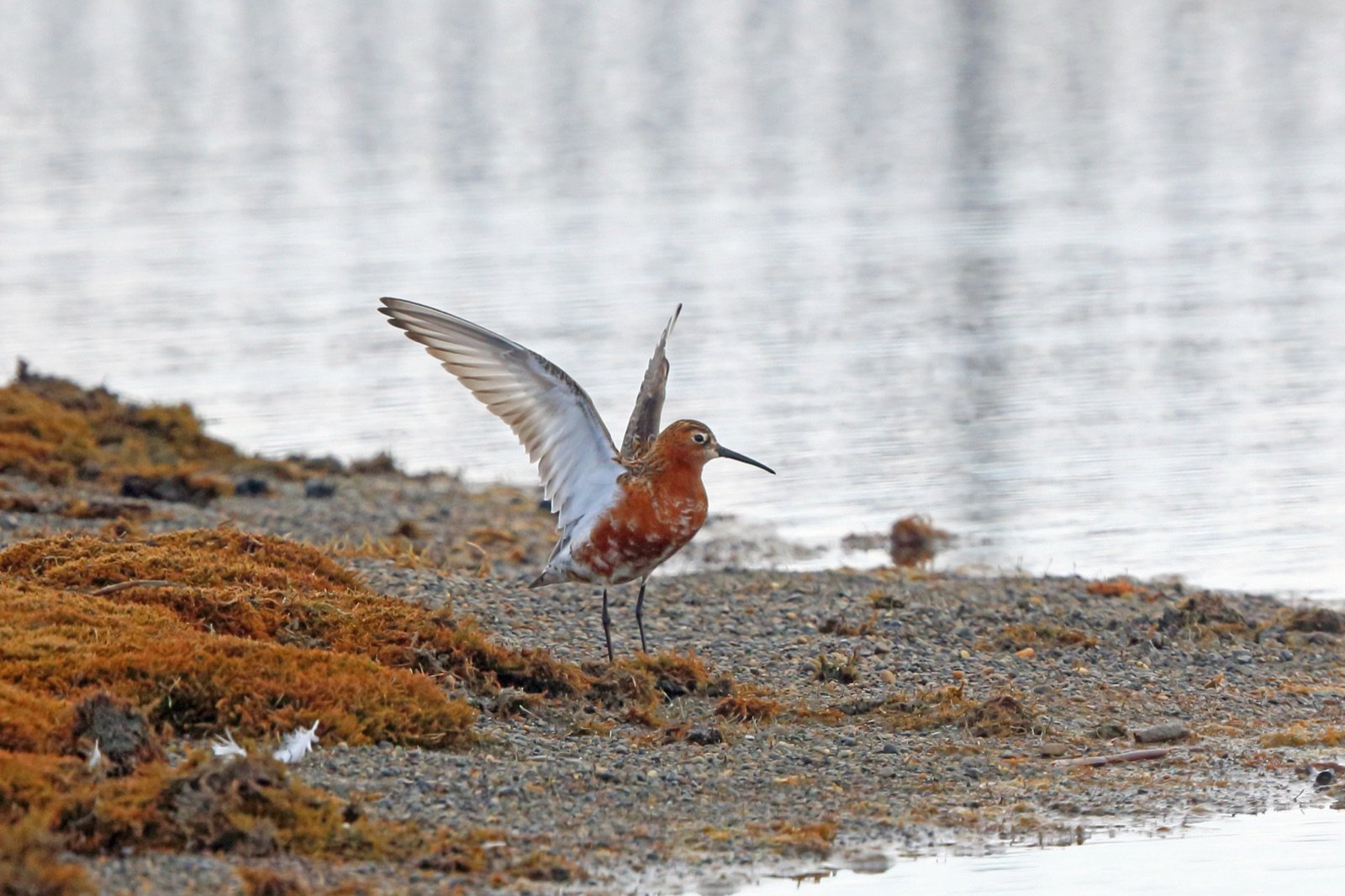
Breeding adults are mostly rich reddish brown. Juveniles and winter adults are gray above and whitish below. In non-breeding plumage it is pale ash gray above and clean white below, with a faint pale eyebrow stripe above the eye.
The clearest marks, in plain terms:
A long, dark, strongly downcurved bill, longer and thinner than a Dunlin's, with a smoother curve.
Slim, dark legs, longer than a Dunlin's.
A longer neck than a Dunlin, and a bird a little larger overall.
A pure white rump in flight, at every age and season.
It is also darker and more slender than a Red Knot. When it feeds, the long legs tilt the rear end up, and this shows the white rump from far away.
What it sounds like
Behaviour and diet
It feeds in shallow water, probing the mud with its bill and sometimes picking items off the surface. It often wades a bit deeper than Dunlins when the two feed together, and it hunts by sight along muddy shores and coastal marshes.
It is very sociable and often joins flocks of other small sandpipers, especially Dunlin. That is useful to know when scanning flocks in Costa Rica, because a stray is most likely to be found inside one.
Where it lives
Across its range it uses intertidal mudflats of estuaries, lagoons and mangroves. It also uses beaches, rocky shores and the edges of lakes.
In Costa Rica the known records come from near Colorado in Guanacaste, where a bird was mist-netted, and from the San José area, where a specimen was collected. Both were found among or near other small shorebirds.
When to see it
The Guanacaste bird was netted on 7 November 1984, and the first San José-area specimen was collected on 16 November 1985. Both dates fall in autumn, which suggests autumn migration.
Similar birds
The Dunlin is the usual look-alike in non-breeding plumage, but the Curlew Sandpiper has longer legs and a longer, thinner, more curved bill. The Red Knot is larger and has a straight bill. In Costa Rica the real challenge is the flock of Least, Western and Semipalmated Sandpipers around it. A Brazilian record described one beside Semipalmated Sandpipers by its long, pointed, downcurved bill, long legs and gray back and breast.
Names and lore in Costa Rica
The official Costa Rican name is Correlimos Zarapitín. Other Spanish sources call it Playero Zarapito, Correlimos Cucharón and Correlimos de Garganta Roja.
Status and conservation
The official Costa Rican list (2025-2026 version) codes it M, a migrant, while the IUCN treats Costa Rica as a place of non-breeding vagrants and lists the species as Vulnerable worldwide, with a decreasing population.
Photography tips
The long legs lift the rear end while it feeds, and this shows the white rump from far away. Use that tilt to pick the bird out of a flock of peeps before you raise the camera.
How we know this 17 sources, each read on the date shown
- Lista Oficial de las Aves de Costa Rica (AOCR) read 2026-11-04
https://listaoficialavesdecostarica.wordpress.com/lista-oficial/lista-oficial-online/ - IUCN Red List read 2026-11-04
https://www.iucnredlist.org/species/22693431/180593985 - Audubon Field Guide read 2026-11-04
https://www.audubon.org/field-guide/bird/curlew-sandpiper - Birds in Backyards (Australian Museum) read 2026-11-04
https://www.birdsinbackyards.net/species/Calidris-ferruginea - Animalia.bio read 2026-11-04
https://animalia.bio/es/curlew-sandpiper - Bird Identifier read 2026-11-04
https://birdidentifier.com/encyclopedia/curlew-sandpiper - The Condor (Digital Commons @ USF) read 2026-11-04
https://digitalcommons.usf.edu/cgi/viewcontent.cgi?article=12388&context=condor - Kingbird (Wilson, New York State) read 2026-11-04
https://nybirds.org/KBsearch/y2001v51n1/y2001v51n1p460-477wilson.pdf - Birds of North America read 2026-11-04
https://www.birds-of-north-america.net/Curlew_Sandpiper.html - Wikipedia (es) read 2026-11-04
https://es.wikipedia.org/wiki/Calidris_ferruginea - Blog de Francisco Javier Torres Goberna read 2026-11-04
http://oestrymnio.blogspot.com/2015/11/correlimos-zarapitin-calidris-ferruginea.html - EcoRegistros read 2026-11-05
https://www.ecoregistros.org/site/especie.php?id=2855 - uh.app read 2026-11-05
https://uh.app/lib/es/Correlimos-Zarapit%C3%ADn - Featherbase read 2026-11-05
https://www.featherbase.info/es/species/calidris/ferruginea - ResearchGate (Brazilian records paper) read 2026-11-05
https://www.researchgate.net/figure/Curlew-Sandpiper-Calidris-ferruginea-center-with-Semipalmated-Sandpipers-Calidris_fig2_306373814 - Aves de Chile read 2026-11-05
https://www.avesdechile.cl/551.htm - Birds Colombia read 2026-11-05
https://birdscolombia.com/2023/07/25/playero-zarapitin-curlew-sandpiper-calidris-ferruginea/