Family Grallariidae
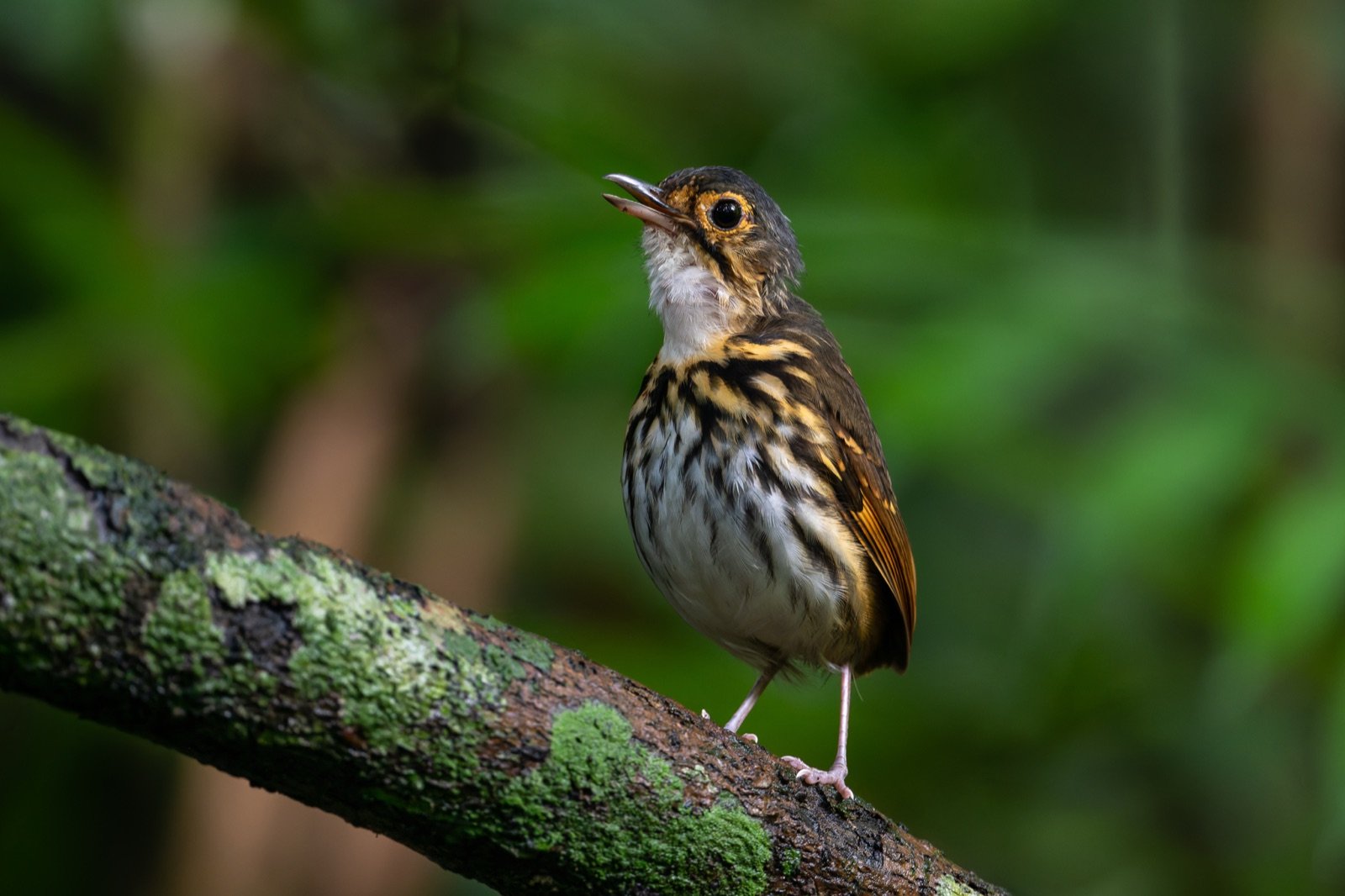
Streak-chested Antpitta
Hylopezus perspicillatus
In Spanish: Tororoi Pechilistado (Hormiguero)
- Resident
A small, haunting-voiced ground bird, easiest at Carara National Park.
The Streak-chested Antpitta (Tororoi Pechilistado) is a small bird of the forest floor, about 12.5 to 14 cm long, and most people find it by ear first. Its call is haunting and a bit melancholic, and it carries far through the forest, often revealing the bird long before you see it.
In Costa Rica it is fairly common on the Pacific side and uncommon on the Caribbean side. On a trip we build, Carara National Park on the Central Pacific coast is the most accessible place to meet the Pacific form, because the understory there is more open than at many other sites.
One birder who knows it in both Costa Rica and Panama found it common at Carara, as easy to view as along Pipeline Road in Panama, and called it the easiest antpitta to see in Central America.
How to find it
For the Pacific form, go to Carara National Park right when it opens and walk the Quebrada Bonita loop. Listen for the sad whistled song, then wait patiently for the bird to show. Scan the forest floor slowly in the direction of the call, since the bird may be standing in the open a few metres away. It often gives itself away by hopping into view or puffing its chest feathers in and out. Antpittas in general are best surprised on a narrow, quiet forest trail, either very early or late in the day. Costa Rica has no antpitta feeding stations, so this one is found by stealth and patience.
How to recognise it
This is a small bird, about 12.5 to 14 cm long and 40 to 54 g.
The crown, back of the neck and mantle are slate gray, turning grayish olive on the rump and shoulder feathers. The brown, grey and white streaked plumage blends into the leaf litter. The back is marked with buffy tear-shaped spots.
The shape helps too: a short stubby tail, long legs and strictly ground-dwelling habits separate antpittas from other understory birds.
The yellow patch before the eye and the wide yellow eye ring belong to the nominate form, which is not the Costa Rican one, so do not expect a bold spectacled look here.
What it sounds like
Recording: Tommy Andriollo, CC BY 4.0, source, read 4 Nov 2026.
Behaviour and diet
It spends nearly all its time on the forest floor, foraging or resting. It hops, sometimes runs, over the ground and stops to toss leaves aside. When resting, it repeatedly puffs its breast feathers in and out in a distinctive way, and that movement often gives it away.
It can also turn up at the edges of army ant swarms. At Carara, birders have had excellent views of two foraging together at a swarm, and one pair opened and closed their wings and briefly jumped on each other while feeding.
It can stand in the open a few metres away unnoticed until it dashes across the ground.
Where it lives
In Costa Rica it lives in lowland evergreen forest in the tropical and lower subtropical zones, reaching about 1,200 m elevation. It keeps to the lower level and the floor of the forest.
In the southern Pacific it prefers mature humid forest with an open understory, and it is described as common in the southern Pacific lowlands. Calls have been recorded on farms near forest in the Golfo Dulce Forest Reserve area.
One form lives on the Caribbean slope, and another, lizanoi, on the Pacific slope of southern Costa Rica.
Similar birds
Costa Rica's Caribbean and Pacific slope birds differ in song and in flank colour. The Caribbean form has unstreaked buffy flanks and sings higher, starting on a high note. The Pacific form has little or no streaking on the back and sings mostly below 2 kHz, starting low, rising slightly for a few notes, then falling.
Names and lore in Costa Rica
Costa Ricans call it Tororoi Pechilistado, which literally means streak-chested. Nicaragua uses Hormiguero Pechirrayado, and Honduras uses Hormiguero de Anteojos. Colombia and Ecuador use Tororoi de Anteojos.
Status and conservation
The AOCR lists it as a resident (R), and the IUCN rates it Least Concern.
Photography tips
Birders at Carara can watch the antpittas hop around in the more open understory, which makes the park a good place to try for photos. Once found, it can allow long views even with a group of birders a few metres away.
How we know this 12 sources, each read on the date shown
- Wikipedia read 2026-11-04
https://en.wikipedia.org/wiki/Streak-chested_antpitta - Wikipedia (Spanish) read 2026-11-04
https://es.wikipedia.org/wiki/Hylopezus_perspicillatus - Redalyc (acoustic study, Golfo Dulce) read 2026-11-04
https://www.redalyc.org/journal/6650/665078627001/ - Birdingcraft read 2026-11-04
https://birdingcraft.com/wordpress/tag/costa-rica-antpittas/ - Birdingcraft read 2026-11-04
https://birdingcraft.com/wordpress/2013/05/03/carara-can-be-great-for-antbirds/ - Aratinga Tours read 2026-11-04
https://aratinga-tours.com/ghost-birds-costa-rica/ - Birds on a Shoestring read 2026-11-04
https://birdsonashoestring.wordpress.com/2011/08/04/277/ - Birdingcraft read 2026-11-04
https://birdingcraft.com/wordpress/2020/05/27/streak-chested-antpitta-in-costa-rica-one-or-two-species/ - Cornell Birds of the World read 2026-11-04
https://birdsoftheworld.org/bow/species/stcant2/cur/introduction - Avibase read 2026-11-04
https://avibase.bsc-eoc.org/species.jsp?avibaseid=7280923D5939FCA6 - Birding Craft read 2026-11-04
https://birdingcraft.com/wordpress/2023/12/13/costa-rica-birds-endemic-near-endemic-and-other-target-species/ - Panama Wildlife blog read 2026-11-04
http://panama-wildlife.blogspot.com/2018/04/featured-species-streak-chested.html