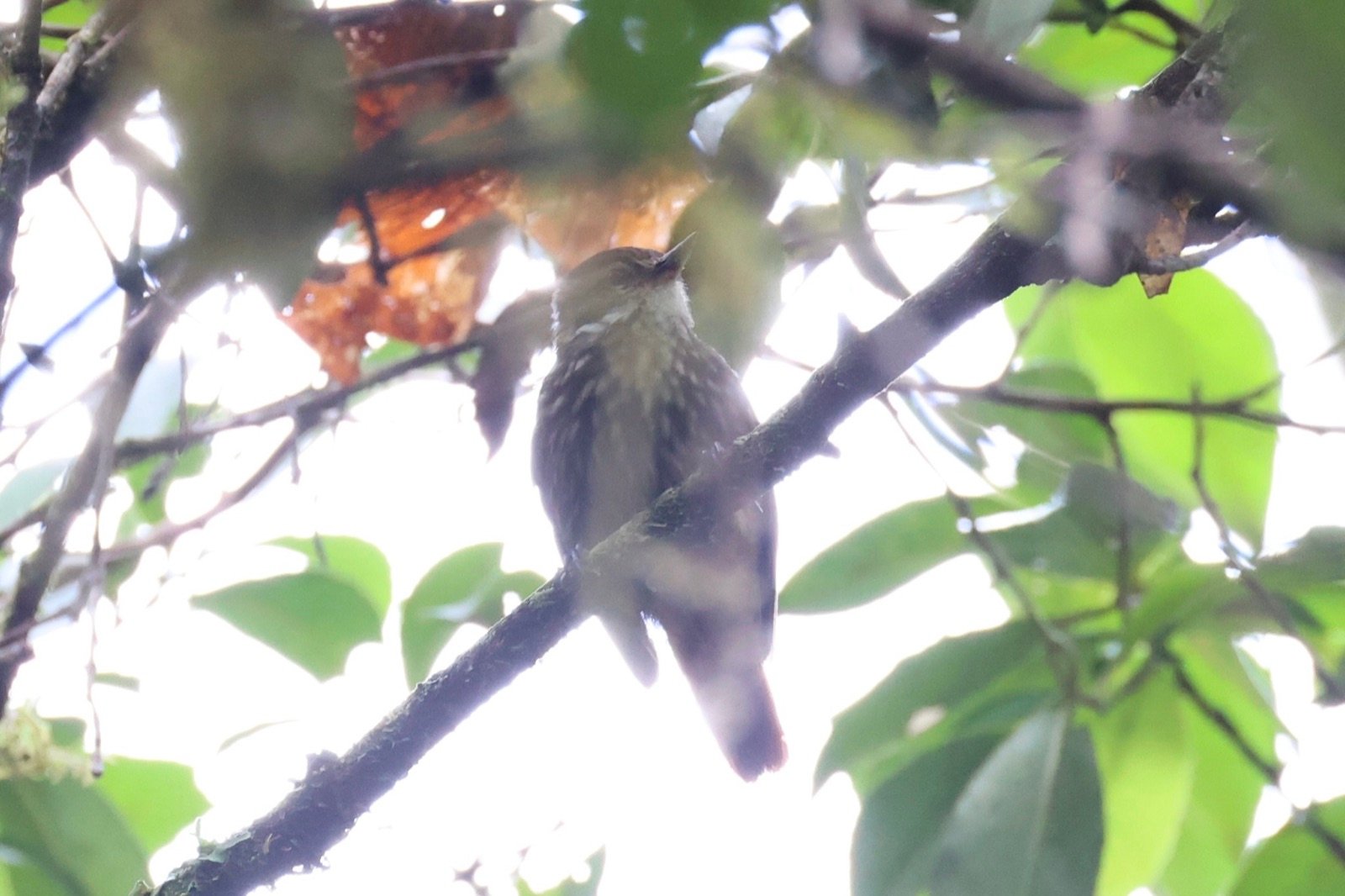
Family Furnariidae
Streaked Xenops
Xenops rutilans
In Spanish: Xenops Rayado
- Resident
A small, scarce bark-climber of highland mixed flocks, best met at Tapantí.
The Streaked Xenops is a small ovenbird that creeps over trunks and twigs in Costa Rica's middle and high elevation forest, roughly 1,200 to 2,500 m (3,900 to 8,200 ft). Costa Rica is the northern end of the species' range.
Tour lists call it much less common than the Plain Xenops, so a sighting feels earned. One birding writer names Tapantí as the only accessible, reliable place in the country for it, and says it is where most birders see their first one.
For a beginner, the trick is to stop looking for a single bird and start checking flocks. On trips we build, highland forest is where guests have the best chance of meeting it, usually briefly.
How to find it
Check every mixed-species flock you meet in highland forest, and watch the middle levels. At Tapantí one bird was found with a small flock that also held Slaty-capped Flycatcher and tanagers. Scan bark, rotting stumps and bare twigs, where it is hard to spot. Listen for the descending metallic notes, since you will often hear it first. Be ready for brief views: one March group had just that at Río Macho, while another group at Tapantí got excellent looks at a single bird.
How to recognise it
This is a small bird, about 12 to 13 cm long, with a short, thick, wedge-shaped bill.
Look for these marks:
- a buff eyebrow stripe
- a pure white stripe along the side of the throat
- a brown back, turning rufous on the rump and tail
- olive-brown underparts with white streaks
Males and females look alike, so there are no two plumages to sort out. The white-streaked underparts help separate it from the Plain Xenops, which has much plainer, unstreaked underparts.
What it sounds like
Behaviour and diet
The Streaked Xenops climbs tree trunks in any direction like a treecreeper, without propping itself on its tail. It eats insects and other arthropods, including wood-boring beetle larvae, and sometimes catches flying termites.
It often joins mixed-species feeding flocks, usually in the middle levels of the forest. Across its range it is usually met in pairs, and it forages anywhere from the understory up to the subcanopy.
Where it lives
In Costa Rica this xenops lives at middle and high elevations, roughly 1,200 to 2,500 m (3,900 to 8,200 ft). Across its range it uses humid mountain and foothill forest and edges, and it can also use secondary and regenerating forest.
In Costa Rica it has been recorded in the highlands of Cartago Province around Tapantí, in the Savegre Valley, in the Monteverde region and at Cloudbridge Nature Reserve.
When to see it
Breeding in Costa Rica runs from January to May. Tour reports place sightings in March and May, but these are single trip records, not a seasonal pattern.
Similar birds
The Plain Xenops is the look-alike, but its underparts are much plainer and unstreaked. In Costa Rica the two barely overlap. The Streaked lives in upper middle elevation forest, generally above the Plain's range, so elevation is a useful clue. The Plain is also the more common and more often seen of the two.
Names and lore in Costa Rica
In Costa Rica and Panama the bird is called Xenops Rayado. Elsewhere in Spanish-speaking South America it is known as picolezna rojizo (Paraguay, Argentina) and xenops estriado (Colombia).
Status and conservation
The AOCR list marks it as a resident (R), and the IUCN rates the species as Least Concern.
Photography tips
Checking mixed flocks is a good way to find it, and it can then be worth waiting at the flock's edge for a bird to settle. At Tapantí one stopped in the open and preened for a couple of minutes, giving a tour group great scope views, though such views are not the rule.
How we know this 14 sources, each read on the date shown
- Wikipedia read 2026-11-04
https://en.wikipedia.org/wiki/Streaked_xenops - Cloudbridge Nature Reserve bird list read 2026-11-04
https://www.cloudbridge.org/wp-content/uploads/2020/04/Bird-Species-List-Costa-Rica-13-April-2020.pdf - JungleDragon read 2026-11-04
https://www.jungledragon.com/specie/22927/streaked-xenops.html - Ecoregistros read 2026-11-04
https://www.ecoregistros.org/sheet/Xenops-rutilans?idusuario=628&idlugar=64268&idpais=7&idprovincia=47 - Wikipedia (Spanish) read 2026-11-04
https://es.wikipedia.org/wiki/Xenops_rutilans - Field Guides Birding Tours, Costa Rica 2024 trip list read 2026-11-04
https://fieldguides.com/triplists/cos24.html - Field Guides Birding Tours, Costa Rica 2018 trip list read 2026-11-04
https://fieldguides.com/triplists/cos18.html - Cornell Birds of the World read 2026-11-04
https://birdsoftheworld.org/bow/species/strxen1/cur/introduction - quetzalbycar.com read 2026-11-04
https://www.quetzalbycar.com/locations/el-copal-and-tapanti-np - Birding Craft read 2026-11-04
https://birdingcraft.com/wordpress/category/middle-elevations/page/2/ - Field Guides trip list 2017 read 2026-11-04
https://fieldguides.com/triplists/cos17.html - Rockjumper trip report 2017 read 2026-11-04
https://app.rockjumperbirding.com/sites/rockjumper/attachments/9/Trip%20Report%20-%20RBL%20Costa%20Rica%20-%20Cloud%20Forest%20&%20Quetzals%20and%20Ext%202017.pdf - Ecosistemas de Costa Rica read 2026-11-04
https://ecosistemasdecostarica.blogspot.com/2012/08/aves.html - Field Guides trip list 2020 read 2026-11-04
https://fieldguides.com/triplists/cos20.html