Family Furnariidae
Buffy Tuftedcheek
Pseudocolaptes lawrencii
In Spanish: Trepamusgo Cachetón
- Resident
- Regional endemic
A bromeliad digger of the highland oak forest, with buffy neck tufts.
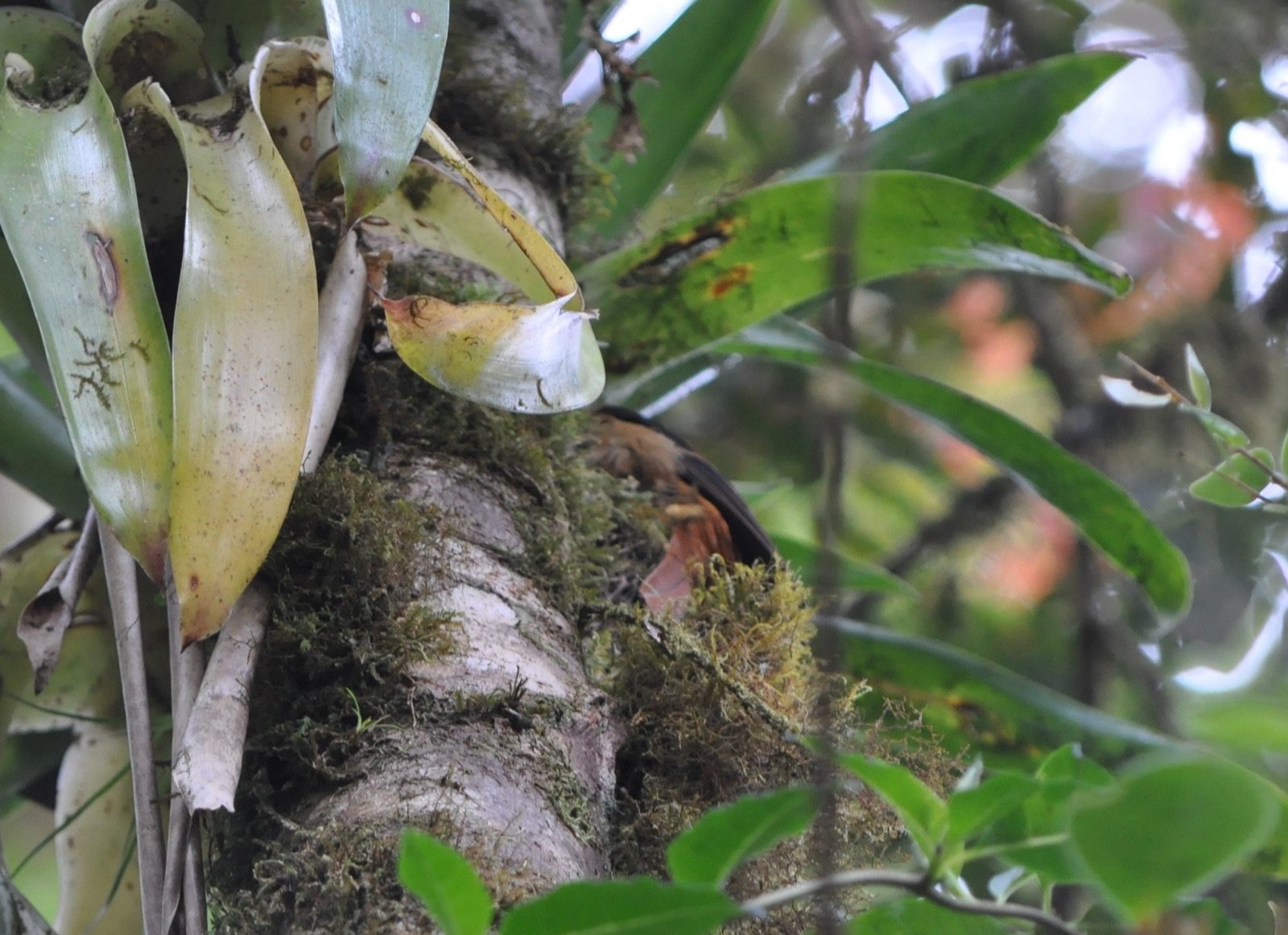
The Buffy Tuftedcheek (Trepamusgo Cachetón) works hard for its living. It climbs right into bromeliads and flips leaves about vigorously, hunting for insects and other small animals.
It lives in Costa Rica and Panama only, since the South American birds were split off as Pacific Tuftedcheek, and the AOCR list marks it as a resident endemic.
On a trip we build into the Talamanca highlands, guests meet it in the Savegre Valley and San Gerardo de Dota, where oak forest is hung with bromeliads. One tour operator lists it as a target bird there, and a trip report from January 2023 called it hilarious looking.
How to find it
Look for it inside big bromeliads in oak forest, often with mixed flocks. Bits of debris flying out of the plants show where the bird is working. Moss clumps and epiphytes on big trees are good places to wait, since a bird has been filmed foraging in moss at 2,313 m near Savegre. Forest edges work too: a tour group found one along the edge in the Savegre area together with Ruddy Treerunner. Guided walks are a typical way to meet it, and a walk in February 2024 turned one up with a mixed flock.
How to recognise it
Start with the throat. A buffy throat runs into a clear buffy tuft on the side of the neck, and that sets this bird apart from other birds in its range.
The cheek and throat carry a buff tint.
The back is unstreaked.
The neck tufts can be flared out when the bird is excited or agitated.
Young birds look different from adults. They lack the buff streaks on the crown, and they show sootier marks on the back and belly and more orange flanks.
What it sounds like
Behaviour and diet
This is a bird of the middle levels and canopy. It searches bromeliads, vine tangles, mosses and other plants that grow on trees.
It often climbs right into a bromeliad and flips leaves about vigorously, looking for prey. It often joins mixed feeding flocks, and in the oak forest above Savegre a group watched a pair feeding inside them.
Nesting in Costa Rica is reported in a tree cavity.
Where it lives
It lives in cloud forest and favors fairly open stretches, the edges of denser forest, and clearings with scattered trees. Across its range it goes from about 1,550 m up to the treeline at about 3,000 m.
In Costa Rica it occurs from the central part of the Central Highlands southward. It is uncommon to fairly common in the Central Volcanic and Talamanca ranges, from 2,000 m up to the treeline, and a rare resident in the Tilarán range above 1,600 m. It rarely strays down to 1,200 m on the Caribbean side.
When to see it
Nesting in Costa Rica is reported between January and May.
Similar birds
The related Streaked Tuftedcheek lives in the Andes, not in Costa Rica. It has a streaked back, while this species has an unstreaked back and a buff tint on the cheek and throat. Remember that young Buffy Tuftedcheeks look different from adults, with no buff crown streaks and more orange flanks.
Names and lore in Costa Rica
Costa Ricans call it Trepamusgo Cachetón. Another Spanish name, used in Panama, is Barbablanca Anteada.
Status and conservation
The AOCR lists it as a resident endemic (R-END), and the IUCN rates it Least Concern, with the bird considered uncommon to fairly common in Costa Rica and found in several protected areas.
Photography tips
Wait near moss clumps and epiphytes on big trees, where birds have been filmed foraging. Watch for flying debris to locate a bird inside a bromeliad, and check the edges of mixed flocks along forest edges and trails.
How we know this 20 sources, each read on the date shown
- Cornell Birds of the World read 2026-11-04
https://birdsoftheworld.org/bow/species/buftuf1/cur/introduction - Wikipedia read 2026-11-04
https://en.wikipedia.org/wiki/Buffy_tuftedcheek - Birds for Beer (blog) read 2026-11-04
https://birdsforbeer.com/2015/06/04/buffy-tuftedcheek/ - Macaulay Library read 2026-11-04
https://macaulaylibrary.org/asset/201211321 - Cloudbridge Nature Reserve read 2026-11-04
https://www.cloudbridge.org/wp-content/uploads/2020/04/Bird-Species-List-Costa-Rica-13-April-2020.pdf - Birds of the World (HBW Alive Ornithological Note 87) read 2026-11-04
https://birdsoftheworld.org/bow/ornith-notes/JN100087 - Animalia.bio (from Wikipedia) read 2026-11-04
https://animalia.bio/buffy-tuftedcheek - Field Guides Birding Tours, Costa Rica 2020 trip list read 2026-11-04
https://fieldguides.com/triplists/cos20.html - Manuel Antonio birding by Johan Chaves read 2026-11-04
https://manuelantoniobirding.wordpress.com/ - Naturalist Journeys trip report, March 2025 read 2026-11-04
https://www.naturalistjourneys.com/pdf/trip-reports/1713-202503-central_america-costa_rica-trip_report.pdf - Birds Wildlife tour itinerary, 2026 read 2026-11-04
https://birdswildlife.com/costa-rica-the-ultimate-tour-march-21st-07th-april-2026/ - Flickr tuftedcheek tag page (species notes) read 2026-11-04
https://www.flickr.com/photos/tags/tuftedcheek - Holbrook Travel read 2026-11-04
https://www.holbrooktravel.com/where-we-travel/central-and-south-america/costa-rica/costa-rica-birding-central-south-pacific-and - Fatbirder, Costa Rica Escape 2023 trip report read 2026-11-04
https://fatbirder.com/wp-content/uploads/2025/09/Costa-Rica-Escape-2023-Trip-Report.pdf - Naturalist Journeys trip report, February 2024 read 2026-11-04
https://www.naturalistjourneys.com/pdf/trip-reports/1178-202402-central_america-costa_rica-trip_report.pdf - Wikipedia (Spanish) via Wikiwand read 2026-11-04
https://www.wikiwand.com/es/Pseudocolaptes_lawrencii - Avibase read 2026-11-04
https://avibase.bsc-eoc.org/species.jsp?avibaseid=74CEB92D4147EBD4 - BirdWeather (Wikipedia text) read 2026-11-04
https://app.birdweather.com/species/buffy-tuftedcheek - Macaulay Library / HBW species page read 2026-11-04
https://www.hbw.com/ibc/species/buffy-tuftedcheek-pseudocolaptes-lawrencii - Macaulay Library read 2026-11-04
https://macaulaylibrary.org/video/201211321?__hstc=65717809.c4a577029c49e44b73bd3bee6fa38565.1711065600378.1711065600379.1711065600380.1&__hssc=65717809.1.1711065600381&__hsfp=892594048