Family Cuculidae
Striped Cuckoo
Tapera naevia
In Spanish: Cuclillo Listado (Rondero, Tres Pesos, Ave de las Ánimas)
- Resident
A shaggy-crested cuckoo that whistles from scrub and forest edge.
The Striped Cuckoo (Cuclillo Listado) is the easy one of Costa Rica's two ground-dwelling cuckoos. The other, the Pheasant Cuckoo, is very hard to find, while the Striped lives along forest edges.
It is a bird you meet first by ear. It is shy and heard more often than seen, but imitating its whistle often makes it show itself.
It has been spreading in Costa Rica in recent years, apparently as forests are cleared, mainly in the humid lowlands of the southern Pacific and the Caribbean. Birders meet it along river edges, entrance drives and lowland fields.
How to find it
Listen for the song from scrubby fields, tangled second growth and edge habitat. The bird is hard to spot when it is not singing, so let your ears lead. A local guide says the song is easy to imitate, and imitating it often makes the bird show itself. One tour group heard one, then found it along the Río Tárcoles just after a boat trip started. Another was seen through a scope along an entrance drive in the deep south.
How to recognise it
This is a medium-sized cuckoo, about 27 to 30 cm long across its range, with a long tail.
Look for these marks:
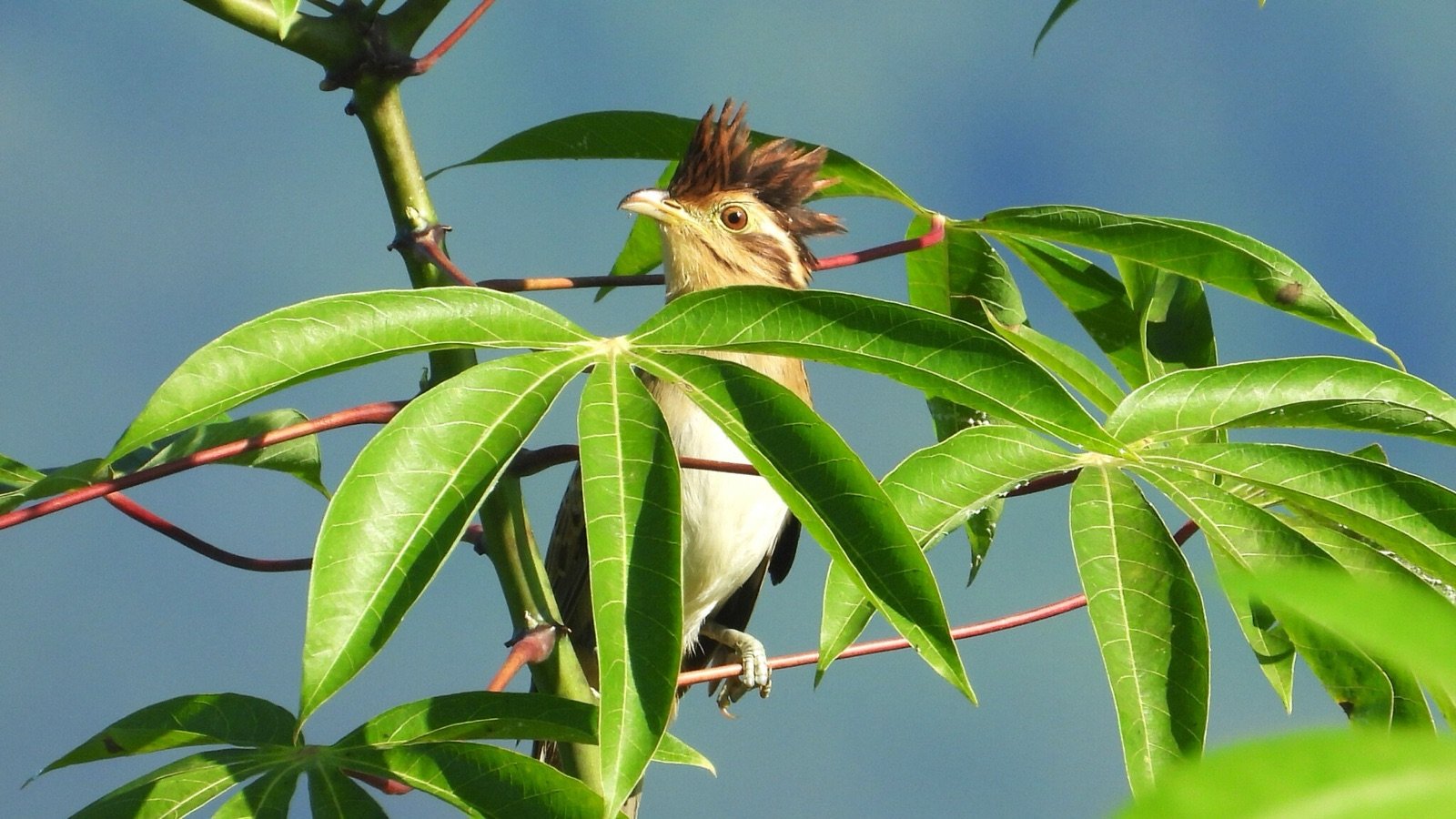
A short, shaggy, reddish-brown and black crest.
A pale eyebrow stripe and a dark malar stripe.
A brown back streaked with black.
Off-white underparts.
A conspicuous black alula, a small wing feather.
Long upper tail coverts, about half the length of the tail.
Young birds are spotted with buff and look more rufous on the back and wings.
What it sounds like
Behaviour and diet
The Striped Cuckoo is solitary and active by day. It eats large insects, mainly grasshoppers and caterpillars, often picked off the ground. It tends to stay in bush cover but will sing from more open perches. When alarmed or disturbed it flashes its alulae.
It is also a brood parasite, laying eggs in the domed nests of other birds. Hosts known in Costa Rica include spinetails, Thryothorus wrens and Arremon sparrows.
Where it lives
In Costa Rica it lives in open areas with scattered trees, pasture, secondary forest, savanna, scrub and farmland. A guide reports hearing it in humid places below about 1,400 m wherever there is enough edge habitat. One photo record comes from El Rodeo Forest Reserve, San José, at 966 m, where the bird was foraging in a field.
It is mainly a bird of the humid lowlands of the southern Pacific and the Caribbean, with smaller numbers in the Central Valley.
When to see it
The song is a common part of the soundscape during much of the year in Costa Rica. One tour report noted that birds were usually not too vocal at that time of year.
Similar birds
It is the only cuckoo in its range with a streaked back, which is how it got its name. Its short shaggy crest, pale eyebrow and dark malar stripe separate it from other Costa Rican cuckoos. The only other ground-dwelling cuckoo in the country is the very hard-to-find Pheasant Cuckoo.
Names and lore in Costa Rica
In Costa Rica the species is called Cuclillo Listado, and local names include Rondero, Tres Pesos, Guía león and Ave de las Ánimas. The name Cuclillo Listado is used in Costa Rica and Nicaragua, while other countries use different names, such as cuco rayado in Mexico and crespín in Argentina.
Status and conservation
The AOCR official list classes it as a resident (R) in Costa Rica, and the IUCN lists it as Least Concern.
Photography tips
Once you have heard one, scan hedgerows and river edges, since it will sing from more open perches. Imitating the whistle can coax it into the open, and a bird was photographed this way in the Sarapiquí lowlands. A scope helps for a bird sitting in cover.
How we know this 17 sources, each read on the date shown
- Aves de Costa Rica read 2026-11-04
https://www.avesdecostarica.com/Tapera-naevia.html - Macaulay Library read 2026-11-04
https://macaulaylibrary.org/asset/201222491 - Naturesongs via Animal Diversity Web read 2026-11-04
https://www.animaldiversity.org/collections/contributors/naturesongs/stcu1/ - BirdWeather (Wikipedia text) read 2026-11-04
https://app.birdweather.com/species/striped-cuckoo - Wikipedia read 2026-11-04
https://en.wikipedia.org/wiki/Striped_cuckoo - Animal Diversity Web read 2026-11-04
https://animaldiversity.org/accounts/Tapera_naevia/ - AOCR Lista Oficial read 2026-11-04
https://listaoficialavesdecostarica.wordpress.com/lista-oficial/lista-oficial-online/ - Birding Craft read 2026-11-04
https://birdingcraft.com/wordpress/2010/07/12/striped-cuckoos-are-common-costa-rica-but-wheres-the-pheasant/ - Field Guides Birding Tours read 2026-11-04
https://fieldguides.com/triplists/cos18.html - Field Guides Birding Tours read 2026-11-04
http://fieldguides.com/triplists/cos12.html - Field Guides Birding Tours read 2026-11-04
https://fieldguides.com/triplists/cr119.html - Birding Craft read 2026-11-04
https://birdingcraft.com/wordpress/tag/striped-cuckoo/ - Howler Magazine read 2026-11-04
https://howlermag.com/cuckoo-birds-in-costa-rica/ - Wikipedia (es) read 2026-11-04
https://es.wikipedia.org/wiki/Tapera_naevia - Birds Colombia (Wikipedia text) read 2026-11-04
https://birdscolombia.com/2017/04/10/cuco-sin-fin-tapera-naevia/ - Morlan bird photo notes read 2026-11-04
https://fog.ccsf.edu/~jmorlan/LA2Chile-Dec2017/StripedCuckooIMG_9382.htm - Aves y Ventanas Costa Rica read 2026-11-04
https://avesyventanascostarica.wordpress.com/algunas-aves-que-han-golpeado-contra-ventanas-en-costa-rica/