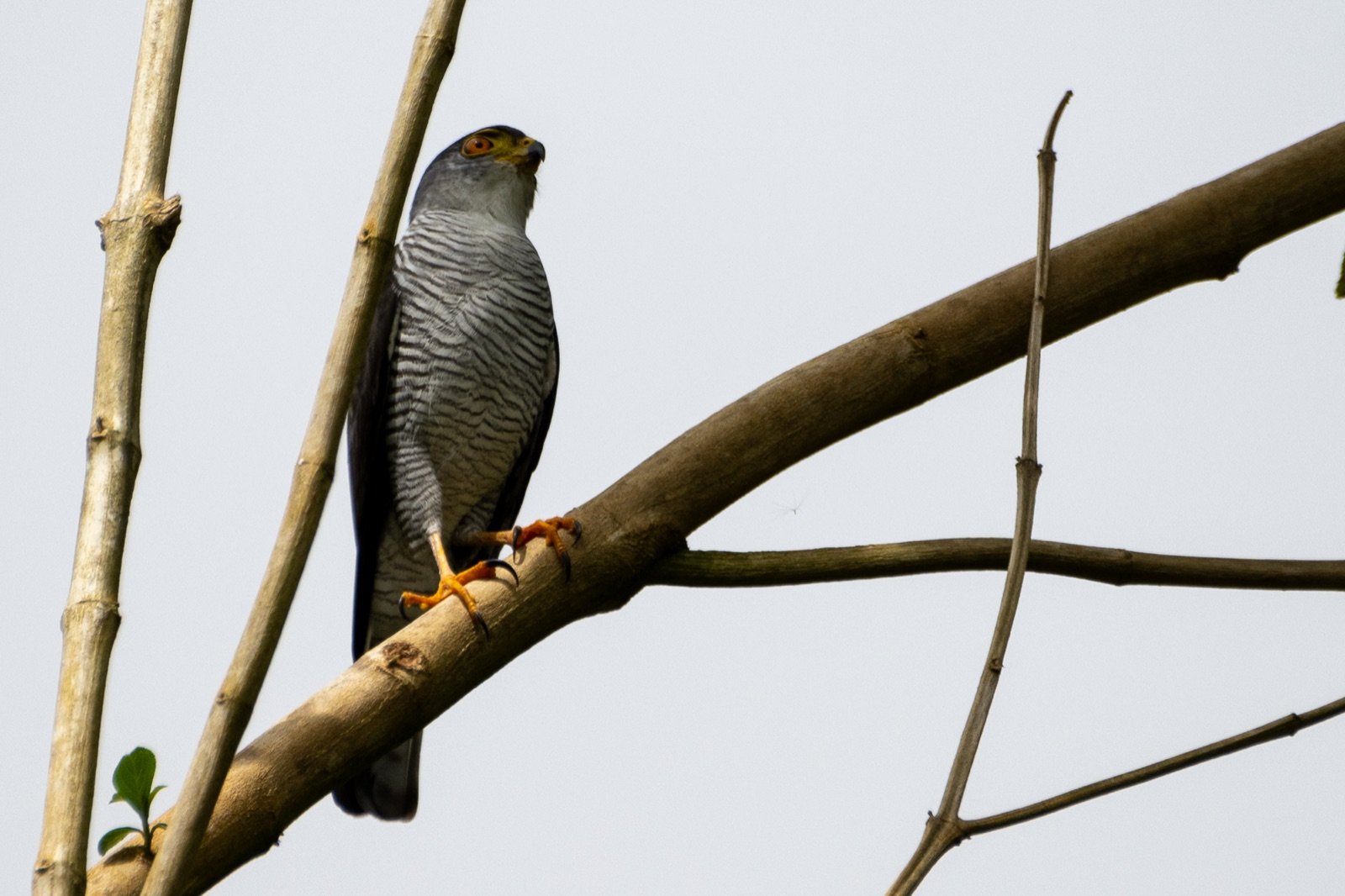
Family Accipitridae
Tiny Hawk
Microspizias superciliosus
In Spanish: Gavilán Enano (Camaleón)
- Resident
One of the smallest hawks in the world, easily taken for a robin.
The Tiny Hawk is one of the smallest hawks in the world, and at first glance it may be mistaken for a robin. Males weigh only about 75 g, which makes it the smallest daytime forest raptor in the Americas.
In Costa Rica it lives on the Caribbean slope and in the Golfo Dulce region of the southern Pacific slope. It is described as rare to fairly uncommon, and perhaps overlooked, so a sighting is a quiet reward for patient scanning of the treetops.
Costa Ricans call it Gavilán Enano, and also Camaleón. Below is what we can say about how to recognise it, where it has been recorded, and how to give yourself a fair chance on a trip.
How to find it
Check forest clearings and edges with scattered trees, fruiting trees and hummingbird activity, and scan the treetops. Look closely at any thrush-like bird that suddenly appears. If small birds are loudly mobbing something in the trees, look carefully, because it may be a Tiny Hawk. Early morning and late afternoon are the times it is more likely to perch in the open, usually on a high branch, so check treetops then and use a scope. Good views have come from canopy towers or from the top of a bare tree at a forest edge, while dense mature forest, where you look up from far below, makes views hard.
How to recognise it
Think small, then smaller. Here are the marks to look for:
Underparts: white with fine gray barring, with an unmarked throat.
Tail: fairly long, dark, with three paler gray bands.
Eyes: red or red-brown in adults, often yellowish in immatures.
Females: browner above, with buffier underparts and browner barring below.
Juveniles: rufous. A young bird perched high in a tree looks much like a thrush, and the short tail and compact shape help separate it.
The Central American form, found from Nicaragua to western Ecuador, is smaller and darker than the South American form. It has a shorter tail and sharper, blacker barring below.
Behaviour and diet
The Tiny Hawk hunts by waiting hidden, then dashing out to catch small songbirds and hummingbirds. It can learn the regular perches in hummingbird territories and ambush the birds there. It hunts alone and is rarely seen in pairs.
It sometimes sunbathes on exposed branches in the morning, which can give a chance to spot it. It may also follow mixed flocks and catch unwary birds. Because of its small size it can sit in plain sight among mobbing small birds and go unnoticed; one birder saw exactly this once at Manzanillo.
Where it lives
In Costa Rica it occurs in humid lowlands and foothills, and in some places it reaches about 1200 m elevation. It uses the canopy and edges of humid forest, and tall secondary forest next to it.
On the Caribbean slope, good habitat is lowland or foothill rainforest. On the Pacific slope it is humid forest from around Carara south to the Golfo Dulce area.
Similar birds
At first glance it can be mistaken for a songbird, a robin or a pygmy-owl. In flight it can look like a thrush or a Myiarchus flycatcher. A bird that seems not quite right, perched in the canopy, deserves a longer look.
Names and lore in Costa Rica
Costa Ricans call it Gavilán Enano, and also Camaleón. A survey of Spanish raptor names lists Camaleón as the name used in Costa Rica, and Gavilán Enano as a name used in Colombia, Costa Rica and Venezuela. Another Spanish name for the species is Gavilancito Americano.
Status and conservation
The AOCR list treats the Tiny Hawk as a resident in Costa Rica, and globally it is rated Least Concern.
Photography tips
Early morning and late afternoon are the times it is more likely to perch in the open, usually on a high branch, so use a scope on the treetops. Canopy towers and bare trees at forest edges have given good views. Watch the edge of a mixed flock for a lurking bird that suddenly dashes in, and listen for alarm calls. A juvenile at San Luis stayed long enough for prolonged scope views and photos.
How we know this 17 sources, each read on the date shown
- Ecos del Bosque (citing Stiles and Skutch) read 2026-11-04
https://ecosdelbosque.com/fauna/accipiter-superciliosus - Birding Craft read 2026-11-04
https://birdingcraft.com/wordpress/2022/07/13/thoughts-and-tips-to-see-tiny-hawk-when-birding-costa-rica/ - Birding Craft read 2026-11-04
https://birdingcraft.com/wordpress/tag/caribbean-slope/ - Hotel Rivel blog read 2026-11-04
https://hotelrivel.online/the-mighty-mite-unveiling-the-tiny-hawk-in-costa-rican-rainforests/ - Animalia.bio read 2026-11-04
https://animalia.bio/tiny-hawk - Wikipedia read 2026-11-04
https://en.wikipedia.org/wiki/Tiny_hawk - DiBird read 2026-11-04
https://dibird.com/species/tiny-hawk/ - Earthlife.net read 2026-11-04
https://earthlife.net/tiny-hawks/ - Cornell Birds of the World read 2026-11-04
https://birdsoftheworld.org/bow/species/tinhaw1/cur/introduction - Hawk Mountain, Spanish common names of Latin American raptors read 2026-11-04
https://www.hawkmountain.org/download/?id=4958&dl=1 - Birding Craft read 2026-11-04
https://birdingcraft.com/wordpress/2010/09/07/where-are-the-raptors-when-birding-costa-rica/ - Birding Craft read 2026-11-04
https://birdingcraft.com/wordpress/tag/costa-rica-birding-2022/ - Birding Craft read 2026-11-04
https://birdingcraft.com/wordpress/tag/birding-costa-rica/page/3/ - Birding Craft read 2026-11-04
http://birdingcraft.com/wordpress/2022/07/ - Birding Craft read 2026-11-04
https://birdingcraft.com/wordpress/tag/costa-rica-bird-finding-guide/ - Birding Craft read 2026-11-04
http://birdingcraft.com/wordpress/2019/03/ - 10,000 Birds read 2026-11-04
https://www.10000birds.com/tiny-hawk-at-quebrada-gonzalez.htm