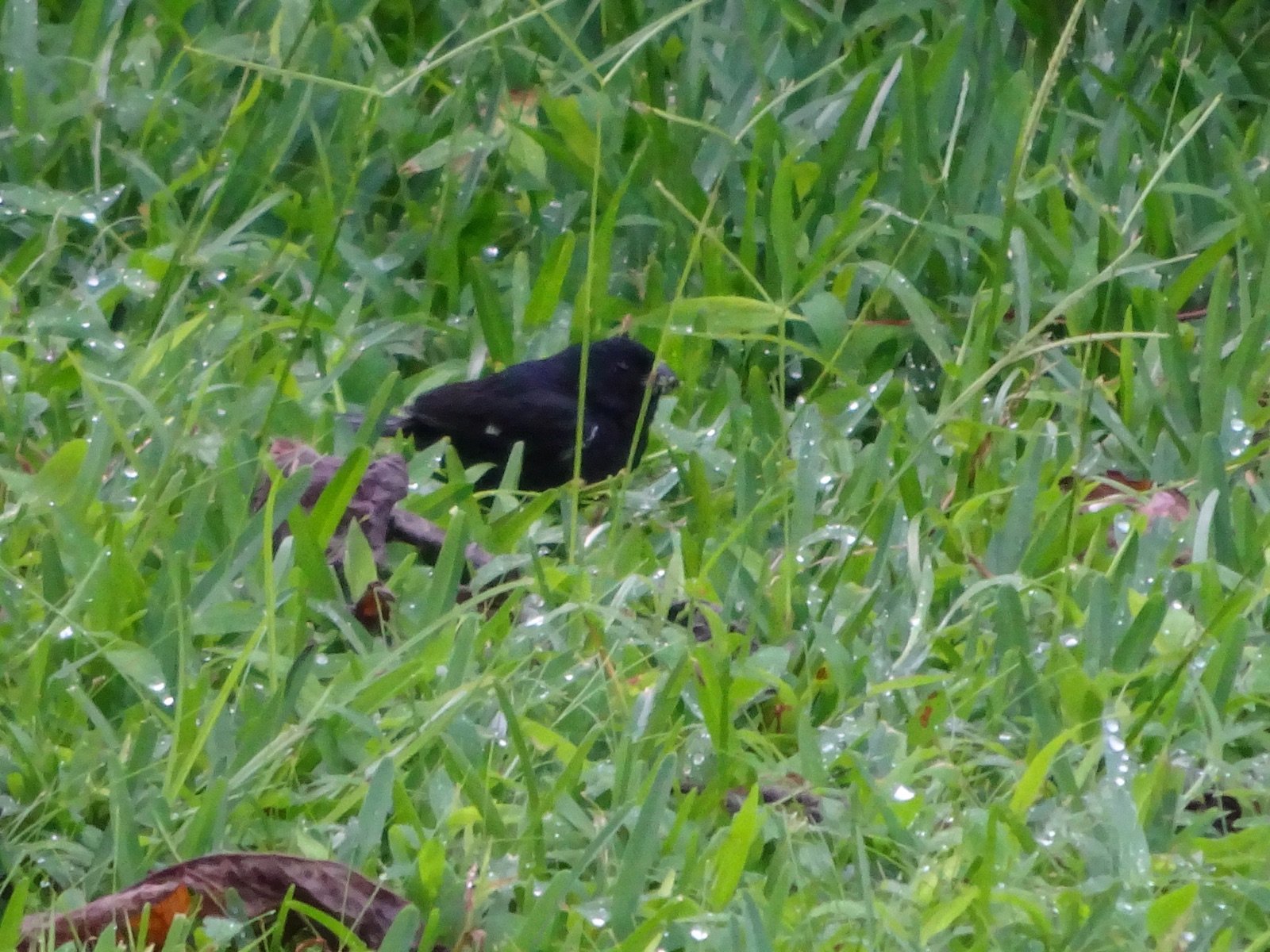
Family Thraupidae
Variable Seedeater
Sporophila corvina
In Spanish: Espiguero Variable (Setillero Collarejo, Monjito, Arrocerito)
- Resident
A tiny seedeater of grassy edges, black on the Caribbean, pied on the Pacific.
The Variable Seedeater is about 10.5 cm long and weighs about 11 g, yet it is one of the easiest small birds to meet in Costa Rica. It is very common wherever grass grows, on empty lots or along road edges, and it is a permanent resident, so it can be seen all year.
Its name is honest. On the Caribbean side the male is all black, while on the Pacific slope he adds a white belly, a white rump and a narrow white crescent on the neck sides. In much of the country the two forms blend, so many birds look in between.
On a trip we build, a morning walk near Chachagua, around Tárcoles and Carara, or in Sarapiquí can all put it in front of you.
How to find it
Check grassy lots and road edges, where it is common, and scrubby gardens. Look for males perched on grass stems. Open areas such as fields, pastures and forest edges suit it, so listen for the trill and watch for small birds flitting from perch to perch. In pasture or young second growth it is easy to find and usually easy to watch. It often shares weedy spots with the slightly larger Thick-billed Seed-Finch, so check each bird's bill as you scan.
How to recognise it
Start with the male, because he changes with the side of the country.
Caribbean male: all black, with white only at the base of the flight feathers. The bill is convex, the best way to tell him from other black seedeaters.
Pacific male: black above with a white rump, plus a white belly and a narrow white crescent on the neck sides.
Both forms: black bill, blackish legs, about 10.5 cm long, about 11 g.
The female is plain drab brown, dull olive above and pale yellowish brown below, with a bill like the male's. On the Pacific side she shows no pattern except a pale whitish belly. She is duller and browner than the females of other seedeaters. The juvenile looks much like her.
What it sounds like
Behaviour and diet
Males often jump up in the air and drop back to the same perch. This acrobatic move is part of the courtship display to attract nearby females. In Costa Rica the breeding season runs from May to October.
These are busy little birds that often cling to tall grass stems and pull out seeds. Males sing from open perches while females feed quietly below. They forage in pairs or small groups, often with other seedeaters, in weedy fields and pastures.
Where it lives
The Variable Seedeater lives in semi-open scrub, forest edges, roadsides and gardens, from sea level up to about 1500 m. It is very common wherever grass grows, on empty lots or along road edges.
The black form is abundant in the lowlands and foothills of the Caribbean side. The Pacific slope form, hoffmanni, lives on the Pacific slope of Costa Rica and extreme western Panama.
When to see it
It is a permanent resident in Costa Rica, so it can be seen all year.
Similar birds
The all-black Caribbean male looks like the male Thick-billed Seed-Finch, but that species has a stouter bill, so check the bill carefully. The Variable Seedeater is smaller, and its female is duller in colour than the female seed-finch. On the Pacific side, males lack the white throat, full collar and wing bars of the White-collared Seedeater (S. torqueola).
Names and lore in Costa Rica
Costa Rican sources list several names: Espiguero Variable, Semillero Variable, Setillero Collarejo and Setillero garganta negra. Other local names are setillero de laguna, and espiguero is also used.
Status and conservation
The AOCR lists it as a resident (R), and the IUCN lists the species as Least Concern.
Photography tips
Scan grass stems along road edges and lots for males on open perches, where they sing in view. Check the bill of each bird, since the seed-finch shares the same spots.
How we know this 18 sources, each read on the date shown
- Cornell Birds of the World read 2026-11-04
https://birdsoftheworld.org/bow/species/varsee3/cur/introduction - Aves de Costa Rica read 2026-11-04
https://www.avesdecostarica.com/Sporophila-corvina.html - The Nature Admirer read 2026-11-04
https://thenatureadmirer.com/2017/08/30/variable-seedeater-sporophila-corvina/ - Diversidad y un poco de todo read 2026-11-04
https://www.diversidadyunpocodetodo.com/semillero-variable-sporophila-corvina/ - xeno-canto read 2026-11-04
https://xeno-canto.org/species/Sporophila-corvina?view=2&pg=2 - Wikipedia (Spanish) read 2026-11-04
https://es.wikipedia.org/wiki/Sporophila_corvina - Hotel Rivel read 2026-11-04
https://hotelrivel.online/a-spot-of-black-and-white-the-enigmatic-variable-seedeater/ - Birds & Breakfast read 2026-11-04
https://birdsandbreakfast.com/en/variable-seedeater/ - Birding Craft read 2026-11-04
https://birdingcraft.com/wordpress/2010/03/11/identifying-variable-and-thick-billed-seed-finches-in-costa-rica/ - Retired in Costa Rica read 2026-11-04
https://www.charliedoggett.net/2022/05/18/variable-seedeater/ - Birding Craft read 2026-11-04
https://birdingcraft.com/wordpress/tag/cerro-lodge/ - Birding Craft read 2026-11-04
https://birdingcraft.com/wordpress/2011/11/14/a-brief-bit-of-birding-in-costa-rica-around-rio-frio/ - World Bird Photos read 2026-11-04
https://www.worldbirdphotos.com/photo/seedeater-variable-sporophila-corvina-female-costa-rica/ - Wikipedia read 2026-11-04
https://en.wikipedia.org/wiki/Variable_seedeater - BirdForum Opus read 2026-11-04
https://www.birdforum.net/opus/Variable_Seedeater - Redalyc (Villegas Retana) read 2026-11-04
https://www.redalyc.org/journal/756/75674979005/html/ - The Firefly Forest read 2026-11-04
https://fireflyforest.net/firefly/2006/07/07/variable-seedeater-or-wing-barred-seedeater/ - Huitzil (Villegas Retana 2022) read 2026-11-04
https://www.mexorn.org/index.php/huitzil/article/view/613