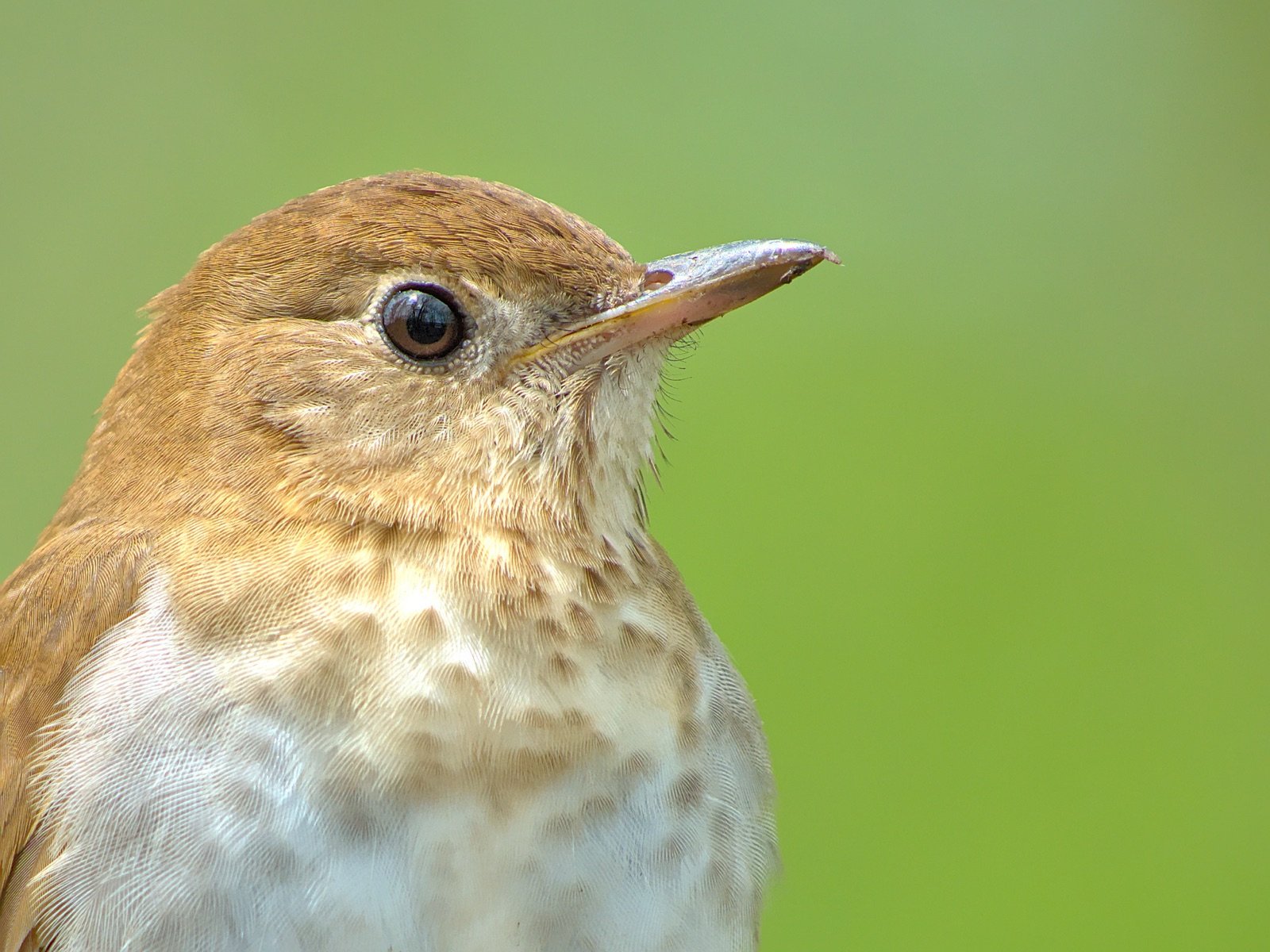
Family Turdidae
Veery
Catharus fuscescens
In Spanish: Zorzal Dorsirrojizo (Conchita)
- Migrant
A cinnamon thrush that passes through Costa Rica on fall migration
The Veery (Zorzal Dorsirrojizo, also called Conchita) is a small forest thrush that does not breed in Costa Rica. The official bird list marks it M, for migrant, so here it is a bird on passage.
It is a hard one to find. A Costa Rica based birder notes that few Veeries are seen in the country and thinks migrants can simply fly over without stopping. A Costa Rica birding guide calls it less easy than the very common Swainson's Thrush.
That is part of its appeal. Fall migration runs from August to November, the biggest numbers pass in October, and a fruiting tree in early October may hold a bird bound for southern Brazil, where tracking shows it winters.
How to find it
Aim for October, when the largest numbers pass. Look at fruiting trees, where several Veeries can sometimes be found in early October among Swainson's and Gray-cheeked Thrushes. Veeries often forage near water, so fruiting trees by a stream or pond are worth a look. In the northeast, ripe fruit peaked from late September to mid October, and fruit-eating migrants were caught most often then. Expect flighty birds that may not linger. Listening at night for the downward slurred flight call is another way birders track migrants overhead.
How to recognise it
The Veery is a small forest thrush, warm cinnamon brown above, with delicate spotting on the throat. The tawny, reddish tone is the feature to look for.
Compare it with its relatives:
- Swainson's Thrush is more olive brown above, with a bold buffy eyering and clearer breast spots.
- The Veery is more uniformly reddish brown, with only faint spotting.
- Gray-cheeked Thrush is a cooler, grayer brown with a grayer face, and it lacks the Veery's warm tawny tone.
Birds from the far northwest and northeast of the breeding range are a darker brown, so a passing migrant may not look like the classic warm bird.
What it sounds like
Behaviour and diet
Veeries hop through the forest understory looking for insects and fruit, and they feed mostly on the ground. They migrate long distances at night and spend the northern winter in South America.
In Costa Rica, several Veeries can sometimes be found at fruiting trees in early October. They are flighty there and feed alongside a few Gray-cheeked and Swainson's Thrushes.
Where it lives
On the breeding grounds the Veery uses damp, young deciduous woods, often near streamside thickets or swamps. It does not breed in Costa Rica, so here it depends on stopover habitat. On migration and in winter it also uses lowland forest, woodland and scrub.
In Costa Rica it has been recorded in the Caribbean lowlands of the northeast, and on the Caribbean side of the southeast, south of Limon, where a few birds were passing through among many other migrants.
When to see it
Fall migration through Costa Rica runs from August to November, with the biggest numbers in October and a few late birds still turning up in November. Stiles and Skutch call it an uncommon to sometimes common fall transient from late September to late October, and a rare spring transient in March and April.
Similar birds
Swainson's Thrush is the common look-alike in Costa Rica, more olive brown above with a bold buffy eyering and clearer breast spots. Gray-cheeked Thrush is a cooler, grayer brown with a grayer face and none of the Veery's warm tawny tone.
Names and lore in Costa Rica
In Costa Rica the Veery is called Zorzal Dorsirrojizo or Conchita. Elsewhere in the region you may hear Zorzal Canelo, Zorzal Rojizo, Zorzalito Rojizo, Zorzal Migratorio Colorado, Zorzal Tropical, Zorzal Solitario or Zorzal Dorsicanelo.
Status and conservation
The official Costa Rican bird list marks the Veery as M, a migrant that does not breed in the country.
Photography tips
Fruiting trees in early October are the best bet, but the birds are flighty, so settle in quietly at a distance and wait for them to return to feed.
How we know this 20 sources, each read on the date shown
- Lista Oficial de las Aves de Costa Rica (AOCR) read 2026-11-04
https://listaoficialavesdecostarica.wordpress.com/lista-oficial/lista-oficial-online/ - Birding Craft (Costa Rica birding blog) read 2026-11-04
https://birdingcraft.com/wordpress/category/migration/ - Birding Craft (Costa Rica birding blog) read 2026-11-04
https://birdingcraft.com/wordpress/tag/caribbean-slope/ - 10,000 Birds read 2026-11-04
https://www.10000birds.com/fall-migration-in-costa-rica-six-things-i-have-learned.htm - Birding Craft (Costa Rica birding blog) read 2026-11-04
https://birdingcraft.com/wordpress/tag/planning-a-birding-trip-to-costa-rica/ - Birds of the World (Cornell Lab) read 2026-11-04
https://birdsoftheworld.org/bow/species/veery/cur/sounds - All About Birds (Cornell Lab) read 2026-11-04
https://www.allaboutbirds.org/guide/Veery/overview - Bird Identifier read 2026-11-04
https://birdidentifier.com/encyclopedia/veery/veery-identification-guide - Birds of the World (Cornell Lab) read 2026-11-04
https://birdsoftheworld.org/bow/species/veery/cur/introduction - PLoS ONE (via PubMed Central) read 2026-11-04
https://www.ncbi.nlm.nih.gov/pmc/articles/PMC3904878/ - PLoS ONE read 2026-11-04
https://journals.plos.org/plosone/article?id=10.1371%2Fjournal.pone.0086221 - The Auk read 2026-11-04
https://academic.oup.com/auk/article/131/4/702/5149377 - ResearchGate (Veery geolocator study) read 2026-11-04
https://www.researchgate.net/publication/331233902_MIGRATORY_ROUTES_AND_STOPOVER_REGIONS_OF_EASTERN_BREEDING_VEERIES_TURDIDAE_CATHARUS_FUSCESCENS_AS_REVEALED_BY_ARCHIVAL_LIGHT-LEVEL_GEOLOCATORS - Avibase read 2026-11-04
https://avibase.bsc-eoc.org/species.jsp?avibaseid=0B8F4EE60AFF4B25 - Eastside Audubon Society read 2026-11-04
https://www.eastsideaudubon.org/corvid-crier/2022/5/veery - NatureServe Explorer read 2026-11-05
https://explorer.natureserve.org/Taxon/ELEMENT_GLOBAL.2.103031/Catharus_fuscescens - Ecology Of Puget Sound (citing Stiles and Skutch 1989) read 2026-11-05
https://www.eopugetsound.org/species/catharus-fuscescens - ArgentiNat (Wikipedia en español) read 2026-11-05
https://www.argentinat.org/taxa/12901 - BirdNote en Español read 2026-11-05
https://www.birdnote.org/podcasts/birdnote-en-espanol/un-ave-migra-hacia-el-sur-paso-paso - ResearchGate (Heckscher et al. 2011) read 2026-11-05
https://www.researchgate.net/publication/232693124_Veery_Catharus_fuscescens_Wintering_Locations_Migratory_Connectivity_and_a_Revision_of_Its_Winter_Range_using_Geolocator_Technology