Family Pipridae
Velvety Manakin
Lepidothrix velutina
In Spanish: Saltarín Coroniceleste
- Resident
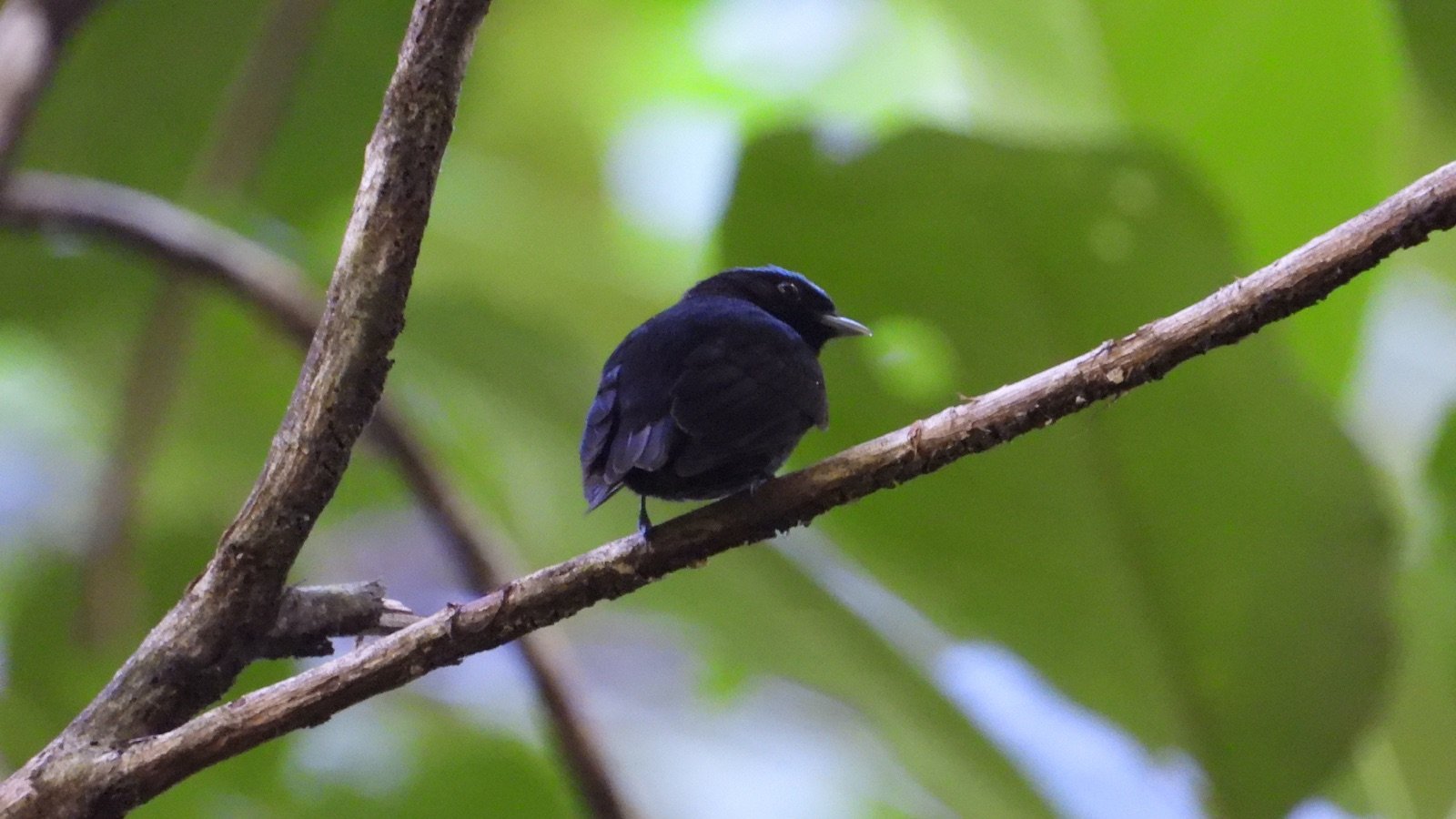
Jet black manakin with a sapphire cap, found in southern Pacific rainforest.
The Velvety Manakin (Saltarín Coroniceleste) is a small forest bird of southern Costa Rica. The male is jet black with a sapphire cap, and in the forests of Refugio Los Cusingos he sings tirelessly.
It is fairly common in the rainforests of the south Pacific slope and uncommon on the Caribbean side. On a trip we build, it is the kind of bird that turns up on a long morning at Carara National Park, alongside Orange-collared and Red-capped Manakins, before the route continues to the Osa Peninsula.
It also has a deep Costa Rican story: much of what is known of its natural history comes from Alexander Skutch's studies here, which began in the 1930s.
How to find it
Start in the south Pacific, where it is far easier than on the Caribbean side. Photography guides in Costa Rica often find it at fruiting bushes and trees, and at bathing pools in the forest, so these are good places to wait. A long morning at Carara National Park can include it, and the lowland rainforest near Golfito, bordering Piedras Blancas National Park, is another option. Expect brief views: on a 2023 guided deep-south trip it was seen only in a few brief sightings, at Los Cusingos and Wilson Botanical Garden. Listening for the soft trill or the loud lek call is often the way in.
How to recognise it
Manakins are small, stocky birds with big heads and short tails and bills, and the Velvety fits that mould. It measures about 8 to 11 cm long, so think compact, not slender.
The male: jet black, shiny, with a sapphire cap. Manakin males in general are black with bright colour patches such as blue, and this one wears its colour on the crown.
The female: usually plain greenish, and hard to identify. The female Velvety is noticeably blue-green, while females of other manakins are olive-green or greyish-green, so a blue-green tone is the clue worth noting.
What it sounds like
Behaviour and diet
Males display together at a lek, a shared courtship area, and this has been recorded in Costa Rica, including a courting lek in rainforest in the Sirena sector of Corcovado National Park. At Refugio Los Cusingos the dance is a series of jumps along low, horizontal twigs.
It eats mostly small fruits and also takes some insects. Birds formerly lumped with it are described as sitting still on a perch in shady forest and then darting out. They come to forest edges mainly to feed at fruiting trees, and often join mixed feeding flocks.
Where it lives
The Velvety Manakin lives in mature forest and tall second growth, mostly in lowlands and foothills below about 1,000 m across its range. In Costa Rica it ranges from sea level to about 1,200 m on the Caribbean side and up to about 1,400 m on the Pacific side. Only locally does it reach 1,400 m in the west.
On the Caribbean slope it lives only in the far south of Limón Province. On the Pacific slope it ranges from about central Puntarenas province southward.
When to see it
Most breeding data for this species come from Costa Rica. The breeding season there runs at least from February to June, when males are displaying at leks.
Similar birds
Males are black with a bright blue crown, so they can be confused with the Blue-capped Manakin of Amazonia. In Costa Rica only the Velvety occurs. The two were long lumped as one species called Blue-crowned Manakin, until vocal and genetic differences led to the split. At Carara, look also for Orange-collared and Red-capped Manakins.
Names and lore in Costa Rica
The Spanish name used in Costa Rica is Saltarín Coroniceleste. Panamanians call the same bird Saltarín Aterciopelado, and Ecuadorians call it Saltarín Coroniazul Occidental.
Status and conservation
The official Costa Rican bird list treats it as a resident species, locally common across its range, common on the Pacific side and uncommon on the Caribbean side.
Photography tips
Photography guides often find it at fruiting bushes and trees and at bathing pools in the forest. Birds formerly lumped with it sit still on a perch in shady forest and then dart out, so watch a fruiting tree patiently and be ready for a quick visit.
How we know this 15 sources, each read on the date shown
- Wikipedia read 2026-11-04
https://en.wikipedia.org/wiki/Velvety_manakin - Macaulay Library read 2026-11-04
https://macaulaylibrary.org/asset/57392 - Ecoregistros read 2026-11-04
https://www.ecoregistros.org/ficha/Lepidothrix-velutina - Cornell Birds of the World read 2026-11-04
https://birdsoftheworld.org/bow/species/bucman1/cur/introduction - Museo Nacional de Costa Rica read 2026-11-04
https://www.museocostarica.go.cr/nuestro-trabajo/investigaciones/historia-natural/saltarines-de-costa-rica/morfologia/ - Lista Oficial de las Aves de Costa Rica (AOCR) read 2026-11-04
https://listaoficialavesdecostarica.wordpress.com/lista-oficial/lista-oficial-online/ - Lifer Tours read 2026-11-04
https://www.lifertours.com/single-post/manakins-costa-rica-bird-photography-at-its-best - Ballena Tales read 2026-11-04
https://ballenatales.com/manakins-the-neotropical-birds/ - Birdwatch.info tour page read 2026-11-04
https://www.birdwatch.info/costa-rica/san-jose/costa-rica-birding - Cotinga Tours read 2026-11-04
https://www.cotingatours.com/southern-tour-sample - Field Guides trip list read 2026-11-04
https://fieldguides.com/triplists/cr123.html - Wikipedia (es) read 2026-11-04
https://es.wikipedia.org/wiki/Lepidothrix_velutina - Birds of the World read 2026-11-04
https://birdsoftheworld.org/bow/species/bucman1/1.0/introduction - iNaturalist Ecuador (Spanish text) read 2026-11-04
https://ecuador.inaturalist.org/taxa/14328-Lepidothrix-coronata - Animalia.bio read 2026-11-04
https://animalia.bio/es/blue-crowned-manakin