Family Trochilidae
Veraguan Mango
Anthracothorax veraguensis
In Spanish: Colibrí Manguito de Veragua
- Resident
- Regional endemic
A recent arrival from Panama in the far south Pacific lowlands.
The Veraguan Mango (Colibrí Manguito de Veragua) is one of Costa Rica's newest hummingbirds. It was long thought to live only in Panama, and it was added to the official Costa Rica bird list in 2009.
In Costa Rica it occupies only a tiny sliver of the south, in the Pacific lowlands, and it seems to be spreading north from Panama. The first confirmed records came from the Tropical Research Station La Gamba, near Golfito, starting in December 2008.
For a beginning birder it is a good lesson in how bird lists change. Its range helps separate it from a very similar mango, and a flowering tree is often the best place to start looking.
How to find it
Look for it at flowering Erythrina trees in the southern Pacific lowlands. Birds in the Golfo Dulce area were repeatedly seen at one such tree, with sightings from December to February. Because males guard flowering trees, it pays to wait and watch a blooming tree for a while. Scan open country with scattered trees and shrubby stream edges. Viney roadside brush near Ciudad Neily and the road from La Gamba to Golfito have both produced birds, and towns are worth a glance now that a pair has nested in one. Focus on males if you want a sure identification.
How to recognise it
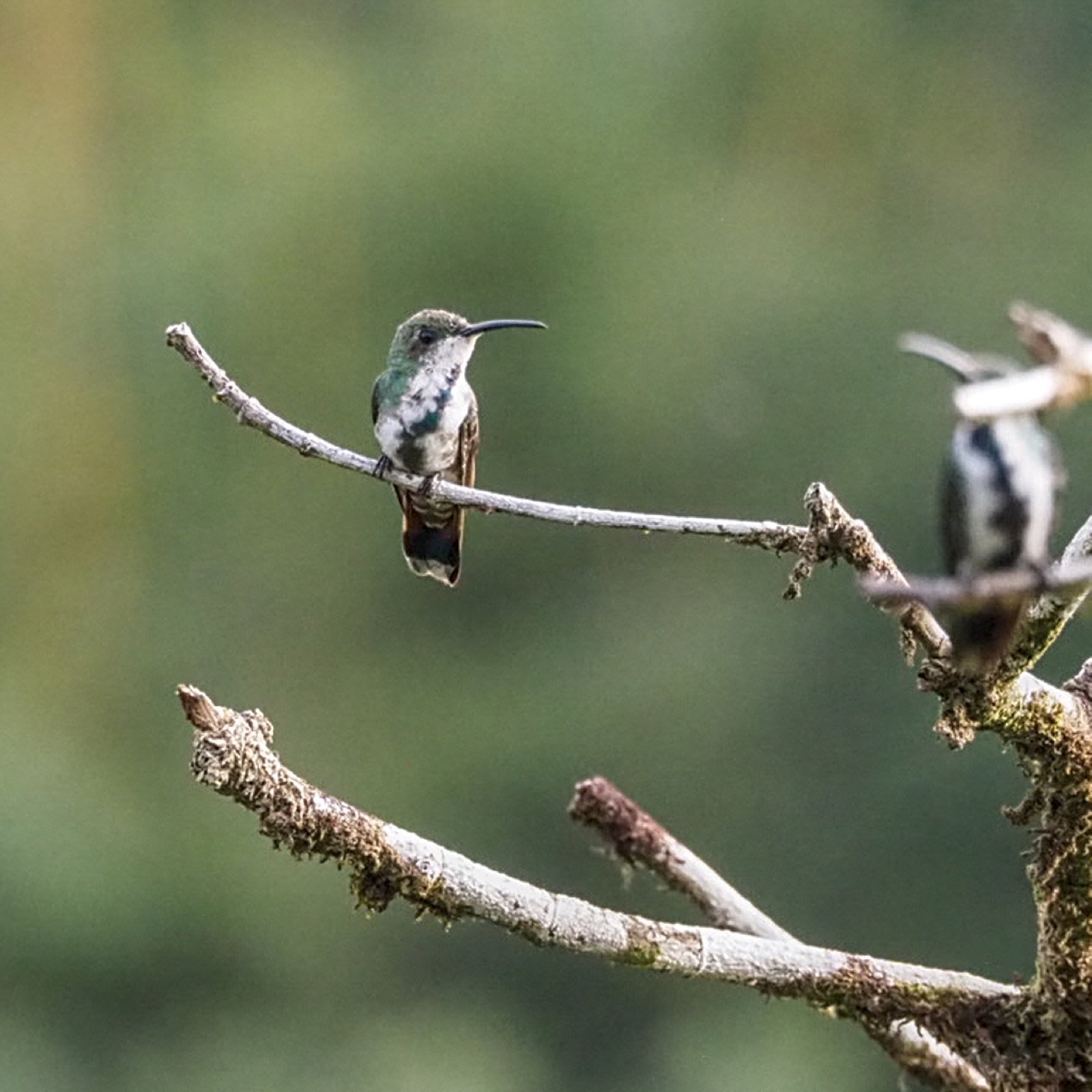
The Veraguan Mango is a medium-sized hummingbird with a bronzy green back and a slightly downcurved bill. It is much larger than the common Rufous-tailed Hummingbird.
Males show blue on the breast and central belly. Their tail is partly rufous-violet, less bright than that species'.
Females are white below with a dark teal stripe down the middle. Females seen in Costa Rica had a dark central stripe from bill to tail base. The tail was rufous on the basal half, and the outer tail feathers had white tips that are easy to see in flight.
Not every female follows this pattern. Some have male-like plumage. A Palmar Norte female like this incubated eggs and fed nestlings, so a bird that looks like a male is not always one.
Behaviour and diet
The Veraguan Mango takes nectar from low and middle levels of vegetation, and it tends to guard flowering trees from other birds. A bird that claims a tree may keep returning to it, which helps the patient observer.
At La Gamba, birds fed at the flowers of an Erythrina gibbosa tree, and females were seen there until late February 2009. In the Golfo Dulce area, birds were repeatedly seen at one such tree.
Where it lives
In Costa Rica it lives in the Pacific lowlands of the far south. Its range starts near the southern edge of the Green-breasted Mango's range and runs along the lowlands through the Osa Peninsula into Panama.
Across its range it uses open pastures with scattered trees and shrubby stream edges, and it is described as locally common in such habitat.
It can also live alongside people. A pair nested in the town of Palmar Norte in 2025, and the town sits at only 32 metres elevation. That shows the species can use towns as well as natural habitat.
When to see it
Birds were seen near La Gamba from December to February, a nest with two nestlings being fed was photographed in Palmar Norte on 13 February 2025, and tour groups saw it in late January. These are records from the species' first years in Costa Rica, not a pattern of seasonal presence.
Similar birds
Females of this species and the Green-breasted Mango cannot be reliably told apart in the field, so males are the safer way to confirm a Veraguan Mango. Male Veraguan Mangos lack the black throat and belly of the Green-breasted Mango, and observers saw no black on males from any angle or in any light. Range helps too: the Green-breasted Mango lives in the lowlands of both coasts and the Central Valley, and the Veraguan Mango begins near the southern limit of that range. Males can also be mistaken for the Sapphire-throated Hummingbird, and the AOCR committee at first judged the first Costa Rica male photo to be that species.
Names and lore in Costa Rica
Costa Rican sources use the name Colibrí Manguito de Veragua, and also the shorter Manguito de Veragua. In Panama the Spanish name is Mango Veragüense.
Status and conservation
The AOCR list marks it as a resident regional endemic (R-END), and the species is listed as Least Concern.
Photography tips
A female fed close in front of a tour group near Ciudad Neily, and another bird perched in the open along the La Gamba to Golfito road. Birders photographed a nesting pair in Palmar Norte from 10 m away with a bridge-type camera, and the nest was in a town setting. A flowering tree that a bird is guarding is a good place to wait.
How we know this 16 sources, each read on the date shown
- Ecology and Evolution (Levey 2025, via PMC) read 2026-11-04
https://www.ncbi.nlm.nih.gov/pmc/articles/PMC12399566/ - Zeledonia (Riedl and Schulze 2010), via Dialnet read 2026-11-04
https://dialnet.unirioja.es/servlet/articulo?codigo=4043229 - Ecology and Evolution (Levey 2025) read 2026-11-04
https://onlinelibrary.wiley.com/doi/10.1002/ece3.72071 - Wikipedia read 2026-11-04
https://en.wikipedia.org/wiki/Veraguan_mango - Aves de Costa Rica read 2026-11-04
https://avesdecostarica.com/Anthracothorax-veraguensis.html - Wikipedia (Anthracothorax) read 2026-11-04
https://en.wikipedia.org/wiki/Anthracothorax - Zeledonia (Riedl and Schulze 2010), via Dialnet read 2026-11-04
https://dialnet.unirioja.es/descarga/articulo/4043229.pdf - Cornell Birds of the World read 2026-11-04
https://birdsoftheworld.org/bow/species/verman1/cur/introduction - Wikipedia (Spanish) read 2026-11-04
https://es.wikipedia.org/wiki/Anthracothorax_veraguensis - Zeledonia (Riedl and Schulze 2010) read 2026-11-04
https://www.researchgate.net/publication/282186501_Observacion_de_manguito_de_veragua_Anthracothorax_veraguensis_Reichenbach_1855_en_las_tierras_bajas_del_Pacifi_co_sur_de_Costa_Rica - Earthlife.net read 2026-11-04
https://earthlife.net/veraguan-mangos/ - Avibase read 2026-11-04
https://avibase.bsc-eoc.org/species.jsp?avibaseid=24DDBD0D95248C55 - 10,000 Birds read 2026-11-04
https://www.10000birds.com/veraguan-mango-panamas-ex-endemic.htm - Field Guides tour report 2023 read 2026-11-04
https://fieldguides.com/triplists/cr123.html - Field Guides tour report 2018 read 2026-11-04
https://fieldguides.com/triplists/cr118.html - Kiddle (Wikipedia-based) read 2026-11-04
https://kids.kiddle.co/Veraguan_mango