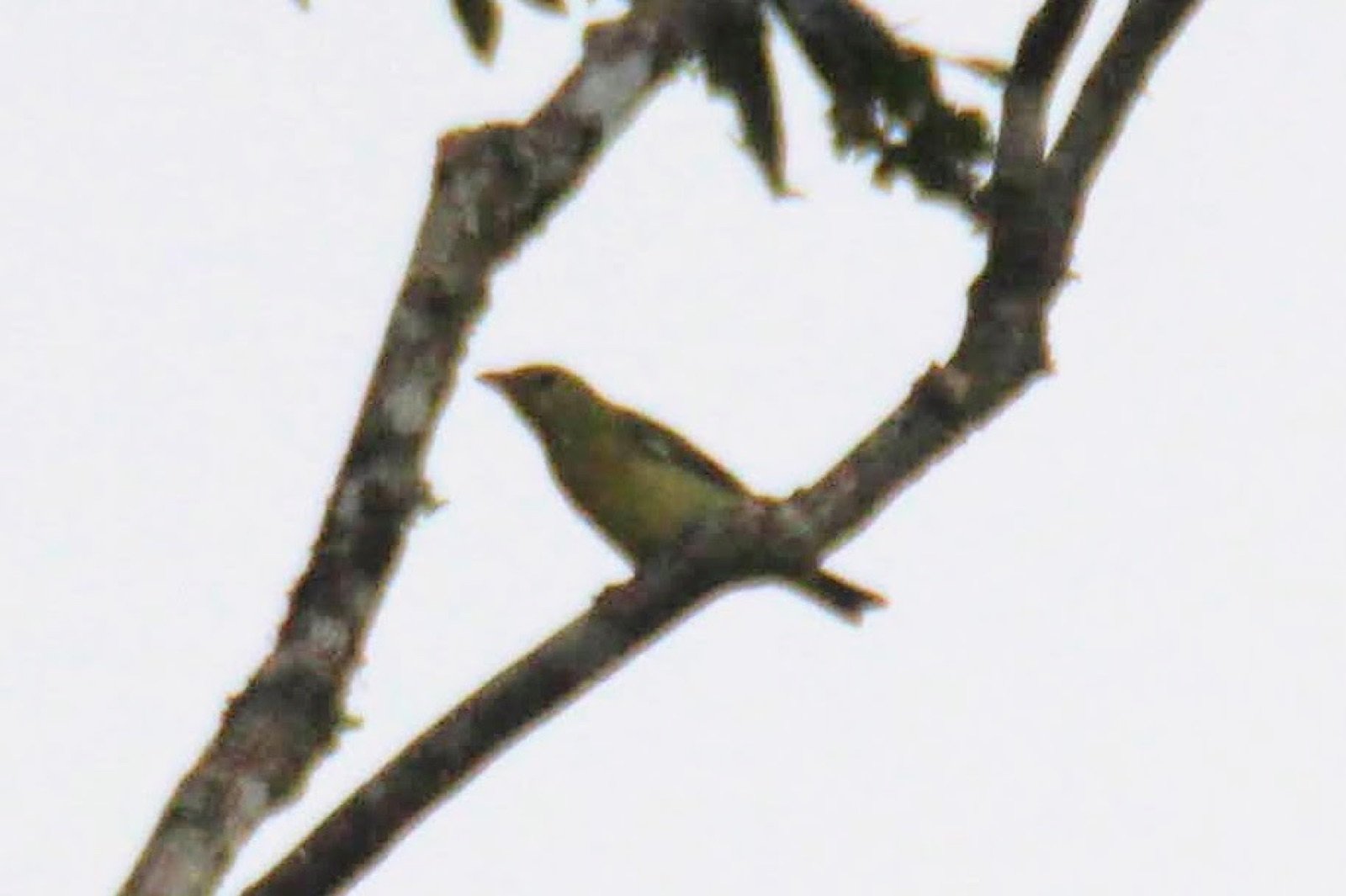
Family Cardinalidae
Western Tanager
Piranga ludoviciana
In Spanish: Tangara Carirroja
- Migrant
A red-headed winter visitor, here late October to April, mostly Pacific side.
The Western Tanager does not nest in Costa Rica. It breeds in western North America and spends the winter from Mexico south to central Costa Rica, which is near the southern end of its wintering range.
A Costa Rican natural history account says it arrives in late October and leaves in April. On a trip we build around the Pacific side, it is a bird to look for in treetops, scrub and fence rows rather than only in tall forest, including around Carara National Park on the central Pacific coast.
How to find it
Concentrate on the Pacific side, where winter habitat includes dry tropical forest. Look in treetops, small trees, scrub and living fence rows, not only in tall forest. Because a winter male may lack the red head, check yellow-and-black birds for two wing bars. Watch a perch for a bird that dashes out to snatch an insect. In winter it can mix with flocks of warblers, honeycreepers and tropical tanagers, so scan mixed flocks.
How to recognise it
The breeding male is the bird in the field guide: a red head, a yellow body and rump, and black back, wings and tail, with two pale wing bars.
In Costa Rica you are looking at a winter bird, and a winter male often lacks the red head. In non-breeding plumage the head has only a reddish tint and the body looks olive, yet it still shows bright yellow and deep black.
The female is yellow-green above and yellow below, with the same two wing bars. The bill is pale, stout and pointed.
What it sounds like
Behaviour and diet
In Costa Rica it hunts insects in the foliage of treetops and often flies out to catch them in the air. In winter it is usually solitary here.
Elsewhere on the wintering grounds it often joins small flocks and may feed lower down in bushes. Across its range the diet is about 82% insects and 18% fruit, and on the wintering grounds it eats much more fruit than in summer.
Where it lives
In Costa Rica it uses the canopy of deciduous forest, the tops of small trees, scrub in partly open second growth, and living fence rows.
It is an uncommon to fairly uncommon winter resident in the dry northwest, and an account lists the Guanacaste, Tempisque, Arenal and Central Volcanic conservation areas. It is rare in the central mountains and on the southern Pacific slope, and turns up only by accident in the Caribbean lowlands.
Across its wintering range it also uses pine and pine-oak woodland, low scrub forest, forest edges and coffee plantations.
When to see it
A Costa Rican natural history account says it arrives in late October and leaves in April.
Similar birds
Among migrant tanagers it is told by its clear wing bars, and it differs from the resident Flame-colored Tanager because it has no streaks on the back. Females and young birds are mostly yellow-green with grayish wings and can pass for orioles or warblers. The upper wing bar is usually yellow and the lower one white or pale. Female Summer and Scarlet Tanagers also have olive backs and yellow underparts, but the Western shows some black on the wings and a faint yellowish line over the eye.
Names and lore in Costa Rica
The official Costa Rican Spanish name is Tangara Carirroja. Other Spanish names listed elsewhere include Piranga Capucha Roja and Tangara del Oeste.
Status and conservation
The official Costa Rica bird list marks it as M, a migratory visitor that does not breed in the country, and the IUCN lists it as Least Concern.
Photography tips
Scan treetops and fence rows on the Pacific side, and watch a quiet perch for the short dash after an insect.
How we know this 16 sources, each read on the date shown
- Lista Oficial de las Aves de Costa Rica (AOCR) read 2026-11-04
https://listaoficialavesdecostarica.wordpress.com/lista-oficial/lista-oficial-online/ - Flickr photo page quoting a Costa Rican species account read 2026-11-04
https://www.flickr.com/photos/jobando/32542470882 - Cornell Lab, All About Birds read 2026-11-04
https://askaboutbirds.com/species/western-tanager/ - Wikipedia (via JungleDragon) read 2026-11-04
https://www.jungledragon.com/specie/8988/western_tanager.html - Wikipedia (via The Bio Files) read 2026-11-04
https://www.thebiofiles.com/info/5591 - Birda species guide read 2026-11-04
https://app.birda.org/species-guide/35954/Western_Tanager - Costa Rica Focus read 2026-11-04
https://www.costaricafocus.com/best-places-to-see-tanagers-in-costa-rica/ - Ecoregistros read 2026-11-04
https://www.ecoregistros.org/ficha/Piranga-ludoviciana - Wikipedia read 2026-11-04
https://en.wikipedia.org/wiki/Western_tanager - Birdzilla read 2026-11-04
https://www.birdzilla.com/birds/western-tanager/ - Positivebloom read 2026-11-04
https://positivebloom.com/the-spectacular-california-bird-you-may-not-see-again-until-spring/ - Avibase read 2026-11-04
https://avibase.bsc-eoc.org/species.jsp?avibaseid=0ADA5F17E6C7CA54 - Birds of the World (Cornell) read 2026-11-04
https://birdsoftheworld.org/bow/species/westan/cur/foodhabits - US Fish and Wildlife Service read 2026-11-04
https://usfws.medium.com/featured-feathers-western-tanager-9897430c59ec - ArgentiNat (from Wikipedia) read 2026-11-04
https://www.argentinat.org/taxa/9919-Piranga-ludoviciana - Avibase read 2026-11-04
https://avibase.bsc-eoc.org/species.jsp?avibaseid=2743D2F9