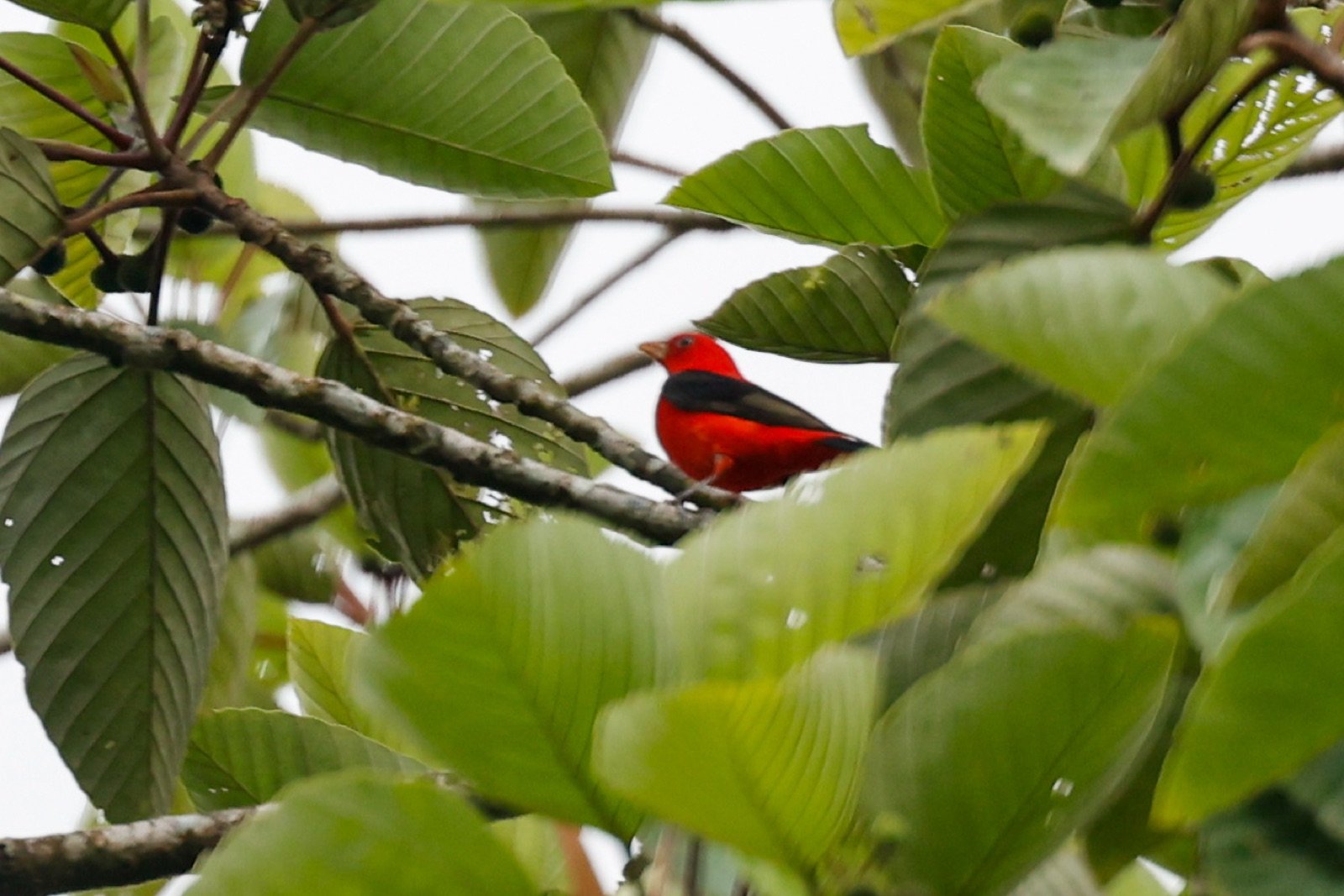
Family Cardinalidae
Scarlet Tanager
Piranga olivacea
In Spanish: Tangara Escarlata (Cardenal Alas Negras)
- Migrant
A black-winged migrant tanager that passes through in fall and spring.
The Scarlet Tanager does not live in Costa Rica. It passes through, a Nearctic migrant that breeds from southern Canada to the southeastern USA and winters from Colombia to eastern Peru and northwestern Bolivia.
In fall it is an uncommon visitor, seen from late September to early November, mostly in the Caribbean lowlands and the central mountains. Spring birds are described as sporadically common from the lowlands of both slopes up to about 1500 m, and that is when males wear their full scarlet.
For a beginner, an all-red songbird here is one of five tanager species, and only two are northern migrants: Scarlet and Summer. The black wings settle it.
How to find it
Keep looking up, because birds stay high in trees and may show only a flash of colour. Check mixed flocks of songbirds, since migrants often join them to feed. Fall migrants may stop at fruiting trees, so a fruiting tree with bird activity is worth a patient look. Garden and lowland edges can also turn it up: one was recorded in a garden in San Antonio in the Central Valley, and another near Siquirres, Limón. Do not listen for it, as it is almost silent here. Spring is the best time to see the male in its red dress.
How to recognise it
Breeding males have a scarlet head and body with black wings and tail. A Costa Rican photo taken in April shows a male in exactly that plumage, ready to head north.
In fall the picture changes. Males seen in Costa Rica in the non-breeding season are olive above and bright yellow-green below, but they keep black wings. This is the plumage most visitors meet in fall, so look for dark wings rather than for red.
Females are olive with darker olive-brown wings and tail. Females and young birds are greener than Summer Tanager and have whitish, not yellow, wing linings.
What it sounds like
Behaviour and diet
It hunts insects and spiders from foliage, sometimes flying out to snatch them from leaves or branches. It also eats many kinds of fruit. In Costa Rica it is solitary in fall and forms larger groups in spring. On migration it often joins mixed flocks of other songbirds to feed, and it stays high in the trees.
Where it lives
In Costa Rica it uses the canopy and edges of forest, tall second growth and partly open areas. It sometimes drops lower into scrubby areas. Fall birds are mostly reported in the Caribbean lowlands and the central mountains, and photos come from the north, around La Fortuna and Bijagua. Spring migrants are sporadically common from the lowlands of both slopes up to about 1500 m. Away from the country, it breeds mainly in large deciduous forests of eastern North America and winters in forests on the Andean foothills of northwestern South America.
When to see it
Birds pass through Costa Rica between September and November heading to South America, with fall sightings from late September to early November. They return north between March and May, and one source puts the spring passage in late March through April.
Similar birds
Summer Tanager is the far more common red bird, seen across Costa Rica from mid-September to late April, and it has no black wings. Female Scarlet has darker wings than female Summer, whose wings are paler and yellower. Western Tanager shows clear wing bars, which Scarlet lacks. Costa Rican guides also note that Western, Summer and Hepatic Tanagers are not true tanagers.
Names and lore in Costa Rica
Besides the official Costa Rican name Tangara Escarlata, a Spanish-language species page also lists Tángara Rojinegra Migratoria, meaning black-and-red migratory tanager.
Status and conservation
The official Costa Rican bird list classes it as M, a migrant that neither resides nor breeds, and it is listed as Least Concern overall.
Photography tips
Fruiting trees in fall and mixed songbird flocks are the best places to wait, looking up into the canopy. Spring offers the best chance of a male in full scarlet.
How we know this 14 sources, each read on the date shown
- Aves de Costa Rica read 2026-11-04
https://avesdecostarica.com/Piranga-olivacea.html - Flickr (Costa Rica natural history photo notes) read 2026-11-04
https://www.flickr.com/photos/jobando/33855666536 - Avestikas read 2026-11-04
https://avestikas.com/2022/10/17/piranga-olivacea/ - Flickr (Costa Rica natural history photo notes) read 2026-11-04
https://www.flickr.com/photos/jobando/38022127711 - Lista Oficial de las Aves de Costa Rica (AOCR) read 2026-11-04
https://listaoficialavesdecostarica.wordpress.com/lista-oficial/lista-oficial-online/ - Birdfact read 2026-11-04
https://www.birdfact.com/birds/scarlet-tanager - Wikipedia read 2026-11-04
https://en.wikipedia.org/wiki/Scarlet_tanager - Birds for Beer (Costa Rica blog) read 2026-11-04
https://birdsforbeer.com/2016/04/17/scarlet-tanager-first-in-my-yard-tangara-escarlata-primera-vez-aqui-en-casa/ - Cornell Lab, All About Birds read 2026-11-04
https://www.allaboutbirds.org/guide/Scarlet_Tanager/id - Tennessee Wildlife Resources Agency read 2026-11-04
https://www.tn.gov/twra/wildlife/birds/forest-birds/scarlet-tanager.html - Birds of Costa Rica (birdsofcolombia.org) read 2026-11-04
https://www.birdsofcolombia.org/costarica/Piranga.html - Cornell Lab, All About Birds read 2026-11-04
https://www.allaboutbirds.org/guide/Scarlet_Tanager/overview - Ecos del Bosque read 2026-11-04
https://ecosdelbosque.com/fauna/piranga-olivacea - EcoRegistros read 2026-11-04
https://www.ecoregistros.org/sheet/Piranga-olivacea