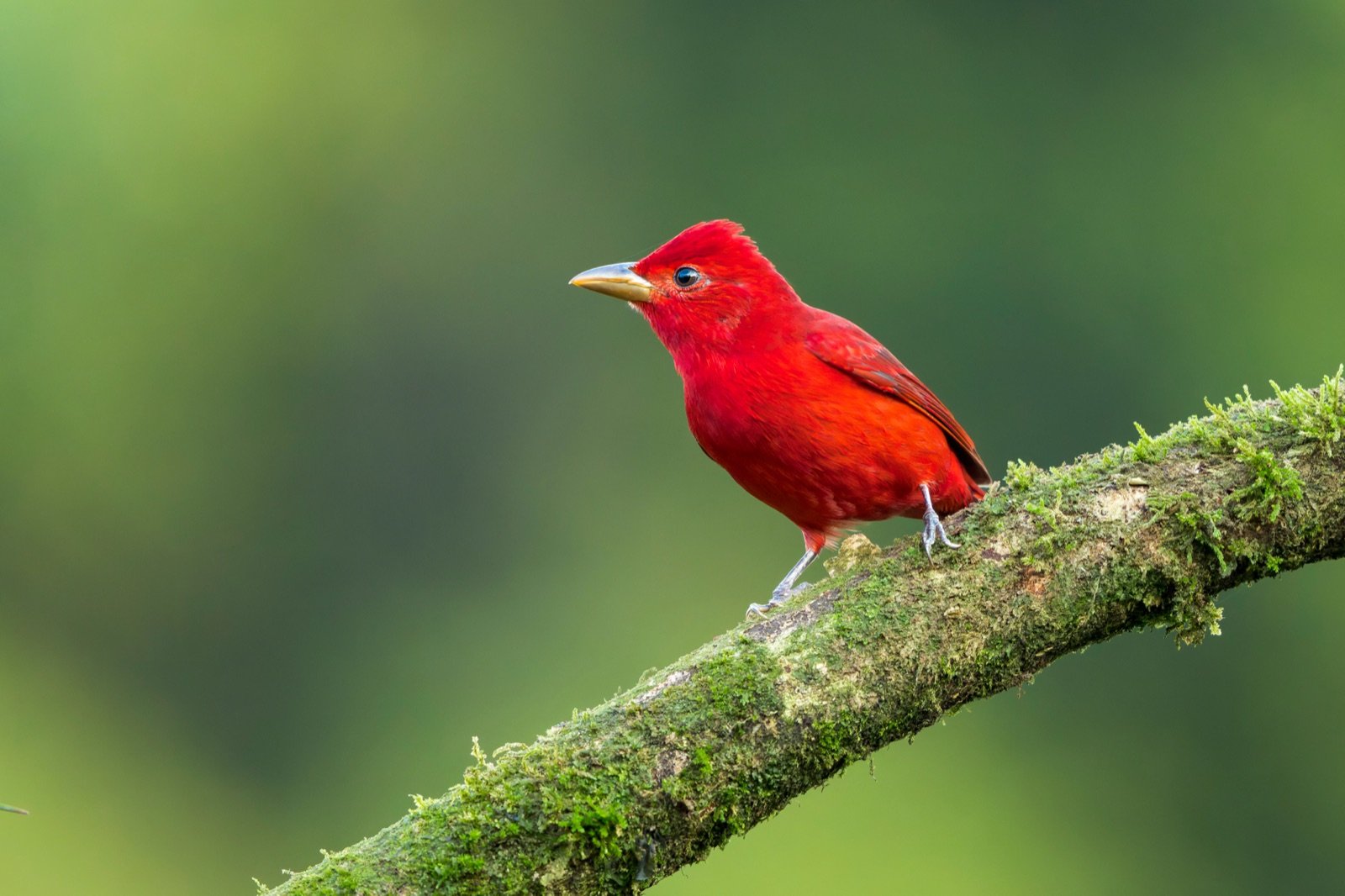
 Summer Tanager
Family Cardinalidae
Summer Tanager
Piranga rubra
In Spanish: Tangara Veranera (Cardenal Veranero, Pan de Achiote, Sangre Toro)
- Migrant
A rose-red North American visitor, common in the lowlands mid September to late April.
The Summer Tanager (Tangara Veranera, Piranga rubra) does not breed in Costa Rica. The official national list marks it M, a migrant, because it is a visitor from North America.
A Costa Rican field guide summary calls it common from mid September to late April, mainly in the lowlands of both the Caribbean and Pacific slopes. It uses canopy, forest edges, garden trees and pastures, so you do not need a remote trail to meet it.
On a trip we build, it is a bird to look for in lowland forest canopy, in the shaded gardens of the Central Valley and in the fields of the San Carlos area, which a Zona Norte news article says it colours each winter.
How to find it
In Guanacaste, look around fruiting trees such as fig or mango. An active army ant swarm in the dry season can bring several tanagers at once. Check forest edges, gardens and open woodland, where it forages in the trees. Early morning is a good time because the birds are most active in the cooler hours. Guided canopy walks in lowland forest in the wintering period give a chance to see it move through the treetops.
How to recognise it
The adult male is entirely rosy red with a pale, thick bill.
Males stay red through the winter and do not change plumage.
The female is olive above and yellowish olive below, with ochre-tinted underparts. Her undertail is brighter orange-yellow, and her bill is pale grey to horn-coloured.
Immature males look like females, then become a patchwork of red, olive and yellow as they reach adult colour. A blotchy bird in winter may be a young male on his way to full red.
What it sounds like
Recording: dylancamachoguzman10, CC0 1.0, source, read 4 Nov 2026.
Behaviour and diet
In winter the Summer Tanager is usually alone, but it often joins mixed flocks of other tanagers and warblers. It eats many kinds of fruit and catches insects in flight. It also tears open wasp and stingless bee nests to eat the larvae and pupae, and it visits banana feeders. It follows army ant swarms too, and an active swarm in the dry season can bring several tanagers. Range-wide, it mostly forages in treetops and often hunts from a perch with short sallies after flying insects.
Where it lives
Most birds are in the lowlands of both slopes. Numbers drop with altitude, but some birds reach up to about 2500 m. It uses the canopy and edges of evergreen and deciduous forest, partly cleared land with tall second growth, garden trees and pastures. Guanacaste dry forest is described as the most reliable region, while it is less common on the Osa Peninsula and in the Central Valley foothills. It is still listed among birds of shaded gardens and green patches in the Central Valley, and it is noted in San Carlos in the Zona Norte.
When to see it
It is common from mid September to mid or late April, as a migrant and winter resident. A lowland rainforest canopy records it from October to April.
Similar birds
The Summer Tanager has a pale horn-coloured bill, while the Hepatic Tanager has a dark bill, and the bill is the most reliable feature for separating the two. The female has paler wings than the female Scarlet Tanager (Piranga olivacea), which is also a migrant to Costa Rica. The Scarlet Tanager's song is a little hoarser.
Names and lore in Costa Rica
The official list gives Tangara Veranera as the main Spanish name, with the local names Cardenal Veranero, Pan de Achiote and Sangre Toro. Pan de Achiote refers to its colour. Plain Cardenal is also used for other red tanagers, so it can cause mix-ups.
Status and conservation
The official Costa Rican list marks it as M, a migrant, and in Costa Rica it is a non-breeding winter visitor.
Photography tips
Watch the upper canopy, where it can be seen carrying prey to a perch. Range-wide, it often hunts from a perch with short sallies, so wait near an open treetop perch. Early morning light and cooler hours find it most active.
How we know this 16 sources, each read on the date shown
- AOCR Lista Oficial Aves de Costa Rica read 2026-11-04
https://listaoficialavesdecostarica.wordpress.com/lista-oficial/lista-oficial-online/ - Ecos del Bosque (citing Stiles and Skutch) read 2026-11-04
https://ecosdelbosque.com/fauna/piranga-rubra - Aves de Costa Rica read 2026-11-04
https://www.avesdecostarica.com/Piranga-rubra.html - Central America Living read 2026-11-04
https://centralamericaliving.com/summer-tanager-costa-rica-complete-photography-guide-2026/ - Chachagua Rainforest Hotel blog read 2026-11-04
https://blog.chachaguarainforesthotel.com/species-spotlight-summer-tanager-piranga-rubra - Costa Rica Focus read 2026-11-04
https://www.costaricafocus.com/best-places-to-see-tanagers-in-costa-rica/ - Mistico Park read 2026-11-04
https://misticopark.com/blog/costa-rica-travel-tips/migratory-birds-costa-rica/ - EcoRegistros read 2026-11-04
https://www.ecoregistros.org/ficha/Piranga-rubra - Biosonidos UNED read 2026-11-04
https://biosonidos.uned.ac.cr/node/216 - El Colectivo 506 read 2026-11-04
https://elcolectivo506.com/pajareando-en-el-valle-central-de-costa-rica-21-especies-que-debe-buscar/ - Travel To Eat read 2026-11-04
https://traveltoeat.com/colorful-tanangers-in-costa-rica/ - El Norte Hoy read 2026-11-04
https://elnortehoycr.com/2024/01/16/la-tangara-veranera-pinta-de-rojo-los-campos-de-la-zona-norte-cada-verano/ - Oiseaux-Birds read 2026-11-04
https://www.oiseaux-birds.com/card-summer-tanager.html - All About Birds read 2026-11-04
https://askaboutbirds.com/species/summer-tanager/ - Minnesota Seasons read 2026-11-04
https://www.minnesotaseasons.com/Birds/Summer_Tanager.html - Cornell All About Birds read 2026-11-04
https://www.allaboutbirds.org/guide/Summer_Tanager/overview