Family Furnariidae
Western Woodhaunter
Automolus virgatus
In Spanish: Trepamusgo Rayado
- Resident
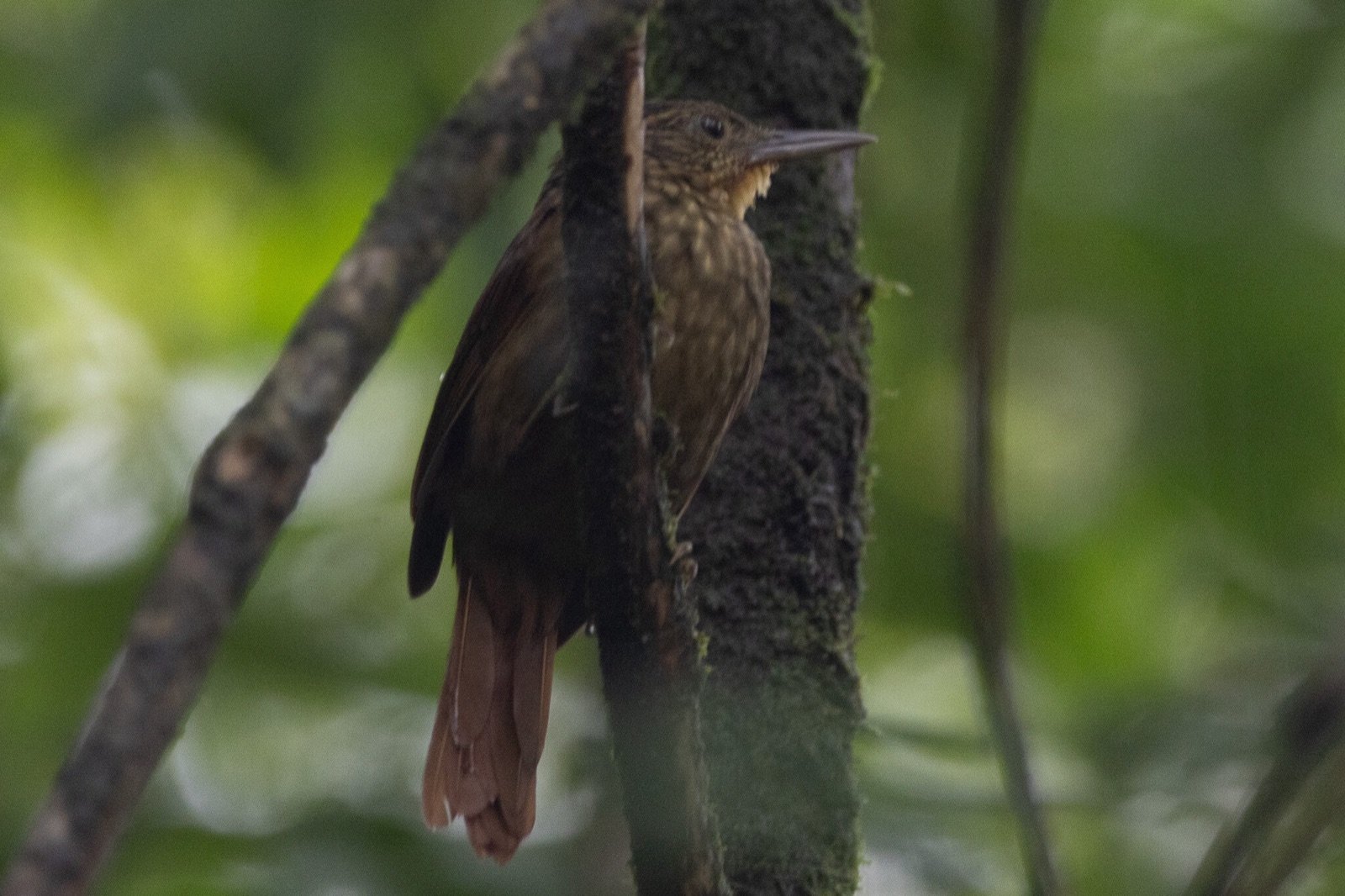
A shy, streaked brown forest bird that tends to travel with mixed flocks.
The Western Woodhaunter, Trepamusgo Rayado in Spanish, is a medium-small brown bird of humid forest. It measures about 17 to 18 cm and keeps to the lower and middle levels of the forest interior, so it rarely makes itself easy to see.
It is a resident species on the official Costa Rican list, and science first described it from Angostura, Costa Rica. The Costa Rican form ranges from here into Panama as far as Veraguas Province.
For a beginning birder it is a satisfying challenge. A Costa Rican guide calls it a tough bird that he sees only rarely, almost always inside a big mixed flock, so patience with flocks is the whole game.
How to find it
Look for it inside large mixed flocks, since that is where Costa Rican guides most often find it. When a flock of tanagers and antwrens moves along a forest trail, slow down and scan the understory. Check the lower and middle levels, especially tangles, mossy branches and vines. Stay in humid forest below about 1,100 m for the best odds. Listen as well as look, because calling birds may stay hidden and ignore playback.
How to recognise it
Look for a medium-small brown forest bird, about 17 to 18 cm long, with a short, heavy bill.
The face and back are streaked with golden buff. There is a pale eyering and a pale stripe behind the eye.
Males and females look alike. The rump is dull rusty brown. The tail is cinnamon, paler than the deep cinnamon upper tail base. The throat is pale fawn and the breast is a deeper fawn with dusky edges.
These details describe the species in general, not only birds in Costa Rica.
What it sounds like
Behaviour and diet
The woodhaunter is shy and keeps to the lower and middle levels of forest interior. It does not climb trunks. Instead it hops through tangles, mosses and vines, searching for invertebrates.
In Costa Rica, guides say it often turns up with large mixed flocks. Tour groups have found it along with tanager flocks and antwrens on forest trails. Once, one foraged on a thin vine about 20 feet up, directly in front of a group.
Both parents incubate the eggs and feed the nestlings.
Where it lives
In Costa Rica, Panama and Ecuador this woodhaunter mostly lives below about 1,100 m, and in some places it reaches roughly 1,500 m. It uses humid forest and woodland in the foothills and lower mountain zone.
Within Costa Rica it has been found on the Caribbean slope, in the wet forests of the deep south near Golfito, and on stops along the way to the Osa Peninsula in the southern Pacific region. A Spanish-language account calls it uncommon and very discreet, staying in the understory of humid forest.
Similar birds
Foliage-gleaners can look very similar in plumage. To separate the woodhaunter, look for blurry buffy streaks on the head and breast, a fairly long straight bill, and no pale eyebrow.
Names and lore in Costa Rica
Costa Rica calls it Trepamusgo Rayado. Panama and Ecuador say Rondamusgos Occidental, and Honduras says Espigahojas Occidental. A general Spanish name for the species is Ticotico Listado Occidental. The Latin name virgatus means striped or streaked, and the genus name Automolus comes from a Greek word meaning deserter.
Status and conservation
The official Costa Rican bird list marks it R, a resident species, and the IUCN lists it as Least Concern.
Photography tips
This is a tough subject. A Costa Rican guide sees it only rarely, almost always inside a big mixed flock, so work the flocks and watch thin vines at the lower and middle levels. Calling birds may refuse playback and stay hidden in the subcanopy.
How we know this 17 sources, each read on the date shown
- Wikipedia read 2026-11-04
https://en.wikipedia.org/wiki/Western_woodhaunter - BirdLens read 2026-11-04
https://birdlens.secondwindltd.xyz/en/birds/33dc2b3a1c - Wikipedia (Spanish) read 2026-11-04
https://es.wikipedia.org/wiki/Automolus_virgatus - Dibird read 2026-11-04
https://dibird.com/species/western-woodhaunter/ - Lista Oficial de las Aves de Costa Rica (AOCR) read 2026-11-04
https://listaoficialavesdecostarica.wordpress.com/lista-oficial/lista-oficial-online/ - Birds Colombia read 2026-11-04
https://birdscolombia.com/2023/12/05/hojarasquero-listado-western-woodhaunter-automolus-virgatus/ - Avibase (Clements checklist) read 2026-11-04
https://avibase.bsc-eoc.org/species.jsp?avibaseid=F4C751F0417D642D - BirdForum (Birdingcraft) read 2026-11-04
https://www.birdforum.net/threads/birdingcrafts-costa-rica-patch.131932/ - Field Guides tour report 2024 read 2026-11-04
https://fieldguides.com/triplists/cr124PRINT.html - Birdquest tour report 2023 read 2026-11-04
https://www.birdquest-tours.com/birding-tour-reports/costa-rica-classic-2023/ - Birdquest tour report 2024 read 2026-11-04
https://www.birdquest-tours.com/birding-tour-reports/costa-rica-classic-2024/ - Birdquest tour report 2023 read 2026-11-04
https://www.birdquest-tours.com/birding-tour-reports/costa-rica-best-of-2023/ - Birdingcraft read 2026-11-04
https://birdingcraft.com/wordpress/tag/caribbean-slope/ - Peru Aves read 2026-11-04
https://www.peruaves.org/furnariidae/striped-woodhaunter-automolus-subulatus/ - Wikipedia read 2026-11-05
https://en.wikipedia.org/wiki/Western_Woodhaunter - Animalia.bio read 2026-11-05
https://animalia.bio/western-woodhaunter - Avibase read 2026-11-05
https://avibase.bsc-eoc.org/species.jsp?avibaseid=BD6ADDF58DB3B970