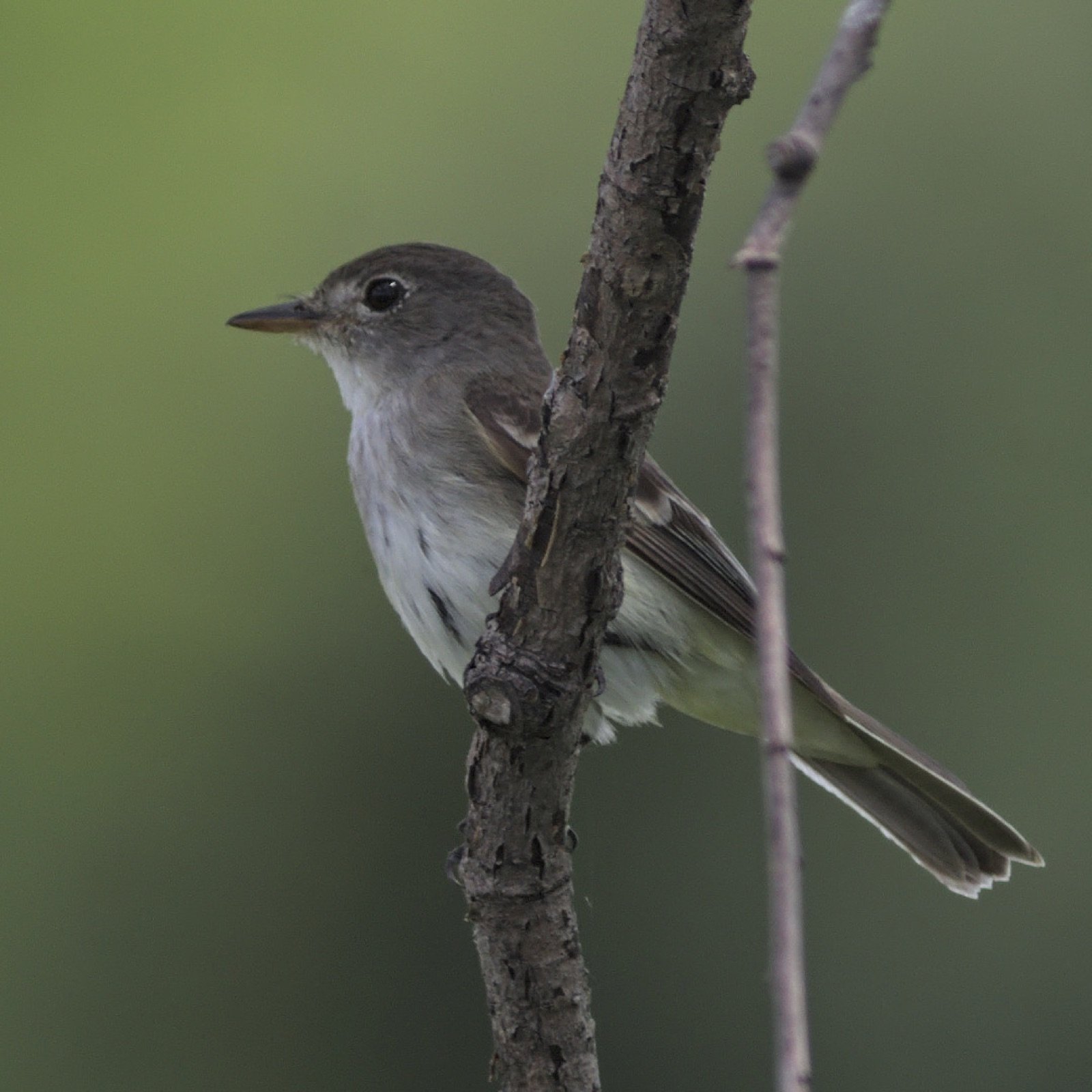
Family Tyrannidae
Willow Flycatcher
Empidonax traillii
In Spanish: Mosquerito de Traill
- Migrant
A look-alike migrant flycatcher, best told apart by its voice
The Willow Flycatcher (Mosquerito de Traill) does not breed in Costa Rica. It breeds in North America and reaches us as a non-breeding visitor and as a passage migrant, and Costa Rica forms the southern part of its main winter range.
It is a small insect-eating tyrant flycatcher that migrates long distances to winter in Central America and northwestern South America. On a trip we build, the place to look is along scrubby edges rather than inside mature forest.
For a beginning birder it is a lesson in listening. It is almost identical to the Alder Flycatcher, and most birds in the field cannot be told apart safely except by voice.
How to find it
Look along scrubby edges, in savanna and in secondary growth, rather than inside mature forest. Scan the tops of bushes for an upright flycatcher that may be singing from there. Listen for the dry, upslurred 'whit' call, because that is how winter birds are usually identified. For a wintering bird, concentrate on the Pacific lowlands, and check wetland edges, since a study in northwestern Costa Rica found wintering birds at seasonal freshwater wetlands. As the dry season goes on, standing water shrinks and their distribution may become more restricted. On passage it can turn up from the lowlands to middle elevations on both slopes.
How to recognise it
This is a small flycatcher, about 13 cm long and about 12 g in weight, with a white throat.
It perches upright, and while perched it flicks its tail slightly upward, a habit worth watching for.
Its close look-alike is the Alder Flycatcher (Mosquerito de Charral). Compared with the Alder, the Willow shows:
- a relatively longer bill
- more rounded wings
- duller brown colour
Those differences are subtle, and most birds in the field cannot be told apart safely by looks alone. Treat them as supporting clues rather than proof, and let the voice give the answer.
What it sounds like
Recording: Quinten Wiegersma, CC BY 4.0, source, read 4 Nov 2026.
Behaviour and diet
The Willow Flycatcher feeds mainly on flying insects such as flies, beetles and moths. It perches upright and often sings from the tops of bushes, which can make it easier to spot.
Wintering birds in Costa Rica defend their own territories, and at the study sites both sexes held them all winter. Territories are small, around 1,100 square metres, so a bird you find is likely to stay in the same patch.
Where it lives
In winter it prefers brushy edges in savannas and areas of secondary growth. Across its wintering range it uses scrubby clearings, light woodland, river islands and humid forest edges, up to about 1000 m elevation.
In Costa Rica, birds identified by voice winter on both slopes and in the interior, and they are most numerous on the Pacific slope. Wetlands bordered by brush are commonly used by wintering birds. Passage birds are fairly common from the lowlands to middle elevations on both slopes, while wintering birds are uncommon, mostly in the Pacific lowlands.
When to see it
Autumn passage runs from mid August to late October, peaking in late September. The spring passage runs from mid March to late May, and some birds stay for the winter.
Similar birds
The Alder Flycatcher (Mosquerito de Charral) is the main look-alike. In winter the practical difference is the call: the Willow gives a 'whit', the Alder a low, flat 'pip'. In song, the Willow's is a sneezy 'fitz-bew' and the Alder's a burry 'fee-bee-o' that drops more sharply in pitch. Voice is the safest way to separate them.
Names and lore in Costa Rica
Costa Ricans call it Mosquerito de Traill. Elsewhere it is known as mosquerito de sauces (Honduras, Ecuador, Peru, Panama) and papamoscas saucero (Mexico).
Status and conservation
It is a migrant (M) on the AOCR list, in Costa Rica both a non-breeding visitor and a passage migrant.
Photography tips
Look for the bird perched upright at the top of a bush, where it often sings. Because wintering territories are small, once you find a bird you can return to the same patch and expect it to still be there.
How we know this 14 sources, each read on the date shown
- Wikipedia read 2026-11-04
https://en.wikipedia.org/wiki/Willow_flycatcher - Cornell Birds of the World read 2026-11-04
https://birdsoftheworld.org/bow/species/wilfly/cur/distribution - Aves de Costa Rica read 2026-11-04
https://avesdecostarica.com/Empidonax-traillii.html - Audubon Field Guide read 2026-11-04
https://www.audubon.org/field-guide/bird/willow-flycatcher - All About Birds (Cornell Lab) read 2026-11-04
https://www.allaboutbirds.org/guide/Willow_Flycatcher/species-compare/ - Spanish Wikipedia read 2026-11-04
https://es.wikipedia.org/wiki/Empidonax_traillii - Ecoregistros read 2026-11-04
https://www.ecoregistros.org/ficha/Empidonax-traillii - Birds of the World read 2026-11-04
https://birdsoftheworld.org/bow/species/wilfly/cur/sounds - Birdfact read 2026-11-04
https://www.birdfact.com/birds/willow-flycatcher - US Fish and Wildlife Service read 2026-11-04
https://www.fws.gov/species/southwestern-willow-flycatcher-empidonax-traillii-extimus - USDA Forest Service RMRS-GTR-60 read 2026-11-04
https://fs.usda.gov/rm/pubs/rmrs_gtr060/rmrs_gtr060_071_082.pdf - USGS read 2026-11-05
https://pubs.usgs.gov/publication/70005478 - The Condor (Koronkiewicz et al. 2006) read 2026-11-05
https://doi.org/10.1093/condor/108.3.558 - Animal Diversity Web read 2026-11-05
https://animaldiversity.org/accounts/Empidonax_traillii/