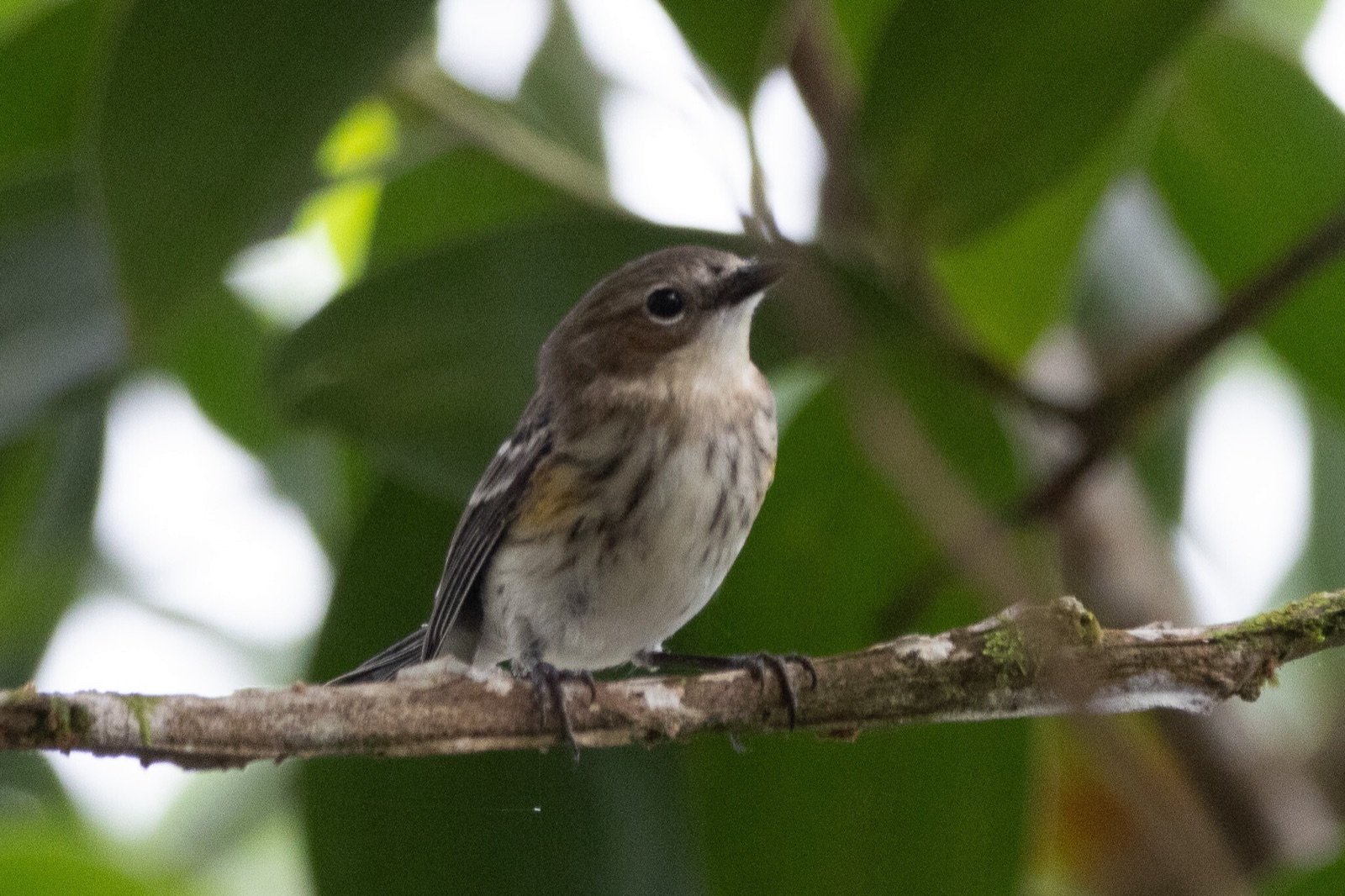
Family Parulidae
Yellow-rumped Warbler
Setophaga coronata
In Spanish: Reinita Lomiamarilla
- Migrant
A winter warbler whose yellow rump shows best when it flies.
The Yellow-rumped Warbler (Reinita Lomiamarilla) is a migrant in Costa Rica. The official list of Costa Rican birds marks it as M: it is not a resident and not a regional endemic.
Costa Rica sits at the southern edge of its winter range, which runs down the Caribbean slope from Belize to Costa Rica and only irregularly reaches central Panama. Few birds get this far south.
On a trip we build, this is a bird to watch for along roadsides and in open country rather than one to plan a day around. The yellow rump is often hidden by the wings, so the moment it flies is the moment to look.
How to find it
Check scrub, pastures, dry forest edge and fruiting shrubs. Scan low first, including the ground, then lift your eyes to the canopy. Watch for fluttering sallies after insects, often launched from an exposed perch. Listen for the sharp tchek and look for the yellow rump as the bird flies away. Roadside open country is worth a slow walk, since a tour group recorded one along the La Gamba road, on the mainland near the Golfo Dulce side of the Osa area. Expect to look carefully, because it is scarce in some areas.
How to recognise it
In breeding plumage the male has a streaked slate-blue back, white wing patches, a streaked breast, and yellow patches on the crown, flanks and rump.
Females are duller and browner but still show a clear yellow rump.
The winter birds that reach Costa Rica are of the eastern white-throated form, known as Myrtle. It has a white throat, a pale eye stripe and a dark cheek patch. The western form, Audubon's, has a yellow throat patch, but both forms show the yellow rump.
In Costa Rica the rump is often hidden by the wings while the bird sits, so watch for it when the bird flies. Birders use the English nickname "butterbutt" for that bright patch; it is not a Costa Rican name.
What it sounds like
Behaviour and diet
In Costa Rica it forages by creeping slowly over trunks and branches. It also catches insects in flight, often with fluttering sallies, and hops on the ground to pick up small insects and spiders.
It is mostly found low, often on the ground, but it also ranges up to the canopy. It usually stays apart from mixed flocks.
Across its winter range it usually occurs in flocks, though sometimes alone. Its feeding style is versatile: it searches twigs and leaves and sometimes hovers to pick insects off foliage.
Where it lives
In migration and winter the species uses open forest, woodland, savanna, roadsides, pastures and scrub. In Costa Rica look in scrub, pastures, dry forest edge and fruiting shrubs.
The Birds of Costa Rica field guide records it on both slopes. Its winter range follows the Caribbean slope south from Belize, Guatemala, Honduras and Nicaragua to Costa Rica. Cloudbridge Nature Reserve includes it on its bird list.
When to see it
In Costa Rica it often shows up by mid-September but is not regular before mid-October, and it leaves by late March. It is irregular, uncommon to rare from November to March on both slopes, and more widespread during migration, in October and November and from March to early April.
Similar birds
The Prairie Warbler sometimes associates with it on or near the ground. It pumps its tail constantly while hopping, and has a bold pale eyebrow, streaky underparts and a dull yellowish rump. The Magnolia Warbler has a similar yellow pattern, but a heavily streaked breast and a broader tail.
Names and lore in Costa Rica
Costa Rica and Panama use the Spanish name Reinita Lomiamarilla. Other countries differ, such as chipe coronado in Mexico and reinita culiamarilla in Colombia.
Status and conservation
The official list of Costa Rican birds marks it as M, a migrant, and it is neither a resident nor a regional endemic.
Photography tips
Watch for its sallies from an exposed perch, where it flies out to catch insects and often returns. Be ready when it flies, because that is when the yellow rump shows.
How we know this 15 sources, each read on the date shown
- Bird Watching Costa Rica read 2026-11-04
https://www.birdwatchingcostarica.com/ave/yellow-rumped-warbler/ - NatureServe Explorer read 2026-11-04
https://explorer.natureserve.org/Taxon/ELEMENT_GLOBAL.2.101442/Setophaga_coronata - Lista Oficial de las Aves de Costa Rica (AOCR) read 2026-11-04
https://listaoficialavesdecostarica.wordpress.com/lista-oficial/lista-oficial-online/ - Ecoregistros read 2026-11-04
https://www.ecoregistros.org/ficha/Setophaga-coronata - Cloudbridge Nature Reserve bird list read 2026-11-04
https://www.cloudbridge.org/wp-content/uploads/2020/04/Bird-Species-List-Costa-Rica-13-April-2020.pdf - Aves y Ventanas Costa Rica read 2026-11-04
https://avesyventanascostarica.wordpress.com/2020/10/09/aves/ - Birds of Costa Rica (Princeton field guide, online copy) read 2026-11-04
https://dokumen.pub/birds-of-costa-rica-9780691243351.html - iNaturalist (NPS Manassas guide) read 2026-11-04
https://www.inaturalist.org/guide_taxa/364401 - 10,000 Birds read 2026-11-04
https://www.10000birds.com/the-wintering-wood-warblers-of-costa-rica.htm - Eagle-Eye Tours trip report read 2026-11-04
https://www.eagle-eye.com/blog/costa-rica-birding-tour-trip-report-jan-22-feb-7-2025/ - Birds for Beer read 2026-11-04
https://birdsforbeer.com/2018/05/26/from-costa-rica-to-minnesota-12-migrant-warblers/ - BirdNote read 2026-11-04
https://www.birdnote.org/podcasts/birdnote-daily/yellow-rumped-warbler-winter-warbler - Cornell Lab, All About Birds read 2026-11-04
https://www.allaboutbirds.org/guide/Yellow-rumped_Warbler/lifehistory - Audubon Field Guide read 2026-11-04
https://www.audubon.org/field-guide/bird/yellow-rumped-warbler - Smithsonian National Zoo read 2026-11-04
https://nationalzoo.si.edu/migratory-birds/news/bird-bound-berry