Family Fringillidae
Yellow-throated Euphonia
Euphonia hirundinacea
In Spanish: Eufonia Gorgiamarilla (Agüío, Caciquita)
- Resident
Tiny yellow-bellied fruit eater of edges, gardens and mistletoe
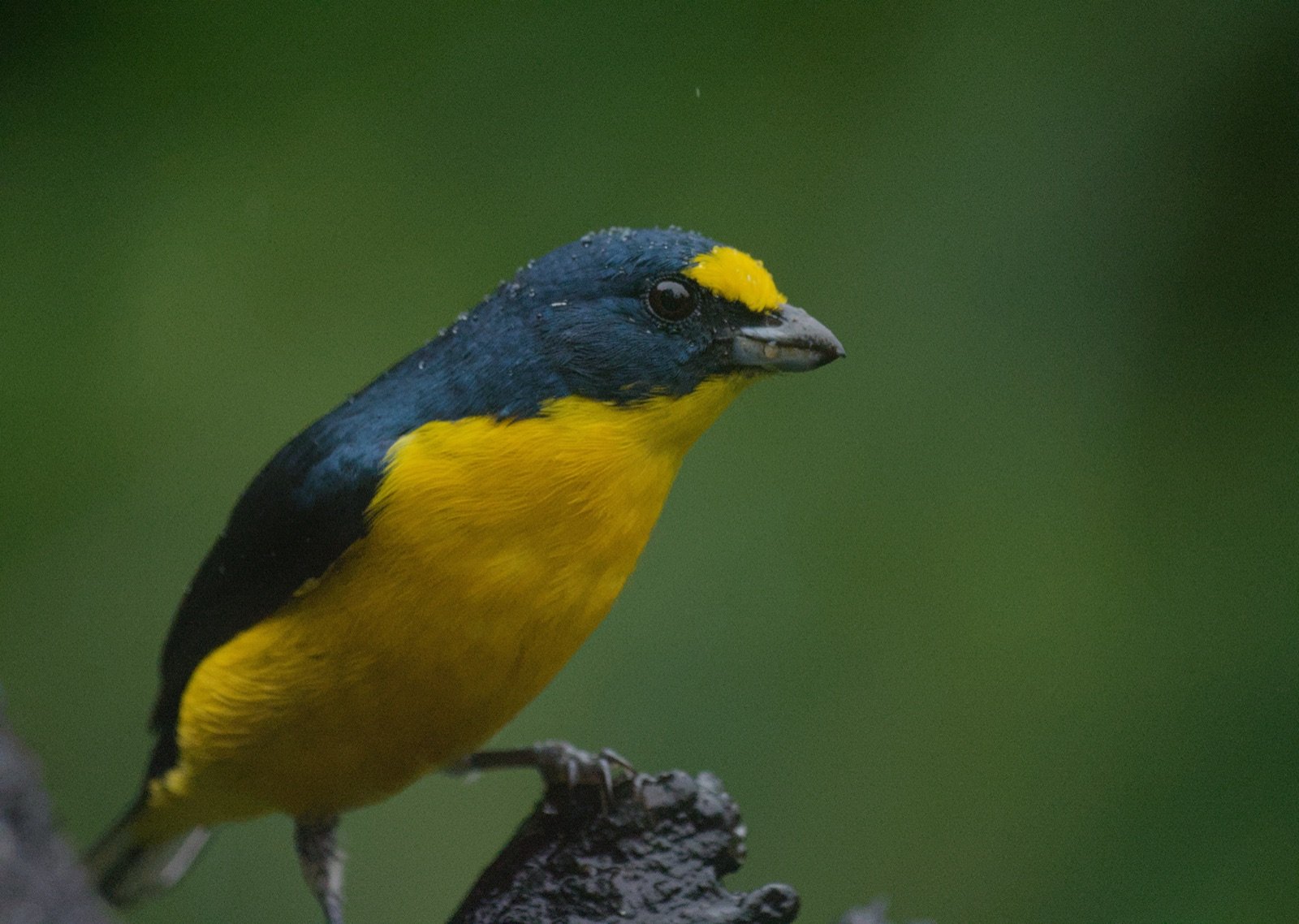
The Yellow-throated Euphonia (Eufonia Gorgiamarilla) is a tiny bird, about 10 to 11 cm long, with a glossy blue-black back and a bright yellow throat, chest and belly. It is a good first euphonia to learn because the male is the only euphonia with a yellow throat across most of its range.
In Costa Rica it lives from sea level up to about 1400 m, and it often turns up in gardens and clearings. Fruiting mistletoe is the place to watch.
How to find it
Look in the canopy in drier areas and along waterside trees. In wetter areas, try semi-open spots such as forest edges, clearings and tree plantations. Fruiting mistletoe is a good place to watch, and pairs or small groups often mix with other euphonias. The female's whitish belly is the key mark against similar yellow-green females, but it is not always easy to see, so sorting out the males first is the easier route.
How to recognise it
Adult males are glossy blue-black above with a yellow forehead patch, and the throat, chest and belly are bright yellow. The bird is tiny, about 10 to 11 cm long, and it has a heavy bill. Females are olive green above with a yellowish throat, a greenish yellow chest and a whitish gray belly. Young birds look like the adult female but are paler below. Young males moult partway and look like a female with an adult male's head for a while. The female is told from other female euphonias by a whitish or pale gray throat, breast centre and belly with yellow flanks.
What it sounds like
Recording: Arturo Benavides-Mendoza, CC BY 4.0, source, read 4 Nov 2026.
Behaviour and diet
It eats mostly fruit, especially mistletoe berries, and sometimes picks small insects off bark or twigs. It usually travels in pairs or small groups, and these often join other euphonias, especially when feeding at mistletoe. In Costa Rica it breeds from March to June. The nest is a ball with a side entrance, set 1 to 15 m up in places such as a fence post, a palm frond or a tangle of epiphytes.
Where it lives
It lives from sea level up to about 1400 m. In wetter areas it uses forest edges, partly cleared land, crops, secondary growth and clearings with scattered trees. In dry areas it prefers gallery forest. It is local and uncommon in the dry northwest and the Central Valley, common to abundant on the Pacific side near the northern mountain ranges and on the Nicoya Peninsula, and rare on the southern Pacific side.
When to see it
It is a year-round resident in most of its range, with some local movements that follow fruiting trees. In Costa Rica, breeding runs from March to June.
Similar birds
The male has a yellow throat and underparts, unlike the male Scrub Euphonia, which has a black throat. Thick-billed Euphonia has a larger yellow crown on the male and no white belly, and it overlaps in southwestern Costa Rica.
Names and lore in Costa Rica
Costa Ricans know it by the AOCR name Eufonia Gorgiamarilla, and local names listed alongside it are Agüío and Caciquita. The word euphonia comes from Greek and means good voice or excellent tone.
Status and conservation
It is a resident (R) on the AOCR list, and the IUCN lists it as Least Concern, so it is not globally threatened.
Photography tips
Males and females have been photographed at La Fortuna, which makes the Arenal area a good source of images for comparing the sexes. Fruiting mistletoe is a good place to wait for it.
How we know this 15 sources, each read on the date shown
- Costa Rica Link read 2026-11-04
http://www.1-costaricalink.com/costa_rica_fauna/yellow_throated_euphonia.htm - Aves de Costa Rica read 2026-11-04
http://www.avesdecostarica.com/Euphonia-hirundinacea.html - Birds & Breakfast Costa Rica read 2026-11-04
https://birdsandbreakfast.com/en/yellow-throated-euphonia/ - Ecos del Bosque read 2026-11-04
https://ecosdelbosque.com/fauna/euphonia-hirundinacea - Animalia.bio read 2026-11-04
https://animalia.bio/yellow-throated-euphonia - Wikipedia read 2026-11-04
https://en.wikipedia.org/wiki/Yellow-throated_euphonia - Wikipedia (Spanish) read 2026-11-04
https://es.wikipedia.org/wiki/Euphonia_hirundinacea - Birds for Beer read 2026-11-04
https://birdsforbeer.com/2020/12/27/in-my-costa-rican-garden-yellow-throated-euphonia/ - Birds for Beer read 2026-11-04
https://birdsforbeer.com/2016/04/01/yellow-throated-euphonia-v-yellow-crowned/ - Birds of Colombia (Birds of Costa Rica) read 2026-11-04
https://www.birdsofcolombia.org/costarica/Euphonia.html - John Gordon, Listening to Birds read 2026-11-04
https://thecanadianwarbler.blogspot.com/2025/03/costa-rica.html - La Iguana Golf Course local bird guide read 2026-11-04
https://www.golflaiguana.com/wp-content/uploads/sites/9272/2023/10/Wildlife_page.pdf - Avibase read 2026-11-04
https://avibase.bsc-eoc.org/species.jsp?avibaseid=3CD68A81E992C246 - Aves de Costa Rica read 2026-11-04
https://www.avesdecostarica.com/Euphonia-hirundinacea.html - Birds of the World read 2026-11-04
https://birdsoftheworld.org/bow/species/yeteup1/cur/appearance