Family Anatidae
American Wigeon
Mareca americana
In Spanish: Pato Calvo (Carraco)
- Migrant
A white-crowned winter duck of Guanacaste's lagoons and wetlands.
The American Wigeon is a slim, round-headed duck that spends the northern winter in Costa Rica. It is a regular visitor, usually in fairly small numbers, and it is found mostly in the Tempisque river basin and sometimes in other parts of Guanacaste.
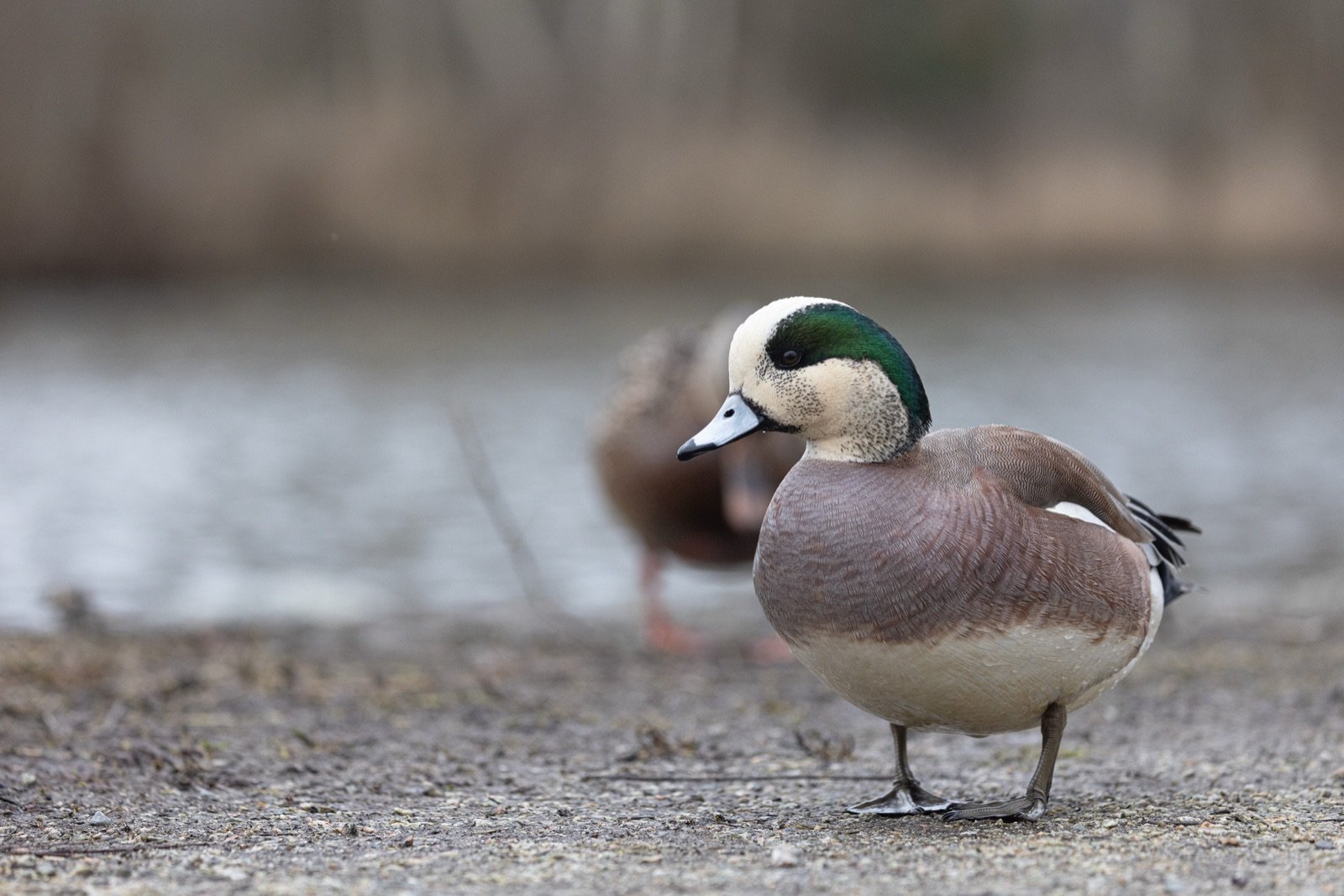
The drake wears its name well. A white crown gives him a bald look, which is why the older English name, still used by some hunters, is Baldpate.
For a beginning birder it is a rewarding duck to learn. It breeds from Alaska and northern Canada to the northern USA, then winters south as far as Panama and northern South America, so every one you see in Guanacaste has made a long journey. On a trip we build around wetlands, the lagoons of Palo Verde are a natural place to look.
How to find it
Start with the wetlands of Guanacaste, especially the Tempisque basin, where it is most regularly found. Because its movements follow water levels, check the lagoons that still hold water as the season goes on. Listen for the airy whistles before you see the birds, since a large flock gives itself away by sound. Then scan the water for the white crown of the males, and watch for the white wing patch when a flock takes off. On a Field Guides trip, at least seven wigeons, including a couple of males in breeding plumage, were seen on a lagoon from a boat in the afternoon.
How to recognise it
This is a medium-sized, slim duck about 51 cm long. Look for these marks:
Rounded head.
Small bluish bill with a black tip.
Large white patch on the upper wing, clear in flight.
The adult male has a white crown and glossy green sides to the head. His back and flanks are pinkish brown, his breast is purplish, and his belly is white.
The female is plainer. Her head is grayish to buff with black speckles, and her breast is pinkish brown. Her wing patch is scaled with white and not sharply defined, so it is less striking than the male's.
What it sounds like
Recording: Fyn Kynd, CC BY-SA 4.0, source, read 4 Nov 2026.
Behaviour and diet
Its movements in Costa Rica follow changes in water levels, so where you find it can shift through the season. Across its range it feeds in shallow water and grazes in fields, eating mainly the leaves, stems, buds and some seeds of pondweeds and grasses. It migrates in small, dense flocks.
Where it lives
In Costa Rica it lives in swamps, pond edges, mudflats, lakes and lagoons. It is found mostly in the Tempisque river basin and sometimes in other parts of Guanacaste. Outside the breeding season, across its range, it uses both fresh and brackish water, foraging along marsh edges, sloughs and sheltered bays.
When to see it
Its Costa Rica season runs from October to March. In very dry years it may leave as early as January.
Similar birds
In silhouette, the wigeon differs from other dabbling ducks by its round head, short neck and small bill. Those three features are a good starting point when you are sorting ducks on a crowded lagoon.
Names and lore in Costa Rica
Costa Rican sources give several names: Pato Calvo (Carraco) on the official list, and Zarceta or Pato Calvo on the Aves de Costa Rica site. The English name Baldpate is an older name that some people still use, especially hunters, and it comes from the white crown.
Status and conservation
The AOCR list marks it as M, a migrant, and BirdLife International rates it Least Concern.
Photography tips
In the dry season, birds crowd into the lagoons that remain at Palo Verde. The trees also lose their leaves, which gives better views. That dry season runs from December to March.
How we know this 15 sources, each read on the date shown
- Aves de Costa Rica read 2026-11-04
https://avesdecostarica.com/Mareca-americana.html - NatureServe Explorer read 2026-11-04
https://explorer.natureserve.org/Taxon/ELEMENT_GLOBAL.2.104824/Mareca_americana - Lista Oficial de las Aves de Costa Rica (AOCR) read 2026-11-04
https://listaoficialavesdecostarica.wordpress.com/lista-oficial/lista-oficial-online/ - EcoRegistros read 2026-11-04
https://www.ecoregistros.org/ficha/especie.php?id=4709&idusuario=2087 - Bird Watching Costa Rica read 2026-11-04
https://www.birdwatchingcostarica.com/ave/american-wigeon/ - Cornell Birds of the World read 2026-11-04
https://birdsoftheworld.org/bow/species/amewig/cur/sounds - Wikipedia read 2026-11-04
https://en.wikipedia.org/wiki/American_wigeon - Smithsonian National Zoo read 2026-11-04
https://nationalzoo.si.edu/animals/american-wigeon - Wild Bird Journal read 2026-11-04
https://wildbirdjournal.blog/2026/06/23/american-wigeon-identification-habitat-diet-and-interesting-facts/ - Exotic Birding Costa Rica checklist read 2026-11-04
http://www.exoticbirding.com/costarica/checklist.html - Animalia.bio read 2026-11-04
https://animalia.bio/american-wigeon - Asociación Ornitológica de Costa Rica (AOCR) read 2026-11-04
https://www.avesdecostarica.org/anatidae.html - Enjoy Costa Rica read 2026-11-04
https://www.enjoycostarica.com/what-to-do-in-costa-rica/birding-in-costa-rica/ - Costa Rica Birding Trips read 2026-11-04
https://www.costaricabirdingtrips.com/north-pacific/palo-verde-national-park - Field Guides trip list read 2026-11-04
https://fieldguides.com/triplists/cr215.html