 Mallard
Family Anatidae
Mallard
Anas platyrhynchos
In Spanish: Pato Cabeciverde (Carraco)
- M-SC
A familiar duck, but a very rare stray here, last described near Turrialba.
The Mallard is a duck many beginners already know from home, and in Costa Rica it is a very rare bird. Older accounts treat it as a rare or accidental visitor, and the AOCR changed its status in its 2015 list update.
The last record described is two wintering females near Turrialba in 1950 and 1951. No recent reports are known, so this page is about knowing the bird rather than expecting it.
Domestic Mallards, by contrast, are common in the country, especially near the coast, so an odd duck is not always a wild one.
How to find it
Realistically, a wild Mallard here would be a surprise, so treat any sighting as something to document. Scan freshwater ponds and marshes, the habitat where it was most likely to occur. Look for the dabbling pose, tail up and head under water. Listen for the female's descending run of quacks. Note the head, bill and speculum colours carefully, because farm ducks and hybrids also exist.
How to recognise it
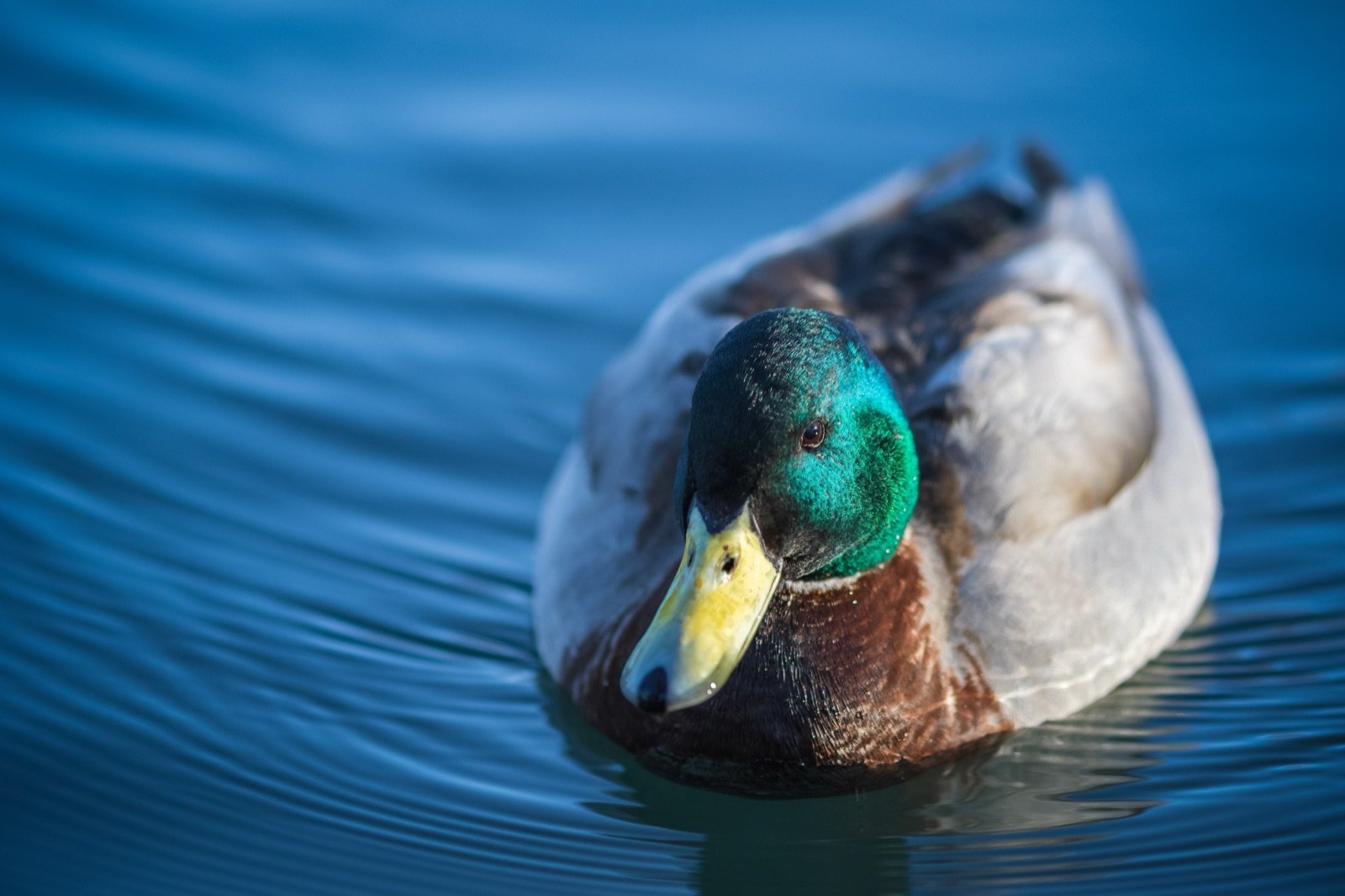
The male is easy to name. He has a glossy green head split from a chestnut breast by a thin white ring. The body is mostly pale gray, the bill is yellow and the feet are orange.
The female is mottled and scaly in buff-brown and blackish tones, with a black and orange bill. She is a large, sturdy duck, about 61 cm long.
Both sexes show a white-edged wing patch (speculum) that is black or iridescent blue. The male's tends to be blue. These marks describe the species in general, not only birds in Costa Rica.
What it sounds like
Behaviour and diet
In Costa Rica it was seen in pairs and sometimes alone, and it rarely joined mixed flocks. Elsewhere Mallards are social and gather in flocks of varying size.
They feed by dabbling, tipping forward with the tail up and the head under water instead of diving.
Where it lives
In Costa Rica the Mallard was most likely to be found on freshwater ponds and marshes. It was apparently a rare to casual visitor to Guanacaste and the Central Valley, and its Costa Rica entry in the Birds of the World listing places it near Turrialba.
Across its wider range it breeds from Alaska and northern Canada to the southern USA. In winter it moves south to central Mexico and rarely reaches Panama, so a bird here would be a rare stray.
When to see it
The wintering females near Turrialba were recorded from 1950 to 1951.
Similar birds
The Northern Shoveler can look similar. It has a much larger bill, a blue-gray patch on the wing and a greenish speculum.
A Mallard x Muscovy Duck hybrid has also been recorded in Costa Rica. One looked like a Muscovy on the back and crest but had a Mallard-like breast, so an odd duck may not be a pure wild Mallard.
Names and lore in Costa Rica
Costa Ricans call this duck Pato Cabeciverde or Carraco, and the AOCR list gives the full name as Pato Cabeciverde (Carraco). Carraco is a general word for several dabbling ducks: the AOCR list also uses it for the Blue-winged Teal, Cinnamon Teal and Northern Shoveler. A Spanish name list for Costa Rica also gives Ánade Azulón.
Status and conservation
The AOCR list marks the Mallard M-SC, meaning migratory with no official voucher held, and it is a very rare bird here.
Photography tips
The pose to look for is the dabbling one: tail up, head under water, rather than a dive. If you do see a candidate duck, photograph the head, bill, feet and speculum, since the AOCR is asking for evidence for species without a voucher.
How we know this 15 sources, each read on the date shown
- AOCR Official List update 2015 (Dialnet) read 2026-11-04
https://dialnet.unirioja.es/servlet/articulo?codigo=7516661 - Aves de Costa Rica read 2026-11-04
https://avesdecostarica.com/Anas-platyrhynchos.html - Cornell Birds of the World read 2026-11-04
https://birdsoftheworld.org/bow/species/mallar3/cur/distribution - Avibase read 2026-11-04
https://avibase.bsc-eoc.org/species.jsp?avibaseid=85625D75 - Bird Watching Costa Rica read 2026-11-04
https://www.birdwatchingcostarica.com/ave/mallard/ - Birds of the World (Cornell Lab) read 2026-11-04
https://birdsoftheworld.org/bow/species/mallar3/cur/sounds - Lista Oficial de las Aves de Costa Rica (AOCR) read 2026-11-04
https://listaoficialavesdecostarica.wordpress.com/lista-oficial/lista-oficial-online/ - Birdwatching in Costa Rica (AOCR list) read 2026-11-04
https://birdwatchingincostarica.com/bird-lists/ - Lista Oficial de las Aves de Costa Rica (AOCR) read 2026-11-04
https://listaoficialavesdecostarica.wordpress.com/nuevos-registros/ - Híbridos silvestres de patos registrados en Costa Rica (ResearchGate) read 2026-11-04
https://www.researchgate.net/publication/314101379_Hibridos_silvestres_de_patos_Anseriformes_Anatidae_registrados_en_Costa_Rica - Audubon Field Guide read 2026-11-04
https://www.audubon.org/field-guide/bird/mallard - Birdfact read 2026-11-04
https://www.birdfact.com/birds/mallard - birdlist.org read 2026-11-05
https://www.birdlist.org/aves/aves_de_costa_rica.htm - Avibase read 2026-11-05
https://avibase.bsc-eoc.org/checklist.jsp?list=howardmoore®ion=CR - AOCR Lista Oficial read 2026-11-05
https://listaoficialavesdecostarica.wordpress.com/2014/12/05/anas-platyrhynchos-mallard-pato-cabeciverde-carraco/