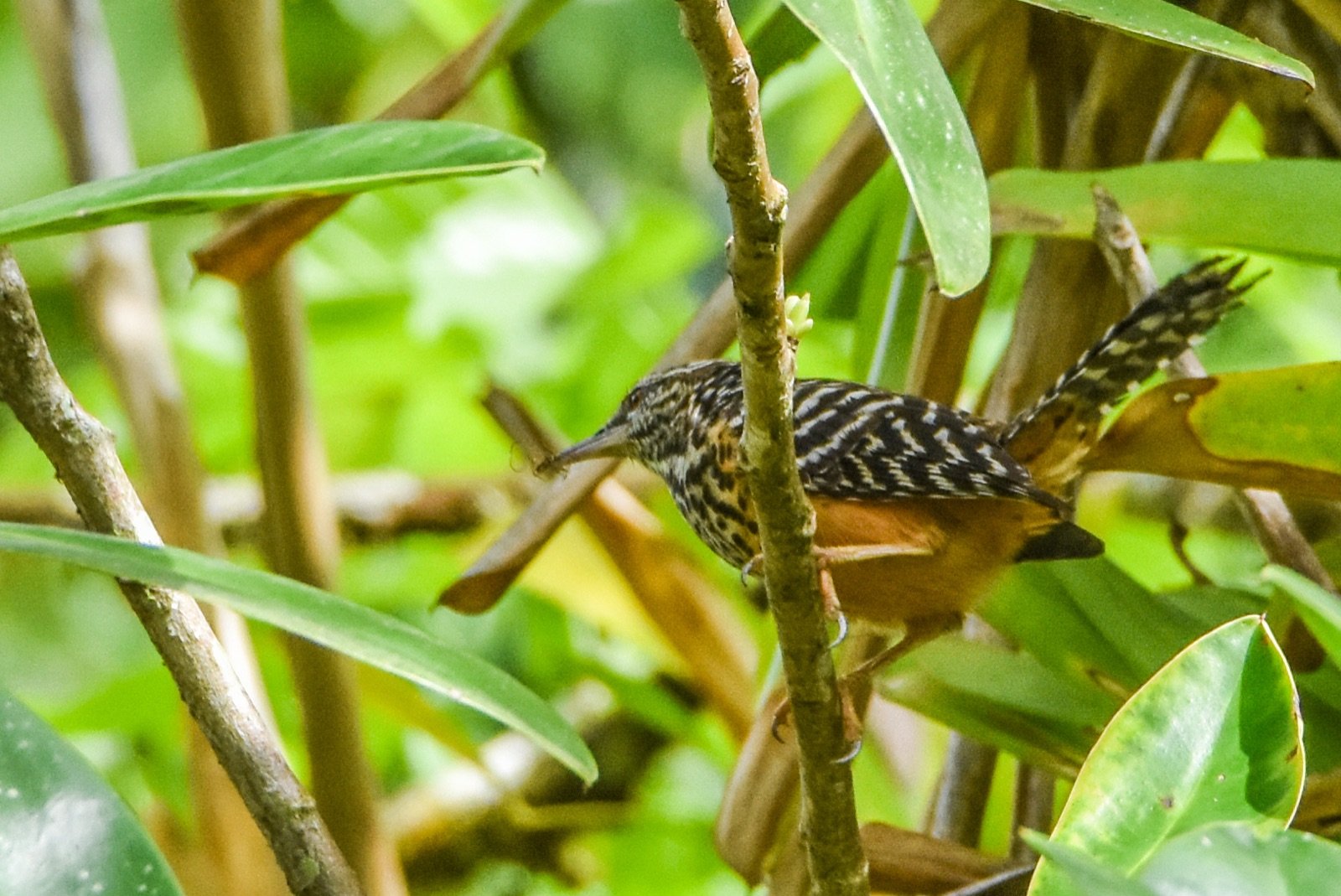
Family Troglodytidae
Band-backed Wren
Campylorhynchus zonatus
In Spanish: Soterré Matraquero
- Resident
A noisy, barred wren of Caribbean slope forest edges and gardens
The Band-backed Wren (Soterré Matraquero) is a common resident on the Caribbean slope of Costa Rica, from the lowlands up to about 1700 m. It usually moves in noisy family groups of 4 to 12 birds, so you often hear the gang before you see it.
Birders meet it on the Caribbean side, and tour groups have recorded it at La Selva, at CATIE near Turrialba, in the Tuis valley and in the gardens at Arenal. Look high in the trees, and check gardens and shrubs near houses.
How to find it
Look high in the trees and listen for odd raspy calls, then check bromeliads and passing mixed flocks. Gardens and shrubs near houses are good places to look. One tour watched a noisy group move through bushes around a house foundation at CATIE as they headed to roost in the evening, so dusk is worth keeping in mind. A pre-breakfast walk at Arenal turned it up on a January tour. At Arenal the birds often stay high, so views can be distant.
How to recognise it
This is a fairly large wren. Adults measure about 16.5 cm and weigh about 29 g.
The field marks, in order:
Crown: brownish grey.
Nape: black.
Back, wings and tail: heavily barred in black, buff and white.
Throat and breast: white with black spots.
Belly: cinnamon.
In Costa Rica adults also show narrow white eyebrows and streaked, mottled sides to the head. The eye is reddish brown. Young birds have duller upperparts and off-white to buff underparts, so a paler wren in a family party is likely a youngster.
What it sounds like
Behaviour and diet
Family groups of 4 to 12 birds forage together, noisy and active. In Costa Rica they check bromeliads and join mixed flocks. The diet is mainly insects, spiders and other invertebrates.
The nest is a big ball with a wide side entrance, 2 to 30 m up and often hidden in bromeliads. Breeding in Costa Rica runs from March to June. Families also sleep together in dormitory nests, built like the breeding nests, throughout the year.
Where it lives
In Costa Rica this wren uses openings and edges of very wet forest on the Caribbean slope, from the lowlands up to about 1700 m. It is most often found in thinned forest, trees along rivers, trees and shrubs around houses, and second growth.
Across its wider range it also lives in open woodland, scrub and gardens, which fits its habit of turning up around buildings. Foothill rainforest on the Caribbean side, such as around Arenal, is a good setting.
When to see it
Tour groups have recorded it in late December to January, which shows it can be seen then.
Similar birds
The other big, boldly marked Campylorhynchus wren in Costa Rica is the Rufous-naped Wren. It lives in dry country in the Pacific lowlands, so the two are split by region. The Banded Wren is a different, smaller bird, a dry-forest wren of the Pacific side, while the Band-backed lives in humid forest on the Caribbean slope.
Names and lore in Costa Rica
Costa Rican sources spell the common name Soterrey Matraquero. Other countries use different names, such as matraca tropical in Mexico and colchonero espalda rayada in Honduras.
Status and conservation
The official Costa Rican list marks it as R, a resident species, and the IUCN rates it Least Concern with a stable population.
Photography tips
Buildings and clearings at La Selva are worth checking, and one participant on a tour got a portrait near the administration buildings, cafeteria and dining hall. A guide said the wren had become harder to find around La Selva, but on that trip a pair turned up along the police station road on the first morning. Gardens near houses at dusk can also bring a group into the open.
How we know this 19 sources, each read on the date shown
- Aves de Costa Rica read 2026-11-04
https://avesdecostarica.com/Campylorhynchus-zonatus.html - Birds of the World (Cornell) read 2026-11-04
https://birdsoftheworld.org/bow/species/babwre1/cur/introduction - EcoRegistros read 2026-11-04
https://www.ecoregistros.org/ficha/Campylorhynchus-zonatus&idlugar=1204 - Birds Colombia (Wikipedia text) read 2026-11-04
https://birdscolombia.com/2019/07/10/cucarachero-matraquero-band-backed-wren-campylorhynchus-zonatus/ - Wikipedia (Spanish) read 2026-11-04
https://es.wikipedia.org/wiki/Campylorhynchus_zonatus - Lista Oficial de las Aves de Costa Rica (AOCR) read 2026-11-04
https://listaoficialavesdecostarica.wordpress.com/lista-oficial/lista-oficial-online/ - Animalia.bio read 2026-11-04
https://animalia.bio/band-backed-wren - Birding Craft read 2026-11-04
https://birdingcraft.com/wordpress/2024/06/07/costa-rica-birding-a-whole-lot-of-wrens-going-on/ - Field Guides tour list, Rancho Naturalista 2021 read 2026-11-04
https://fieldguides.com/triplists/crh21b.html - Field Guides tour list, Edges Part II 2020 read 2026-11-04
https://fieldguides.com/triplists/cr220.html - Field Guides tour list, Costa Rica 2018 read 2026-11-04
https://fieldguides.com/triplists/cos18.html - Eagle-Eye Tours trip report, January 2026 read 2026-11-04
https://www.eagle-eye.com/blog/costa-rica-birding-trip-report-jan-11-27-2026/ - Wikipedia read 2026-11-04
https://en.wikipedia.org/wiki/Campylorhynchus_zonatus - Exotic Birding read 2026-11-04
http://www.exoticbirding.com/costarica/braulio-carrillo/checklist.html - Field Guides itinerary read 2026-11-04
https://fieldguides.com/itineraries/cos26-ITIN.pdf - Birdquest tour report 2024 read 2026-11-04
https://www.birdquest-tours.com/birding-tour-reports/costa-rica-classic-2024/ - Field Guides trip list 2019 read 2026-11-04
https://fieldguides.com/triplists/cos19.html - Birdingcraft read 2026-11-04
https://birdingcraft.com/wordpress/2014/08/14/big-cool-wrens-of-costa-rica/ - Field Guides trip list 2016 read 2026-11-04
https://fieldguides.com/triplists/cos16.html