Family Cracidae
Black Guan
Chamaepetes unicolor
In Spanish: Pava Negra (Pajuila)
- Resident
- Regional endemic
A quiet, turkey-sized black guan with a blue face, of highland cloud forest.
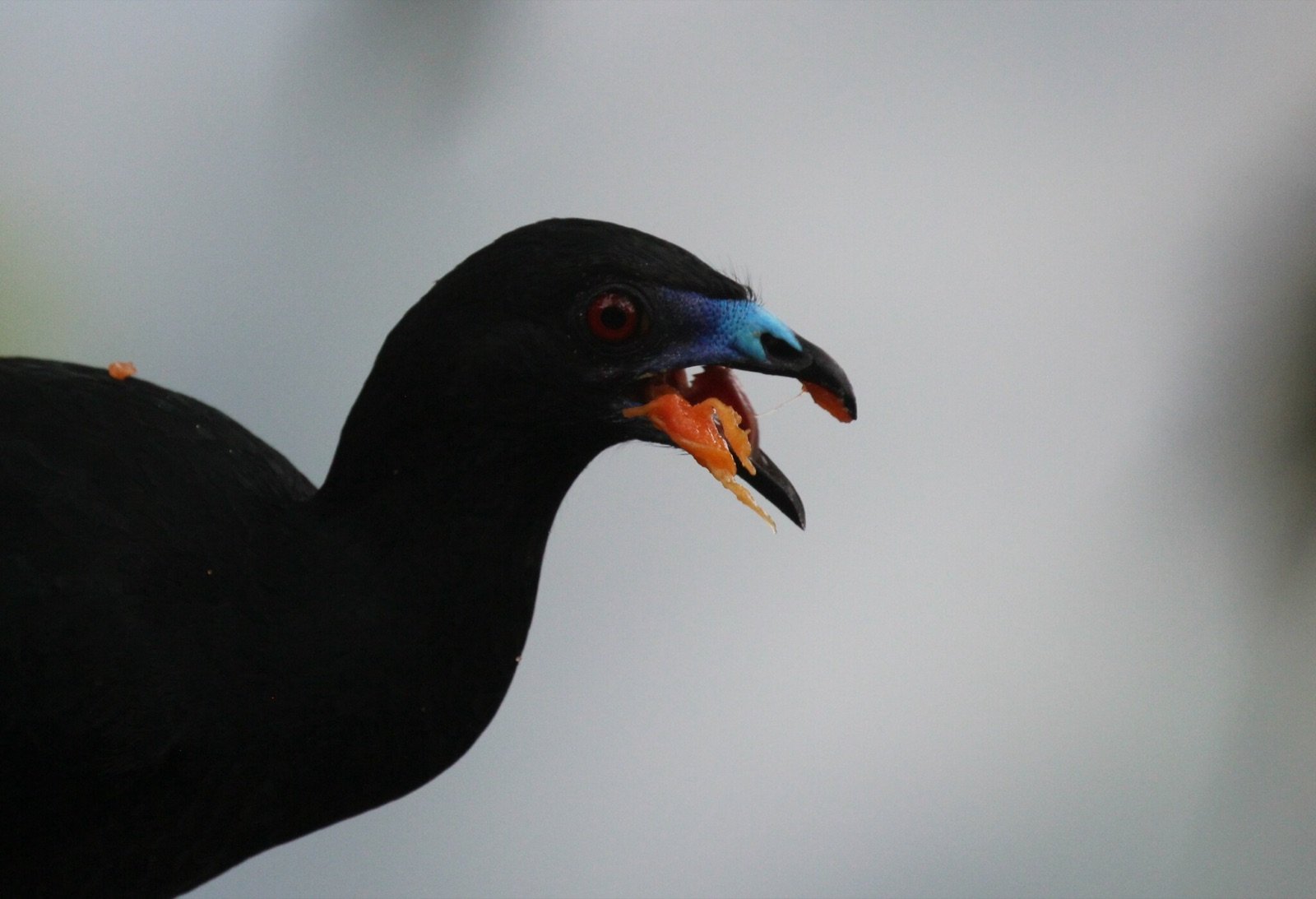
The Black Guan (Pava Negra, also called Pajuila) is a turkey-sized, almost all black bird with a bright blue bare face, a red eye and red legs. It is endemic to the highlands of Costa Rica and western Panama, and in Costa Rica it is fairly common in protected areas.
Because it barely calls, it is easy to miss. Once found, it is not easily alarmed when you walk beneath it, so it is easy to watch and photograph.
On the mornings we build around San Gerardo de Dota, it shares the day with the Resplendent Quetzal, the Fiery-throated Hummingbird and the Northern Emerald-Toucanet, with the guan in the oaks.
Where to see it
How to find it
Start in a protected highland forest such as Monteverde, Tapantí or Cerro de la Muerte, where it is called pretty common. It is less noticeable than the Crested Guan because it is so quiet, so look rather than listen. Scan the treetops and the forest floor. At Cinchona a few birds used the feeders at a cafe, and the advice there is to scan the ground as well as the feeders, and the forest across the canyon. On a 2025 group tour the first one came on the drive over Cerro de la Muerte down into the San Gerardo valley.
How to recognise it
Look for a turkey-sized bird that is almost all black. The upperparts are glossy and the underparts duller.
The bare face is bright blue, the eye is red and the legs are red. Against that black body, those three colours are the quickest check when a dark shape moves in the branches or on the ground.
Juveniles look duller than adults, with browner underparts and darker facial skin.
Behaviour and diet
The Black Guan eats mainly fruit and is thought to be an important seed spreader. It feeds alone, in pairs or in small family groups, in the treetops and on the forest floor. It roosts at night in large, isolated trees, and in flight it gives a few flaps and then glides.
Breeding is thought to run from February to June. The nest is a small platform of twigs and leaves in a clump of epiphytes high in a tree, with two or three eggs.
Where it lives
This is a bird of cloud forest on steep, rugged ground. It is usually found at about 1,000 to 2,250 m, and occasionally lower or higher depending on the area.
It prefers dense mountain forest in protected areas, though it can also use patchy high forest mixed with secondary growth and clearings where hunting is light. In Costa Rica the range runs from the Cordillera de Guanacaste in the north south into western Panama, and it is a bird of the Talamancan montane forest zone.
When to see it
A 1998 study in the Tilarán range found both guan species most numerous at 1,400 m in the breeding season, then scarcer there and more numerous lower down afterwards. Birds move down the slope seasonally, though the species is mostly sedentary.
Similar birds
The Crested Guan is the other guan birders meet in Costa Rica. It is much noisier and more easily alarmed, and it lives in the lowlands and foothills, up to about 1,850 m. The two can overlap at mid elevations in the Tilarán range, but in higher cloud forest the Black Guan is the one to expect.
Names and lore in Costa Rica
The Costa Rican Spanish name is Pava Negra, which one writer translates as black turkey. The AOCR list adds Pajuila as an alternate name.
Status and conservation
The AOCR list marks it R-END, a resident endemic, and the IUCN lists it as Least Concern, though it is heavily hunted for food even where it is nominally protected.
Photography tips
Fruit feeders are the easiest place to get close views, since in forest the bird can be very hard to see. Once you find one it is not easily alarmed when you walk beneath it, which makes it easy to photograph. At Cinchona, check the ground and the forest across the canyon as well as the feeders.
Trips that find it
- Nature Birding Tour11 nightsSee the trip
- Arenal, the Pacific and the Quetzal Valley16 nightsSee the trip
- Bird Photography in Costa Rica9 nightsSee the trip
- Carara, the Osa and the Quetzal11 nightsSee the trip
Tell us when you are travelling and our team in Costa Rica builds the trip around the birds you want to see.
Plan my birding tripHow we know this 15 sources, each read on the date shown
- The Tico Times read 2026-11-04
https://ticotimes.net/2024/02/12/costa-rica-birding-meet-the-black-guan - Grokipedia read 2026-11-04
https://grokipedia.com/page/black_guan - Birding Craft read 2026-11-04
https://birdingcraft.com/wordpress/2010/02/12/seeing-curassows-guans-and-chachalacas-when-birding-costa-rica/ - Birda read 2026-11-04
https://app.birda.org/species-guide/38070/Black_Guan - Animalia.bio (Wikipedia text) read 2026-11-04
https://animalia.bio/black-guan?taxonomy=1742 - Wikipedia read 2026-11-04
https://en.wikipedia.org/wiki/Black_guan - EcoRegistros read 2026-11-04
https://www.ecoregistros.org/ficha/Chamaepetes-unicolor - Flickr (Rosa Gamboias) read 2026-11-04
https://www.flickr.com/photos/rgamboias/34834640953?rb=1 - Universidad Nacional de Costa Rica repository read 2026-11-04
https://repositorio.una.ac.cr/items/8495c0a6-ce53-465a-8655-86395cba1206 - Ornitología Neotropical (Chaves-Campos 2003) read 2026-11-04
https://digitalcommons.usf.edu/cgi/viewcontent.cgi?article=1344&context=ornitologia_neotropical - Birding Craft read 2026-11-04
https://birdingcraft.com/wordpress/tag/black-guan/ - Eagle-Eye Tours trip report read 2026-11-04
https://www.eagle-eye.com/blog/costa-rica-birding-tour-trip-report-jan-22-feb-7-2025/ - Field Guides trip report read 2026-11-04
https://fieldguides.com/triplists/cos25/ - Wikipedia (Spanish) read 2026-11-04
https://es.wikipedia.org/wiki/Chamaepetes_unicolor - Cornell Birds of the World read 2026-11-04
https://birdsoftheworld.org/bow/species/blagua1/cur/introduction