Family Apodidae
Black Swift
Cypseloides niger
In Spanish: Vencejo Negro
- Resident
A sooty, cigar-shaped swift of the highlands, a summer resident here.
The Black Swift, Vencejo Negro in Spanish, is a bird you find by looking up. The Costa Rican form, costaricensis, is a summer resident from April to October and breeds in the Costa Rican highlands.
The first documented Costa Rican nest was found on 28 May 1997 and held a fresh egg. It extended the known breeding range by about 1500 km to the southeast, so earlier writers who had only suspected breeding here were proved right.
Nowhere in its range is the species an abundant breeder, so a good view of one is worth savouring.
How to find it
Watch the sky over mountain cliffs and waterfalls, since nests are usually near or behind falling water. That water is loud, which makes the birds hard to hear at breeding sites, so rely on your eyes. At colonies the birds are most vocal at dawn and dusk, when they leave or return to the nests. Keep an eye on the leading edge of an approaching rainstorm, where it often feeds with other swifts. Scan high, because it often hunts far above the ground.
How to recognise it
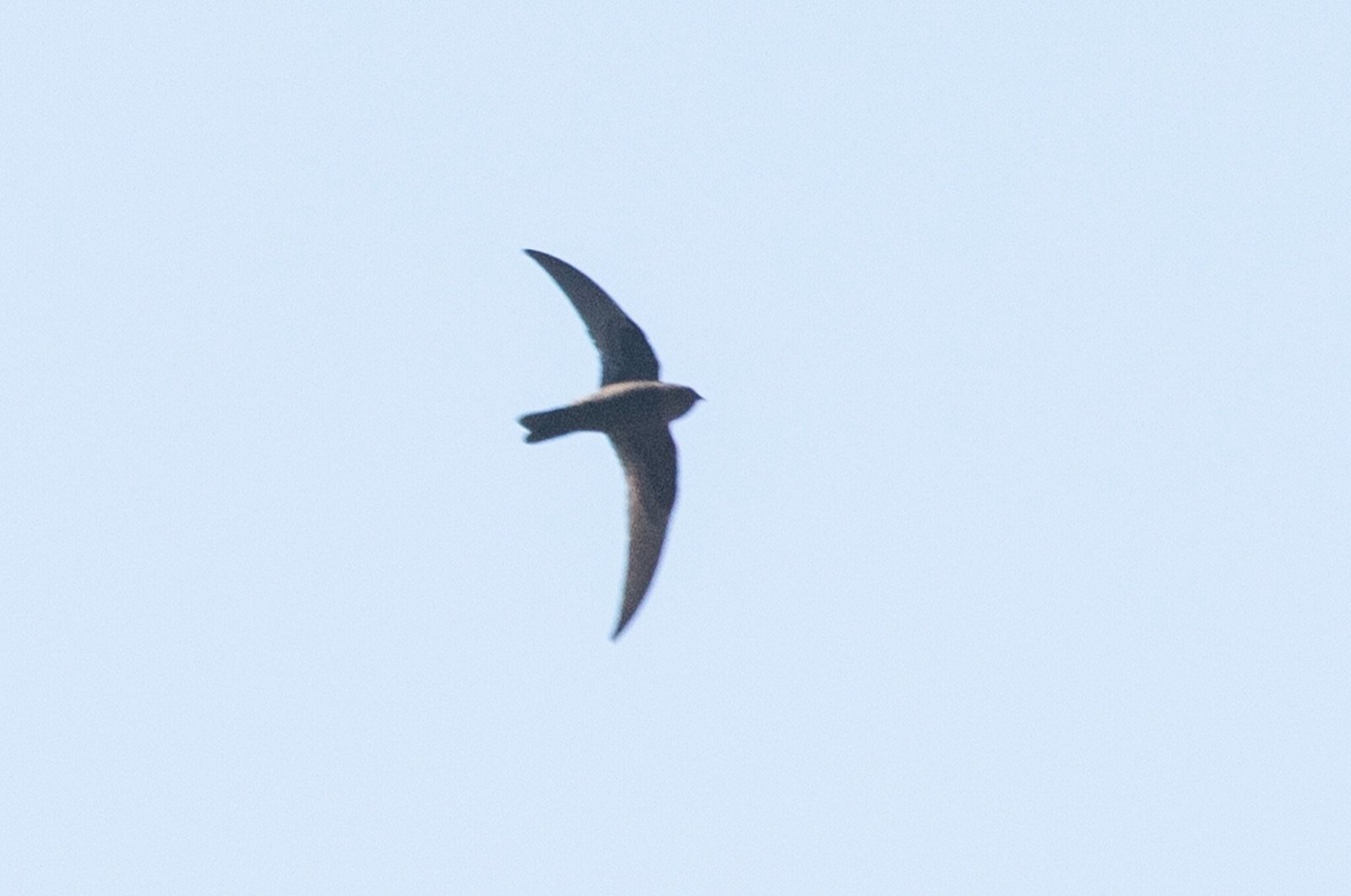
In flight it looks like a flying cigar, with long, slender, curved wings and a short, slightly forked tail. It is mostly sooty dark gray.
The shoulders are clearly darker than the rest of the wing, and the inner and outer wing show some contrast.
Adults are black with a bluish gloss above and paler, grayer underparts. There is whitish scaling on the forehead. The bill and feet are black, and length is about 18 cm.
The Costa Rican subspecies is darker than the northern borealis form and mid-sized between the northern and Caribbean forms. Males have a grayer head and neck than Caribbean birds.
Behaviour and diet
The Black Swift catches flying insects in the air, often very high up. In Costa Rica it often feeds with other swifts along the leading edge of rainstorms. Prey includes winged ants, bees, wasps, flies and beetles, and it lives in groups.
Its wings are long and its legs very short, so it almost never lands on the ground. It feeds in flight and only perches for long periods when nesting on cliffs.
Where it lives
The Costa Rican subspecies breeds in the Costa Rican highlands, and the first specimen came from the San José area. The Costa Rican race breeds in the central highlands, and possibly in western Panama as well.
Across its range it nests in colonies on ledges of steep rock faces, usually near or behind waterfalls. Nest sites are scattered and hard to reach.
When to see it
The Costa Rican form is a summer resident from April to October. Flocks are sometimes seen moving north between Costa Rica and southern Mexico in March and April.
Similar birds
Black Swift and Chestnut-collared Swift can look almost identical, even with long, good views. Their voices separate them right away. That comes from fieldwork in Mexico, not Costa Rica, but it is a useful reminder to listen as well as look.
Names and lore in Costa Rica
The Costa Rican Spanish name is Vencejo Negro, and some lists give the Costa Rican subspecies its own name, Vencejo Negro de Costa Rica. Its habit of flying very high gave it old English names such as cloud swift, and a myth said it spent the winter hibernating in the clouds.
Status and conservation
The AOCR list marks it as R,M, a resident and migrant, and BirdLife International lists the species as Vulnerable across its whole range.
How we know this 20 sources, each read on the date shown
- Birds of the World (Cornell) read 2026-11-04
https://birdsoftheworld.org/bow/species/blkswi/cur/systematics - Avibase read 2026-11-04
https://avibase.bsc-eoc.org/species.jsp?avibaseid=7FB66FEB52C865E7 - EcoRegistros read 2026-11-04
https://www.ecoregistros.org/ficha/Cypseloides-niger - Birds Colombia read 2026-11-04
https://birdscolombia.com/2021/04/09/vencejo-negro-black-swift-cypseloides-niger/ - Bird Watching Costa Rica read 2026-11-04
https://www.birdwatchingcostarica.com/ave/black-swift/ - NatureServe summary (eopugetsound.org) read 2026-11-04
https://www.eopugetsound.org/species/cypseloides-niger - Avian Conservation Partners of New Mexico read 2026-11-04
https://avianconservationpartners-nm.org/wp-content/uploads/2017/01/Black-Swift.pdf - Birds of the World (Cornell) read 2026-11-04
https://birdsoftheworld.org/bow/species/blkswi/cur/introduction?lang=es - All About Birds (Cornell Lab) read 2026-11-04
https://www.allaboutbirds.org/guide/Black_Swift/sounds - earbirding.com (Nathan Pieplow) read 2026-11-04
http://earbirding.com/blog/archives/679 - Audubon Field Guide read 2026-11-04
https://www.audubon.org/field-guide/bird/black-swift - earbirding.com (Nathan Pieplow) read 2026-11-04
https://earbirding.com/blog/archives/4946 - Bird Watching Academy read 2026-11-04
https://www.birdwatchingacademy.com/blogs/blog/black-swift - Grokipedia read 2026-11-04
https://grokipedia.com/page/American_black_swift - Ornitologia Neotropical 9 (Short Communications, 1998) read 2026-11-04
https://www.ibiologia.unam.mx/pdf/links/neo/rev9/vol9_2/orni_9_2_219-222.pdf - Cornell Lab of Ornithology read 2026-11-04
https://www.birds.cornell.edu/landtrust/black-swift-blsw/ - Planet of Birds read 2026-11-04
https://planetofbirds.com/apodiformes-apodidae-american-black-swift-cypseloides-niger/ - iNaturalist Mexico read 2026-11-04
https://mexico.inaturalist.org/taxa/6667-Cypseloides-niger - Birdfinding.info read 2026-11-04
https://birdfinding.info/american-black-swift/ - Animalia.bio read 2026-11-04
https://animalia.bio/es/american-black-swift