Family Laridae
Black Tern
Chlidonias niger
In Spanish: Charrancito Negro
- Migrant
A small migrant tern that gathers in feeding flocks over the Gulf of Nicoya.
The Black Tern (Charrancito Negro) is a small tern, about 23 cm long, and in Costa Rica it is a migrant from North America. It is locally common to abundant as a winter resident, mainly on the Pacific coast.
A Costa Rican natural history account names the Gulf of Nicoya, Golfo Dulce and the area south of the Gulf of Papagayo as its main centers of abundance. A local birder calls the Gulf of Nicoya home to thousands of them, which seem to be present all year.
On a trip we build, you can meet it on the Puntarenas to Paquera ferry crossing, where one birder found the number of terns grew the farther the boat went from the Paquera dock.
How to find it
Start with the Gulf of Nicoya, where feeding flocks of Black Terns are worth checking. Galapagos Shearwaters and other seabirds have been found mixed in with them, so guides and birders head for these flocks. The Puntarenas to Paquera ferry is a good way to reach them, since the terns grow in number the farther the boat goes from the Paquera dock. You can also look from the Puntarenas waterfront, including the cruise ship pier and lighthouse area. Watch for terns resting on driftwood, which birders have found on almost every piece during the crossing.
How to recognise it
This is a small tern about 23 cm long, with a gray, slightly forked tail that is shorter than in other terns.
Breeding adults have a black head and underparts with a white rear end.
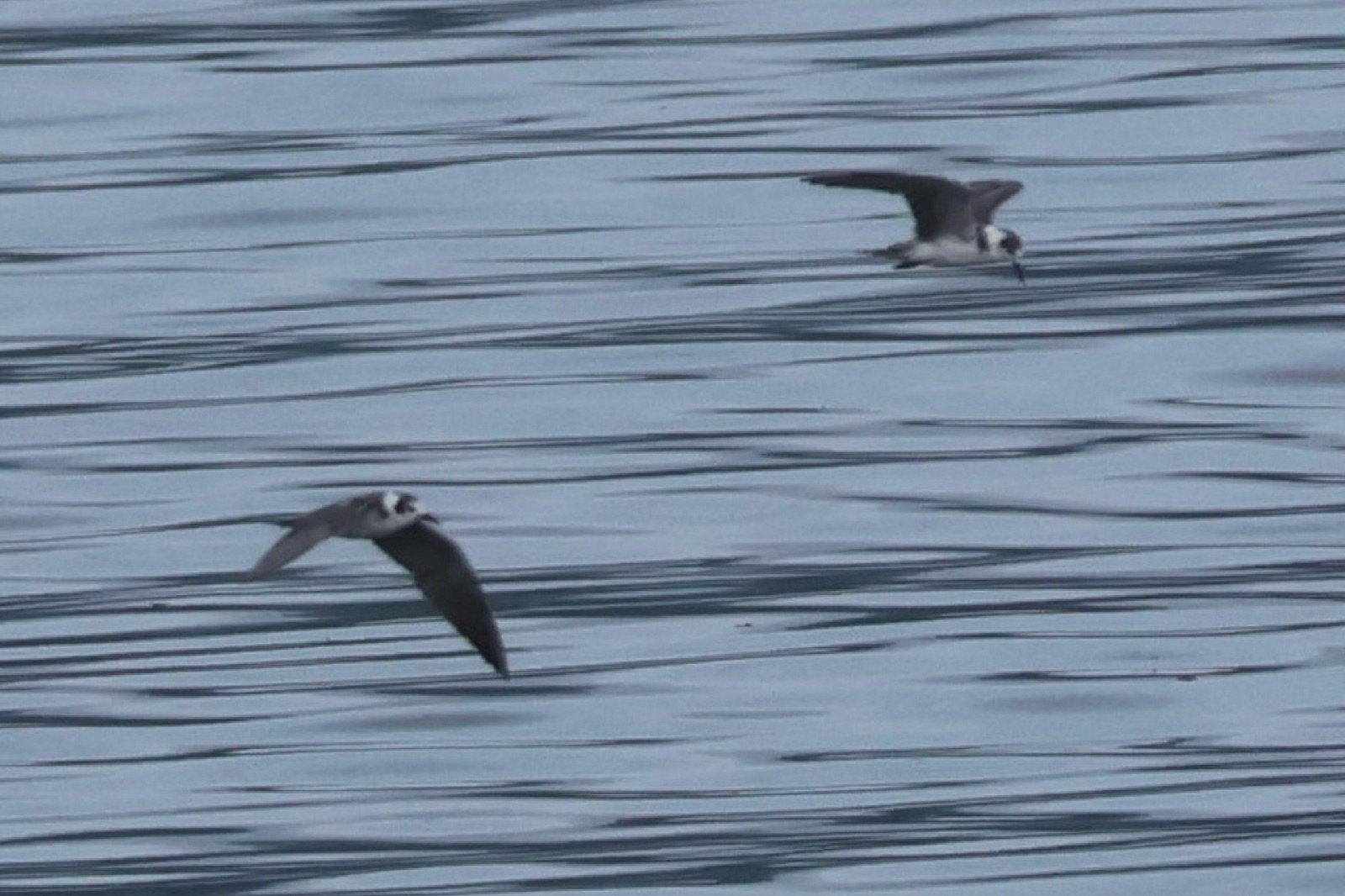
In fall and winter the head and underparts are white, with dusky smudges around the eyes and on the back of the neck. The wings and tail are gray. This is the plumage across its wider range, and it is the one to know when scanning flocks.
Young birds differ from winter adults in three ways: a dark mark at the bend of the wing, a darker and larger cap, and wings that are more uniformly gray in their first summer.
What it sounds like
Recording: Danil Asotsky, CC BY 4.0, source, read 4 Nov 2026.
Behaviour and diet
It usually stays alone near the coast or in small loose groups. These gather quickly over schools of small fish pushed to the surface by larger fish.
It swoops down to take small fish from the surface and rarely plunges in. It also eats plankton and insects, and catches insects in flight over swamps and crops.
Unlike the larger white terns, it does not usually dive for fish, and its flight is erratic and bouncy.
Where it lives
In Costa Rica it prefers waters near the coast and bays, and often goes 10 km or more offshore. On migration it also uses salt ponds, flooded fields, swamps, mudflats and dikes.
It is most common on the Pacific coast, and one account shows a bird photographed at Chomes, Puntarenas. Across its wider range, winter birds are mostly marine and usually stay within about 30 km of land, favoring productive waters where predatory fish drive small prey to the surface.
When to see it
It is abundant as a passage migrant on both coasts from mid-September to mid-November and from late April to early June. Some birds, mostly first-year birds, stay through the northern summer without breeding, and these are uncommon to locally common, especially in the Gulf of Nicoya.
Similar birds
In the Gulf of Nicoya, a small all-dark bird flying low among Black Tern flocks turned out to be a Least Storm-Petrel. It was smaller than the terns and had quick, snappy wingbeats. At Puntarenas, a birder compared Black Terns with Least Terns, another small tern common in the gulf. Scanning the flocks there also turned up a couple of Bridled Terns.
Names and lore in Costa Rica
Costa Ricans know it as Charrancito Negro, the name the AOCR list uses, or as Fumarel.
Status and conservation
The AOCR list codes it as M, a migrant, and in Costa Rica it is locally common to abundant as a winter resident, mainly on the Pacific coast.
Photography tips
From the Puntarenas seawatch, small numbers pass by, mostly far from shore, and the biggest flocks are well out over the water. Bring a telescope or long lens.
How we know this 12 sources, each read on the date shown
- Jorge Obando Nature Photo (Costa Rica species account) read 2026-11-04
https://www.flickr.com/photos/jobando/36922018102/ - Boreal Songbird Initiative, Guide to Boreal Birds read 2026-11-04
https://www.borealbirds.org/bird/black-tern - Wikipedia (via The Bio Files) read 2026-11-04
https://thebiofiles.com/info/4980 - Tennessee Wildlife Resources Agency read 2026-11-04
https://www.tn.gov/twra/wildlife/birds/waterbirds/black-tern.html - Cornell Birds of the World read 2026-11-04
https://birdsoftheworld.org/bow/species/blkter/cur/introduction - Birding Craft read 2026-11-04
https://birdingcraft.com/wordpress/tag/costa-rica-pelagic-birds/ - Birding Craft read 2026-11-04
https://birdingcraft.com/wordpress/2008/12/11/birding-tambor-beachnot-barcelo-and-the-puntarenas-paquera-ferry/ - Birding Craft read 2026-11-04
https://birdingcraft.com/wordpress/2015/09/04/more-ferry-birding-in-costa-rica/ - 10,000 Birds read 2026-11-04
https://www.10000birds.com/mini-pelagic-birding-in-costa-rica-at-puntarenas.htm - Aves de Costa Rica read 2026-11-04
https://avesdecostarica.com/ - ACTo (Area de Conservacion Tortuguero) read 2026-11-04
https://www.acto.go.cr/conociendo-las-aves-marinas-del-caribe-noreste-de-costa-rica-dos-anos-de-observaciones-en-el-mar/ - Birdingcraft read 2026-11-04
https://birdingcraft.com/wordpress/2025/09/21/seawatching-at-puntarenas-september-20-2025/