Family Thraupidae
Blue Dacnis
Dacnis cayana
In Spanish: Mielero Azulejo (Rey de Viuda)
- Resident
A tiny turquoise tanager of sunny treetops and banana feeders.
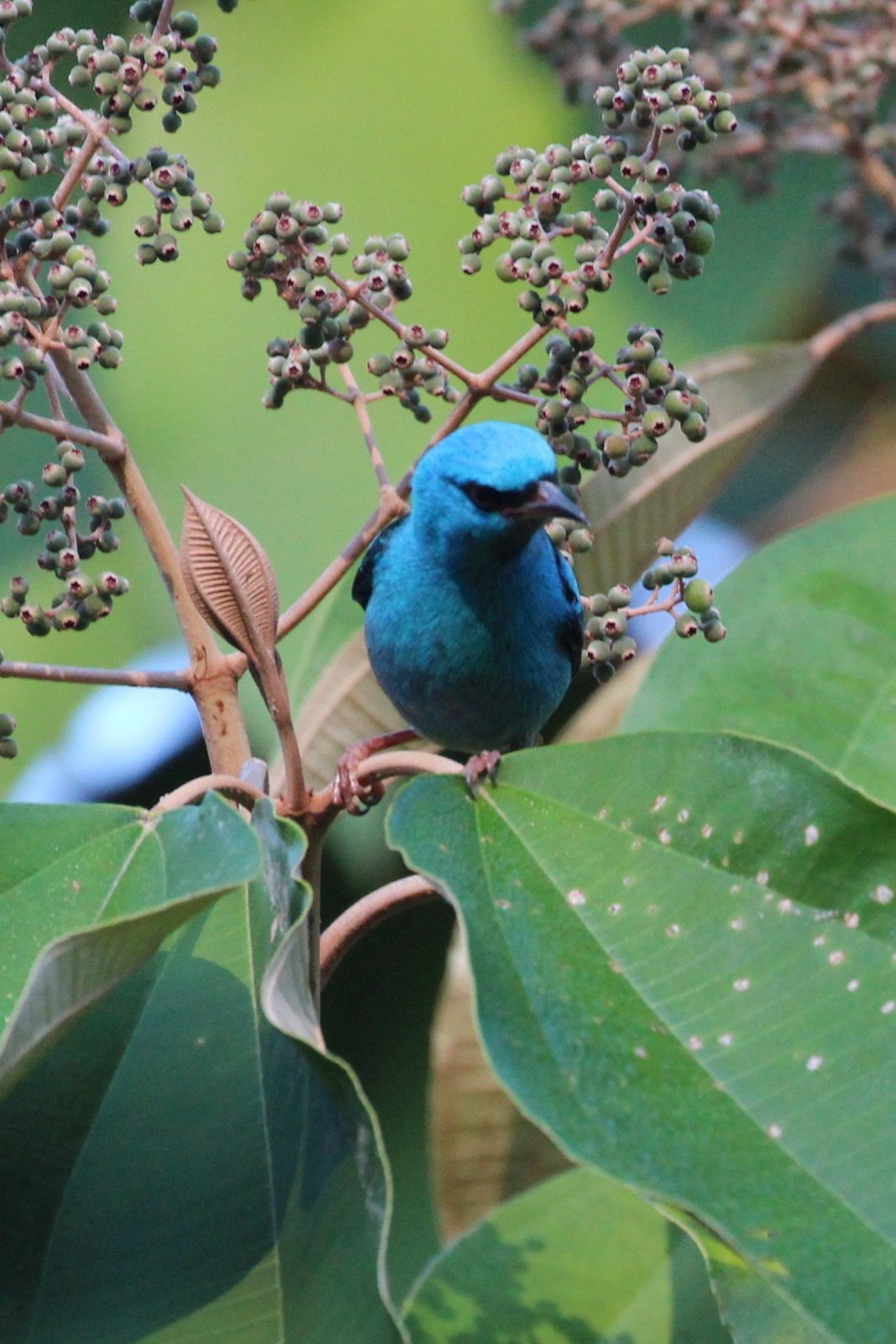
The male Blue Dacnis is bright turquoise blue with a black throat, back and tail, and a black patch around the eye. The female looks like a different bird, mostly green with a blue head.
In Costa Rica it is common in the Pacific lowlands and foothills of the south, ranging north to near Carara National Park, and uncommon in the Caribbean lowlands. It is only about 12 cm long, so you find it by scanning sunny treetops, flowering trees and the edges of forest.
On a trip we build, gardens, forest edges and banana feeders give real chances to watch it well.
How to find it
Watch flowering trees, especially Inga and Erythrina, and forest edges in the lowlands. Gardens at eco-lodges often draw it. One suggestion is the trees near the dining hall at La Selva. It also visits banana feeders, so a feeder busy with butterflies is worth a look. Scan the sunny treetops at forest edges and the clearings next to them.
How to recognise it
The male is bright turquoise blue with a black throat, back and tail, and a black patch around the eye. The female is mostly green with a blue head. It is one of the most strikingly different male and female plumages among Costa Rican birds.
Both sexes share red eyes, reddish legs and feet, and a sharply pointed bill. The whole bird is tiny, about 12 cm long.
The short, straight, pointed bill is a mark worth learning early, because it separates the dacnis from the honeycreepers. Costa Rica Focus calls the male unmistakable, with a black mask.
Behaviour and diet
It usually lives in pairs or small family groups and often joins mixed flocks of tanagers, warblers and other honeycreepers. It picks insects from foliage, eats fruit and takes banana at feeders.
It often searches leaves for brown damaged spots, which may signal an insect, and takes prey with acrobatic moves. It forages mostly in treetops along forest edges and small clearings.
In courtship the male does fluttering display flights, feeds the female and chases her through the canopy. The nest is a deep, pouch-like cup of soft plant fibers, hung between twigs at the outer part of a tree, and the clutch is two eggs.
Where it lives
It favors the sunny upper levels of forest. It also comes down into nearby clearings with scattered trees and shrubs, and into second growth.
In Costa Rica it ranges from sea level to about 900 m on the Caribbean slope. On the Pacific slope it reaches about 1,200 m.
It is common in the Pacific lowlands and foothills in the south, ranging north to near Carara National Park. It is uncommon in the Caribbean lowlands.
When to see it
One account gives a breeding season of March to August, peaking April to June in the wet season, while another gives May to October.
Similar birds
Honeycreepers such as the Purple Honeycreeper can look like the male Blue Dacnis, but they have a much longer, curved bill, while the dacnis has a short, straight, pointed one. The Shining Honeycreeper male is deep purple-blue with yellow legs, whereas the dacnis has pinkish legs. The male Scarlet-thighed Dacnis, which also occurs in Costa Rica, is mostly black with a turquoise head and central back, while the Blue Dacnis male is mostly turquoise blue with a black throat and back.
Names and lore in Costa Rica
The official Costa Rican Spanish name is Mielero Azulejo, with Rey de Viuda as the second name on the AOCR list. Other Latin American countries use names such as dacnis azul, mielero turquesa and saí azul.
Status and conservation
The AOCR list marks it as a resident (R), the IUCN lists it as Least Concern, and it is described as fairly uncommon in Costa Rica.
Photography tips
The best viewing times given are early morning until 8 AM and again from 2 PM to 5 PM. Several pairs may feed in the same tree, so settle in beside a fruiting or flowering tree and be patient.
How we know this 12 sources, each read on the date shown
- Cornell Birds of the World read 2026-11-04
https://birdsoftheworld.org/bow/species/bludac1/cur/introduction - The Firefly Forest read 2026-11-04
https://fireflyforest.net/firefly/2007/06/11/blue-dacnis/ - Wikipedia read 2026-11-04
https://en.wikipedia.org/wiki/Blue_dacnis - Ecos del Bosque (citing Stiles and Skutch) read 2026-11-04
https://ecosdelbosque.com/fauna/dacnis-cayana - Costa Rica Focus read 2026-11-04
https://www.costaricafocus.com/bird-species/blue-dacnis/ - Flickr (Costa Rican natural history notes) read 2026-11-04
https://www.flickr.com/photos/jobando/31824155050 - Carolina Birds (Birds of the World: Dacnis) read 2026-11-04
https://carolinabirds.org/HTML/Thraupidae_Dacnis.htm - Canopy Family read 2026-11-04
https://canopytower.com/blue-dacnis/ - Wikipedia (es) read 2026-11-04
https://es.wikipedia.org/wiki/Dacnis_cayana - Lista Oficial de las Aves de Costa Rica (AOCR) read 2026-11-04
https://listaoficialavesdecostarica.wordpress.com/lista-oficial/lista-oficial-online/ - Cloudbridge Nature Reserve read 2026-11-04
https://www.cloudbridge.org/wp-content/uploads/2020/04/Bird-Species-List-Costa-Rica-13-April-2020.pdf - iNaturalist (Wikipedia text) read 2026-11-04
https://www.inaturalist.org/taxa/10506